
Daily Routine Cards™
$12.00
Routine cards that show your child what happens before, during and after learning — so the next step sits on the table instead of in your voice.
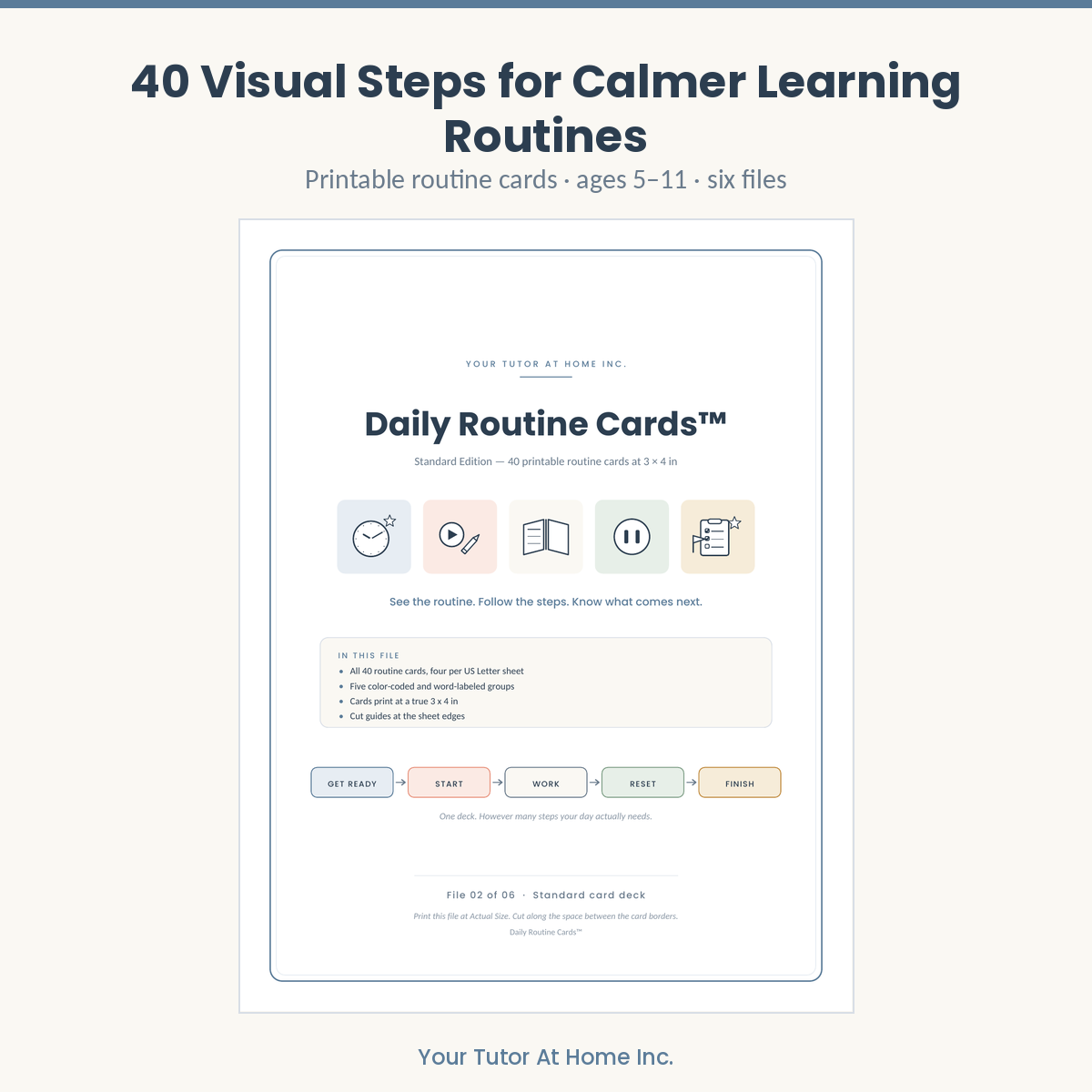
40 printable routine cards in five groups, five routine boards, six ready-made routines, blank cards you can write yourself, and a 31-page parent guide. Standard 3 × 4 in and mini 2 × 3 in decks, full-color and ink-saving.
130 pages · 6 printable + fillable PDFs · Ages 5–11
Product Description
Routine cards that answer the question for you
Get your pencil. Bring your book. Sit down. Start your reading. Then, ten
minutes later, all four again.
Most of what looks like not listening in that moment is not defiance and it
is not carelessness. It is an instruction falling off the end of a short
queue. Your child heard the first two steps, lost the rest, started the first
one, and now genuinely does not know what comes after it. Saying it again does
not add capacity — it just delivers the same four steps a second time.
Understood explains why kids have trouble following a routine or schedule in more detail, and the short version is that following
a sequence draws on skills that are still developing at this age.
Daily Routine Cards is a set of 40 printable routine cards that move the
sequence out of your child’s working memory and onto the table, where they can
check it without needing you to be the one holding it.
In this description
- What changes when the routine is visible
- What is inside the pack
- Why color is never the only cue
- What these routine cards are not
- Start with four cards
- Common questions
- Specifications
- Where this sits
What changes when the routine is visible
The question changes.
“What are you supposed to be doing?” asks a child to recall
something they have already lost. “What comes next?” asks them to
look at something that is still in front of them. That is the entire
mechanism, and it is why visual routine cards work for children who have heard
the same reminder four hundred times without it sticking.
These cards do not teach the routine and they do not motivate anyone. They
make it visible.
What is inside the pack
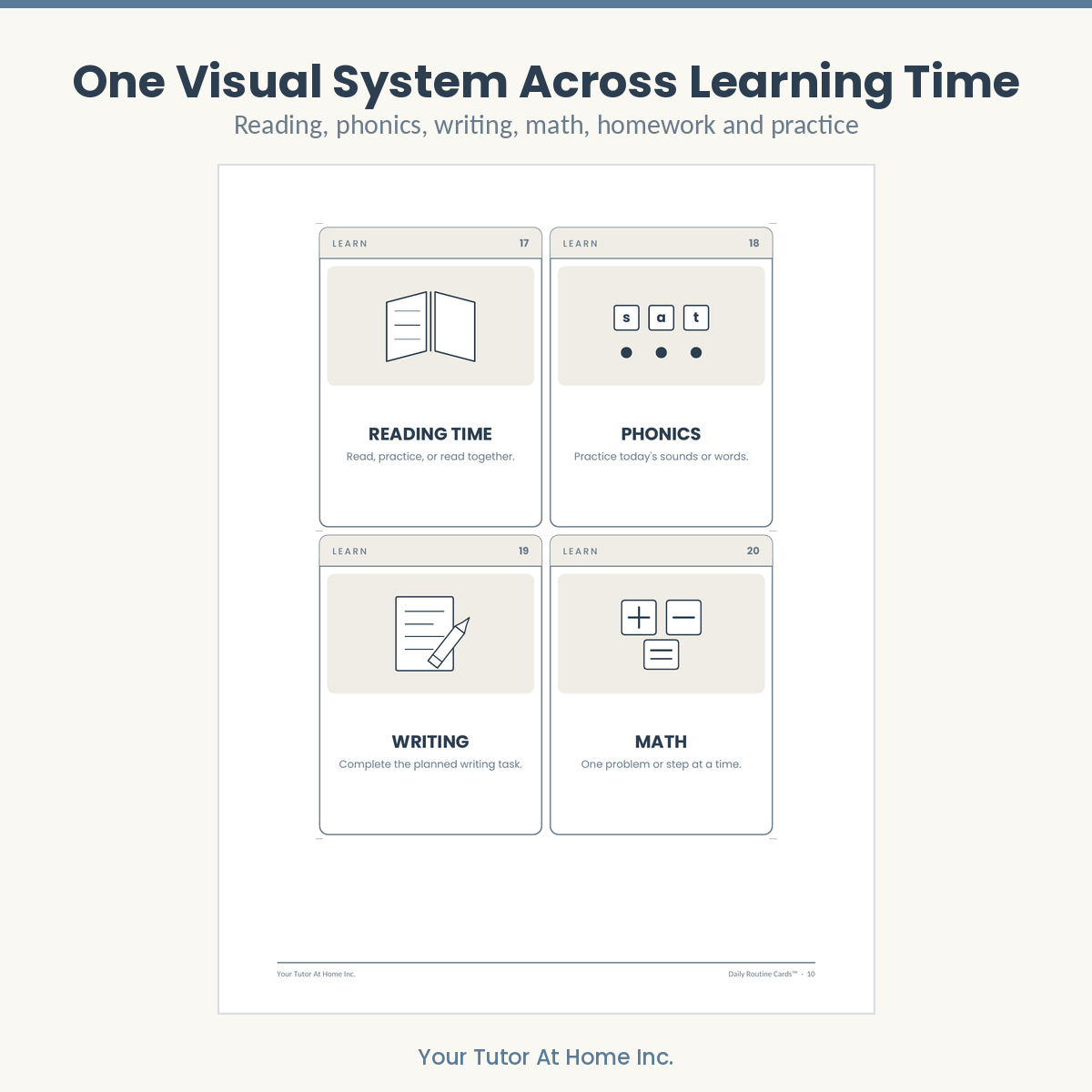
40 routine cards in five groups. Prepare, start, learn,
reset and finish. Eight cards each, covering getting ready, gathering
supplies, reading, phonics, writing, math, homework, short practice, working
one step at a time, asking for help, movement, breaks, returning after a
break, checking work, packing up and preparing for tomorrow.
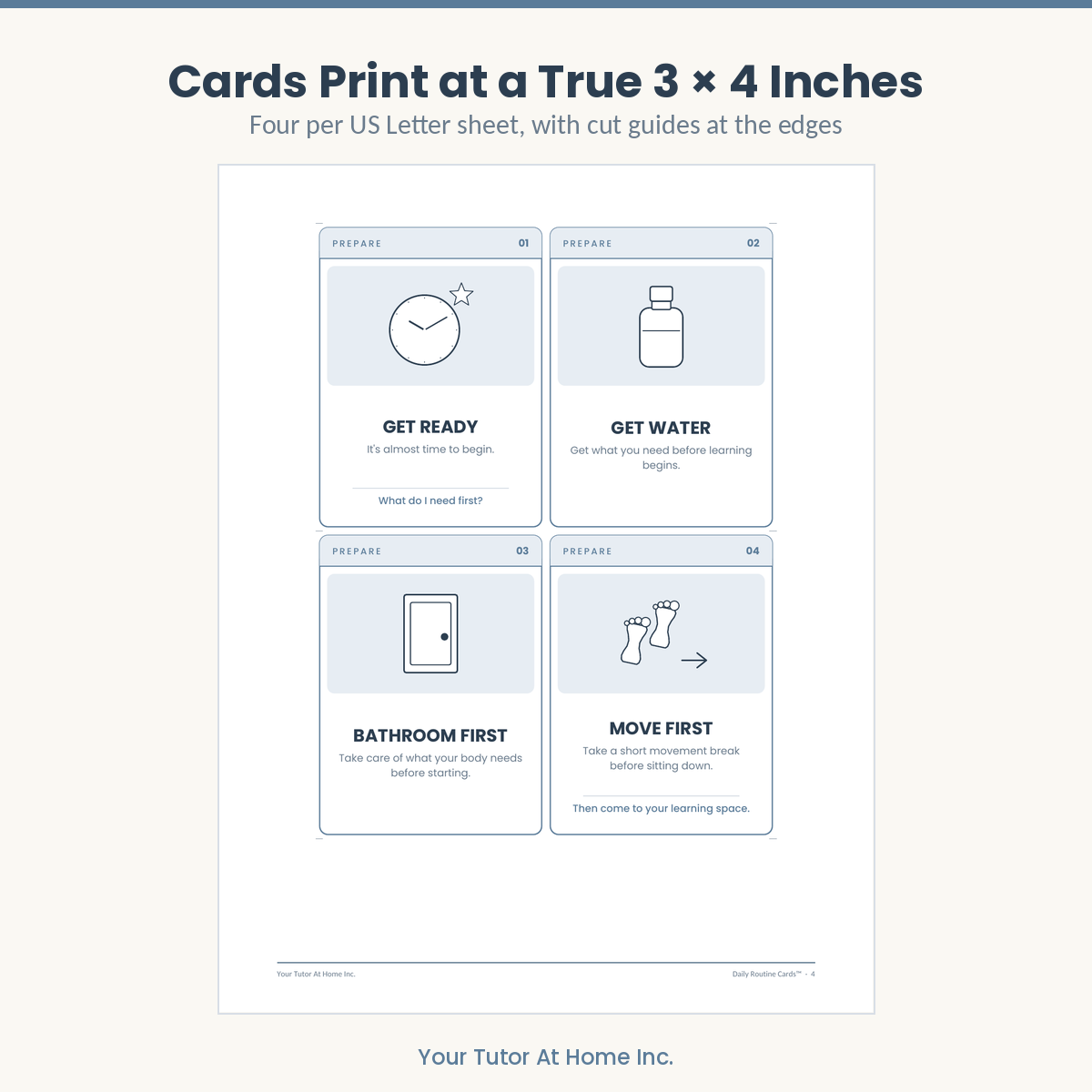
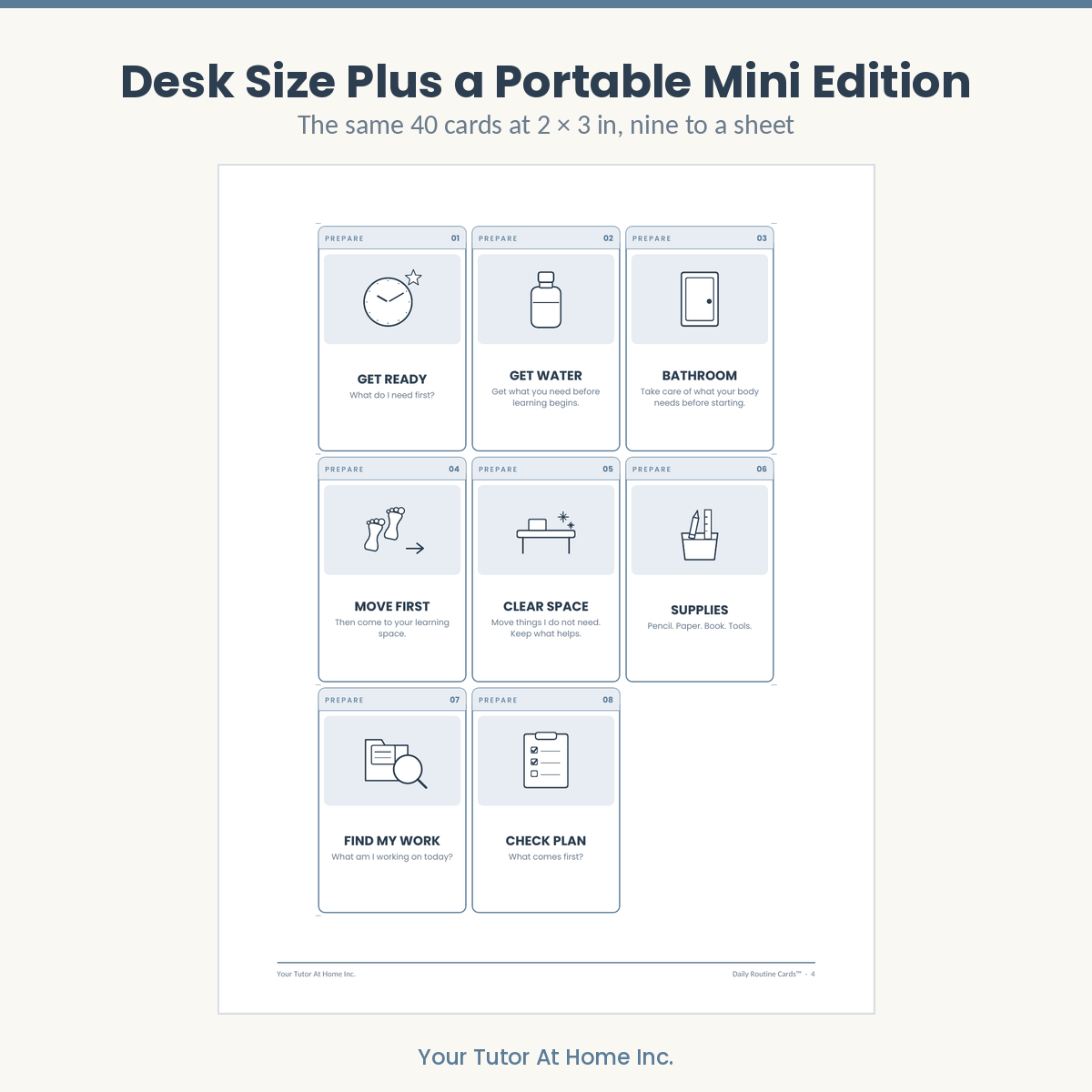
Two sizes of the same deck. The standard routine cards
print at a true 3 × 4 inches, four to a US Letter sheet. The mini
edition prints all forty at 2 × 3 inches, nine to a sheet,
sized for planners, homework folders, refrigerators and binder rings. Most
families print the standard deck for the wall and the mini deck for the
bag.
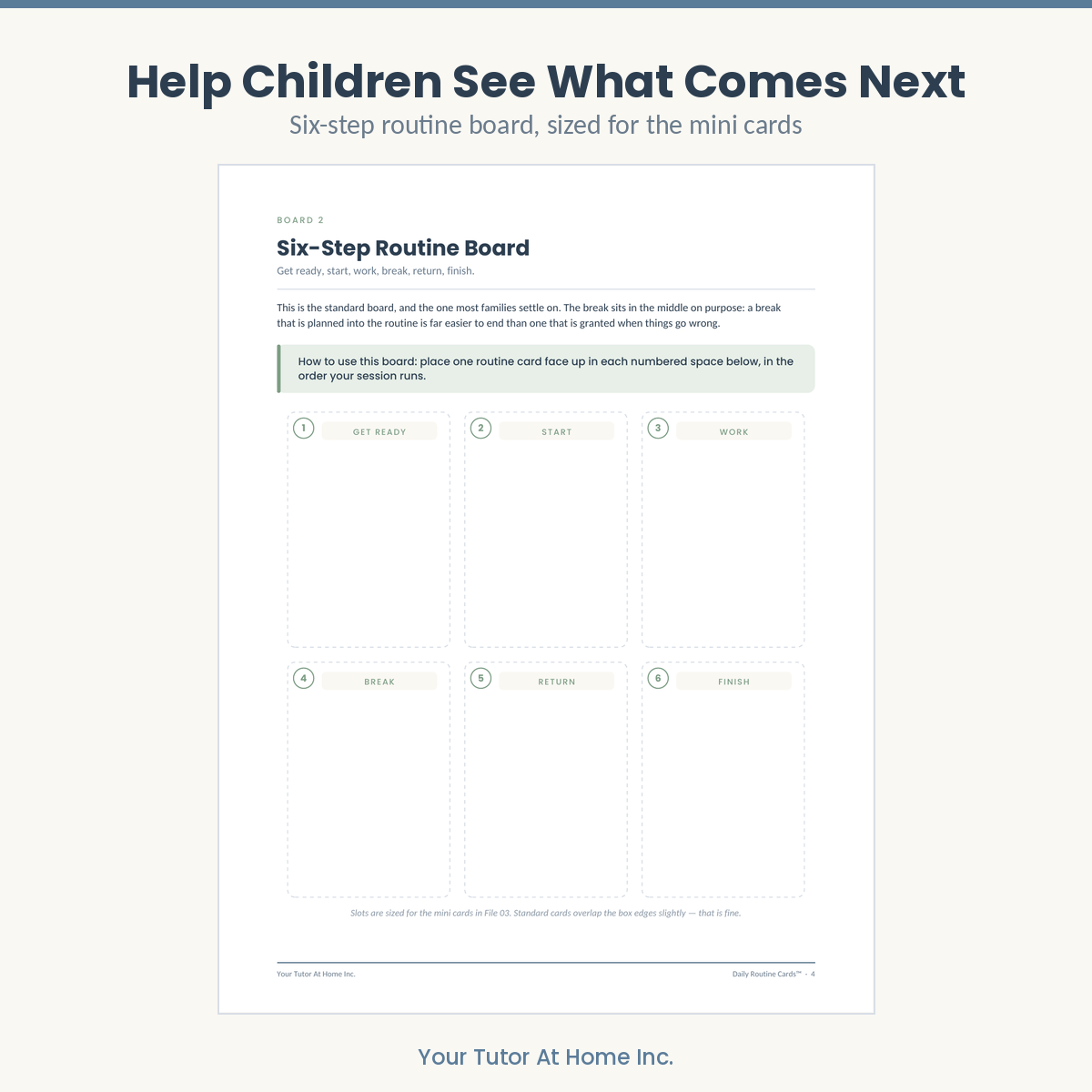
Five routine boards. A four-slot First / Next / Then /
Done board for younger children, a six-step board that most families settle
on, an eight-step board for longer sessions, a build-your-own board with
fillable fields, and a move-the-marker board for children who need to see how
much is left rather than what comes next.
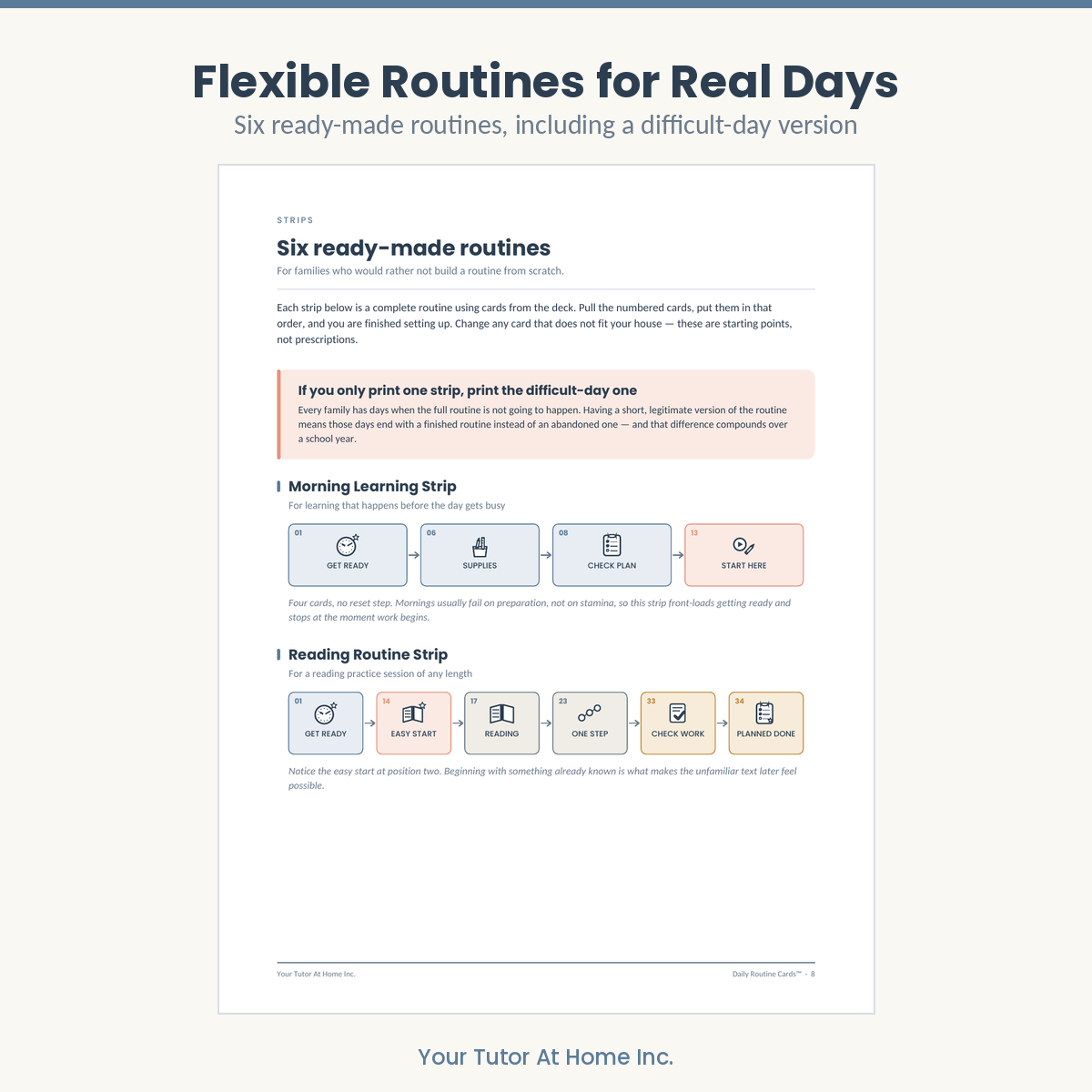
Six ready-made routines. Morning, reading, homework, a
fifteen-minute practice routine, an end-of-day routine, and a difficult-day
routine. That last one matters more than the rest: having a short, legitimate
version of the routine means a hard day ends with a finished routine instead
of an abandoned one.
Blank routine cards. Eight write-in cards and eight
icon-only cards for pre-readers, so the steps that only exist in your house
get a card too.
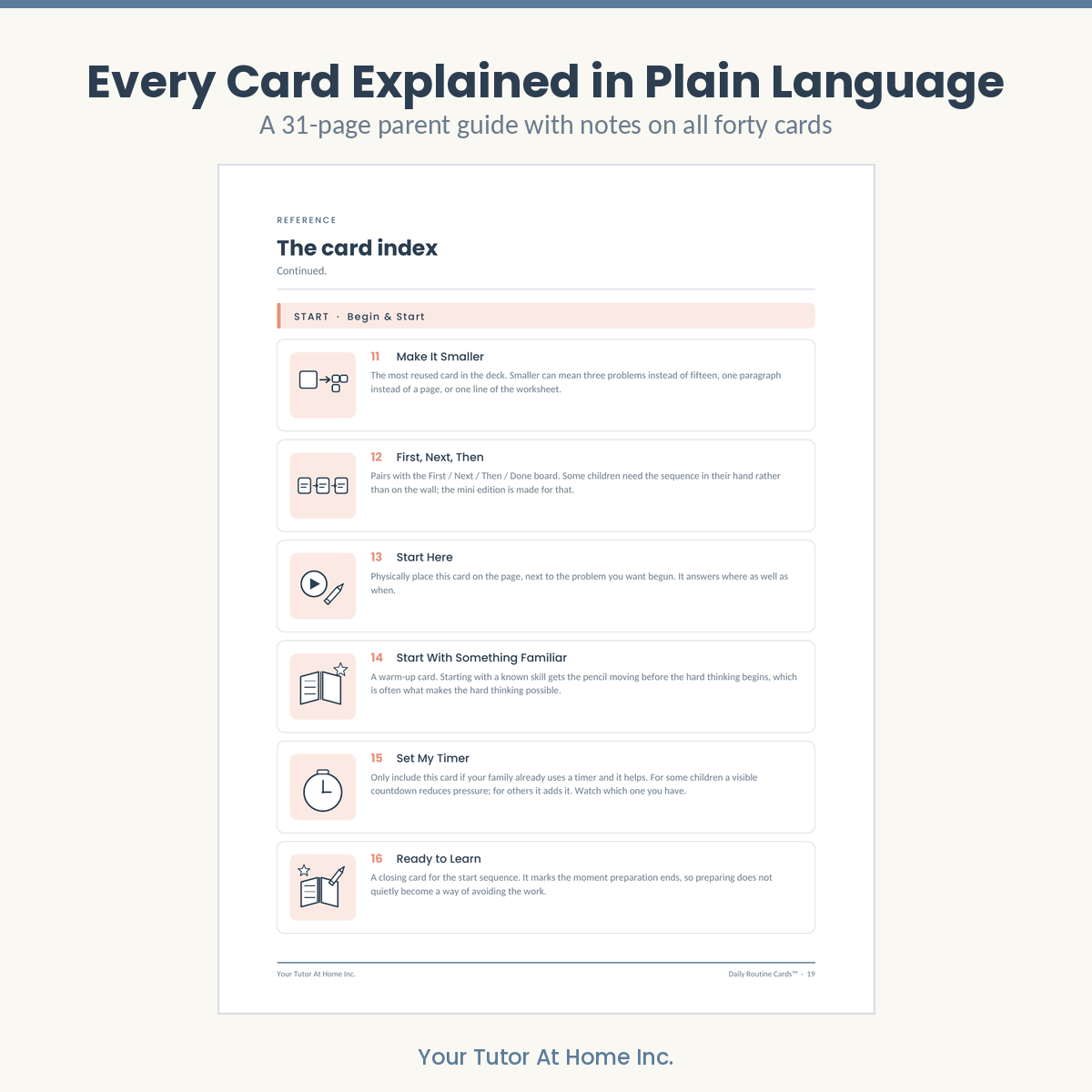
A 31-page parent guide. The 5-Step Routine Method, how
many cards to display at each stage, three worked family examples, seven
troubleshooting scenarios, a first-week plan, and an index explaining what all
forty routine cards are actually for.
Choice and reflection tools. A What Would Help Me
Continue? board, a full-page What’s Next? card, an I’m Stuck card, a routine
practice tracker, a reflection page, storage labels and a printable card
envelope.
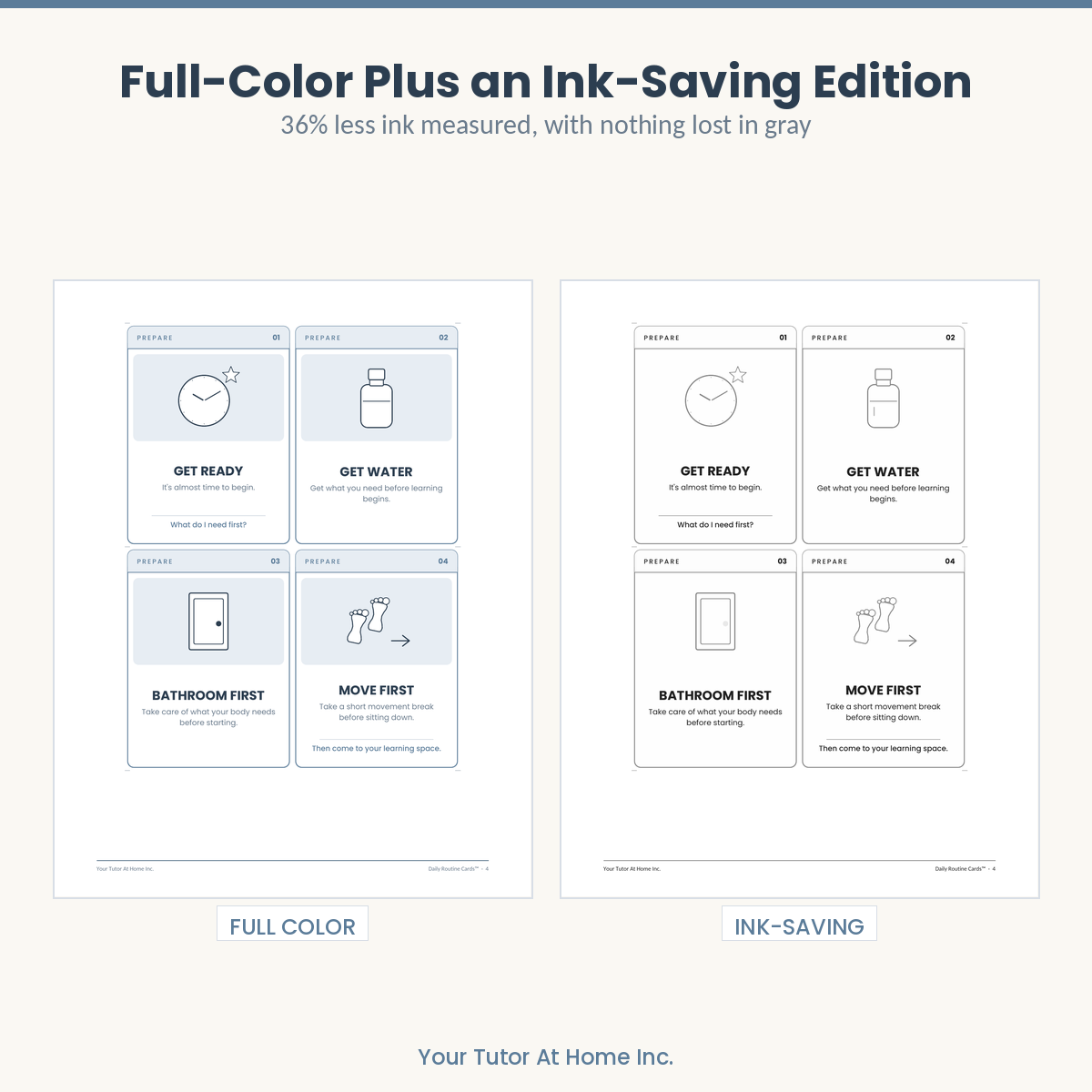
Full-color and ink-saving editions. The ink-saving edition
uses 36% less ink, measured on matched pages rather than estimated.
Why color is never the only cue
Every one of the routine cards carries its group word printed alongside its
group color: PREPARE, START, LEARN, RESET, FINISH. That was a deliberate
design decision and it is what makes the ink-saving edition possible. A child
sorting a gray deck can still tell a starting card from a closing one. The
routine cards still work photocopied at school, faded by a sunny window, or
used by a child who does not distinguish those colors easily.
What these routine cards are not
There is no card here that rewards obedience and none that records
non-compliance. The tracker marks that the routine got used, not that the
child was good. There are no times on any card except the optional timer card.
Nothing in the pack should be withheld or removed as a consequence.
And the pack does not promise independence. Nothing will make a child fully
independent at home learning, and any product claiming otherwise is selling
you something. What these routine cards develop is a child who knows which
steps they can manage and where they need support, and can show you the
difference. Reading Rockets covers the same ground from the school side in its
work on executive function and getting homework turned in.
Start with four cards
The most common mistake with a forty-card deck is using forty cards. The
library is large so you can choose well, not so your child has a forty-step
schedule.
Print the standard deck, cut out four routine cards, and lay them on the
table in order. That is a complete working routine and it takes about ten
minutes to set up. Everything else in this pack is a refinement of those four
cards.
Common questions
My child cannot read yet. Every card pairs its words with
a drawn picture, and the pack includes eight icon-only blank cards for exactly
this. Younger children usually do best with the four-slot board and three or
four routine cards rather than six.
We tried a visual schedule and it lasted a week. That is
almost always the reset step. If the cards are not returned to starting order
at the end of a session, the next session opens with a small setup job, and a
small setup job is enough to skip a board. The guide covers this and six other
things that commonly go wrong.
Is this for school or home? Both. The license covers the
children in your own home or the students in your own classroom, and the
ink-saving edition exists partly because thirty copies of anything is a lot of
toner. If homework is where your family struggles, Reading Rockets has
practical homework tips for parents that pair well with the homework routine strip.
Do I have to laminate them? No. A stack of cut routine
cards and a clear space on the table is a complete routine board. Laminating,
velcro and magnets make the system tidier and longer-lived; none of them makes
it work better.
Specifications
- 130 pages across six PDF files
- 40 routine cards, standard 3 × 4 in and mini 2 × 3 in
- 5 routine boards, 6 prebuilt routines, 16 blank cards
- 133 fillable form fields on the boards, tracker and planning pages
- US Letter, 8.5 × 11 in — print at Actual Size
- Full-color and ink-saving editions of every printable page
- Instant digital download, for your own home or classroom
- Suggested ages 5–11
Where this sits
Daily Routine Cards is the visual implementation layer. If homework is the
only place your family struggles, the Homework Calm Checklist™ goes deeper on that one block. If
breaks are the sticking point, Brain Break Cards™ covers the break itself. If you want a
parent-led framework for building the routine in the first place, that is the
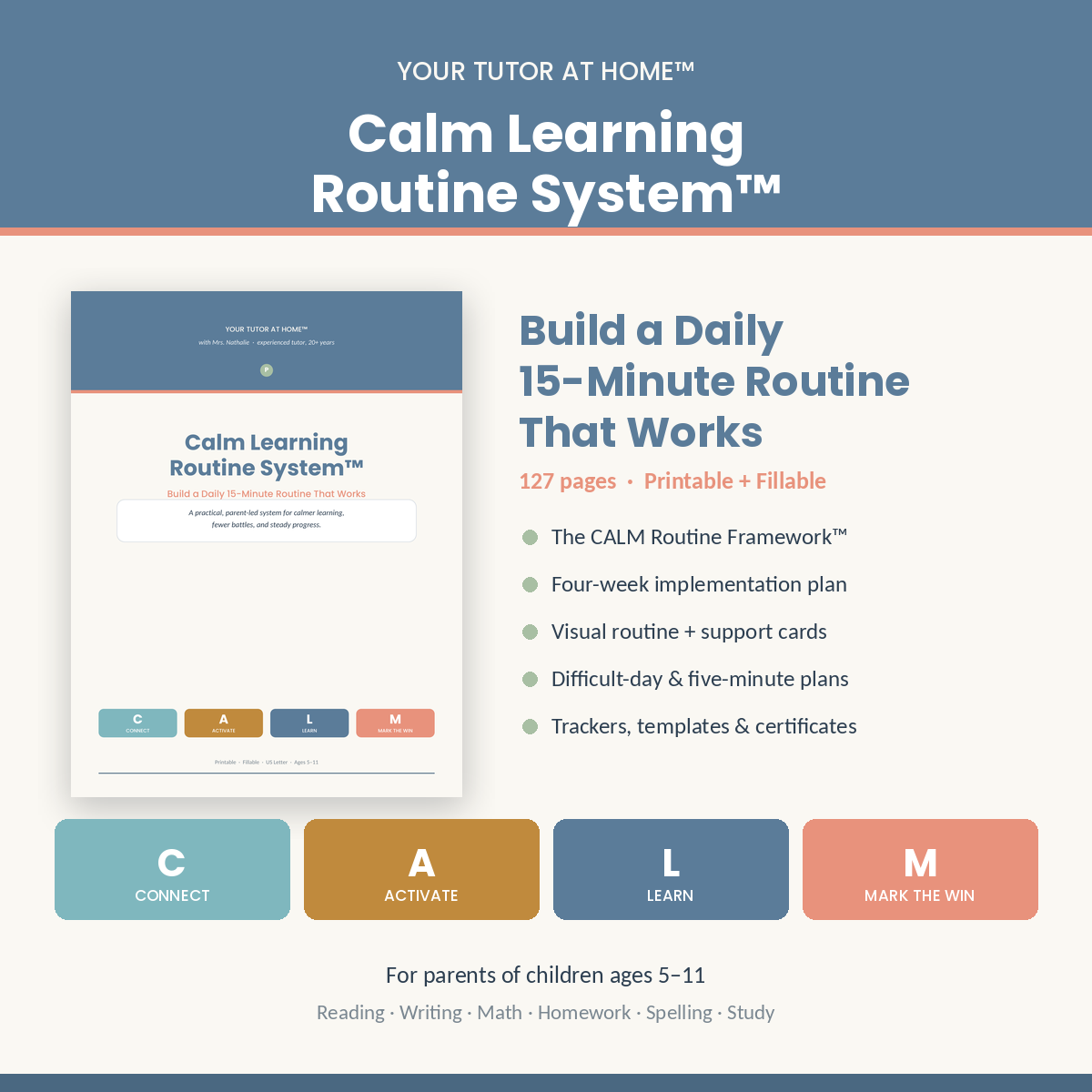
Calm Learning Routine System™, and the full framework behind all of it is The C.A.L.M. Learning Method™. These routine cards cover
the whole home-learning rhythm and stay deliberately broad.
Daily Routine Cards provides general educational organization and
routine-support tools. It is not a diagnostic, therapeutic,
behavioral-treatment or medical resource, and does not replace advice from a
qualified professional.
Make the routine visible so your child doesn’t have to remember
every next step.


Reviews
There are no reviews yet.