
Reading Confidence Workbook™
$27.00
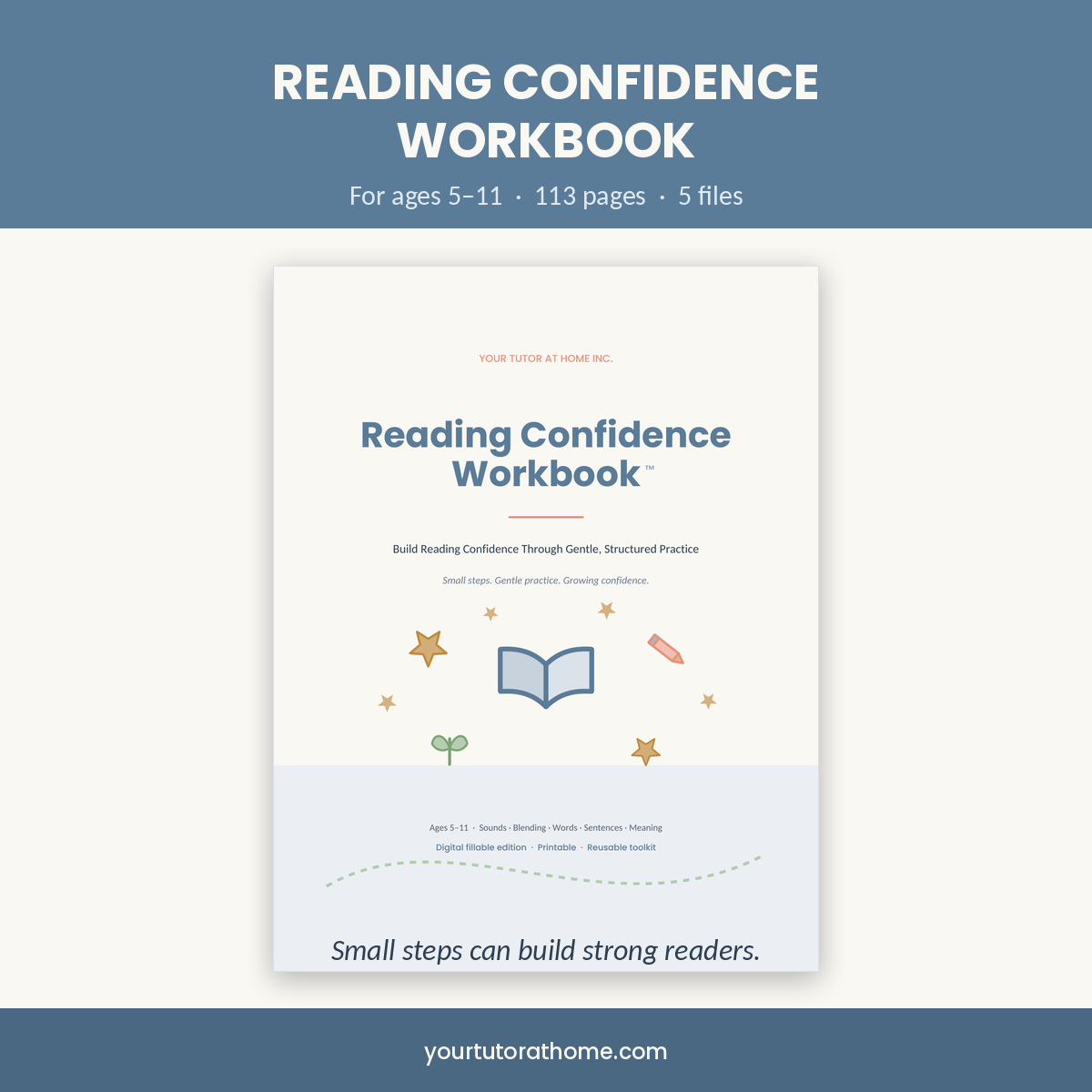
A calm, 113-page reading confidence workbook for children aged 5–11 who have already decided they are “bad at reading.”
It rebuilds belief first, then teaches the skills — sounds, blending, word families, practice words, sentences and understanding — in fifteen-minute sessions, with no score, no grade, and no page your child can fail.
Instant download · 5 files · Digital fillable + 2 printable editions + Reusable Toolkit + Parent Quick-Start Guide
Product Description
Contents
- What this reading confidence workbook is for
- Why confidence has to come before phonics
- What’s inside the reading confidence workbook
- How a fifteen-minute session works
- What you receive
- Who it’s for — and who it isn’t
- What makes this different from a phonics scheme
- Questions parents ask
What this reading confidence workbook is for
This is for the child who has already decided something about themselves: that reading is the thing they are bad at.
You know the signs. The book pushed away before it is opened. The guess instead of the attempt. The “I can’t” that arrives before the word has even been looked at. By the time a child says that sentence out loud, the problem is no longer only a reading problem — it is a belief problem sitting on top of a reading problem, and teaching phonics harder does not touch it.
So this reading confidence workbook does something slightly unusual. It spends its first two sections rebuilding what your child believes about reading, before asking them to decode a single word. Then it teaches the skills properly, across 113 pages your child works through at their own pace.
There is no score anywhere in this reading confidence workbook. No grade, no reading level, and no page that can be failed.
Why confidence has to come before phonics
A child who believes they are bad at reading treats every reading page as a test. They arrive braced, already expecting the outcome, carrying every previous failure with them. Instruction lands very poorly in that state — not because the instruction is wrong, but because the child is not really available to receive it.
This is well documented. Both Understood.org and Reading Rockets describe how avoidance, anxiety and reading difficulty reinforce one another, and the British Dyslexia Association makes the same point about self-esteem in children who struggle with written language.
Which is why the first week of this reading confidence workbook contains no phonics at all. Five short sessions of pages that cannot be got wrong change what the book means before the hard part arrives. It is the least skippable week in the product.
What’s inside the reading confidence workbook
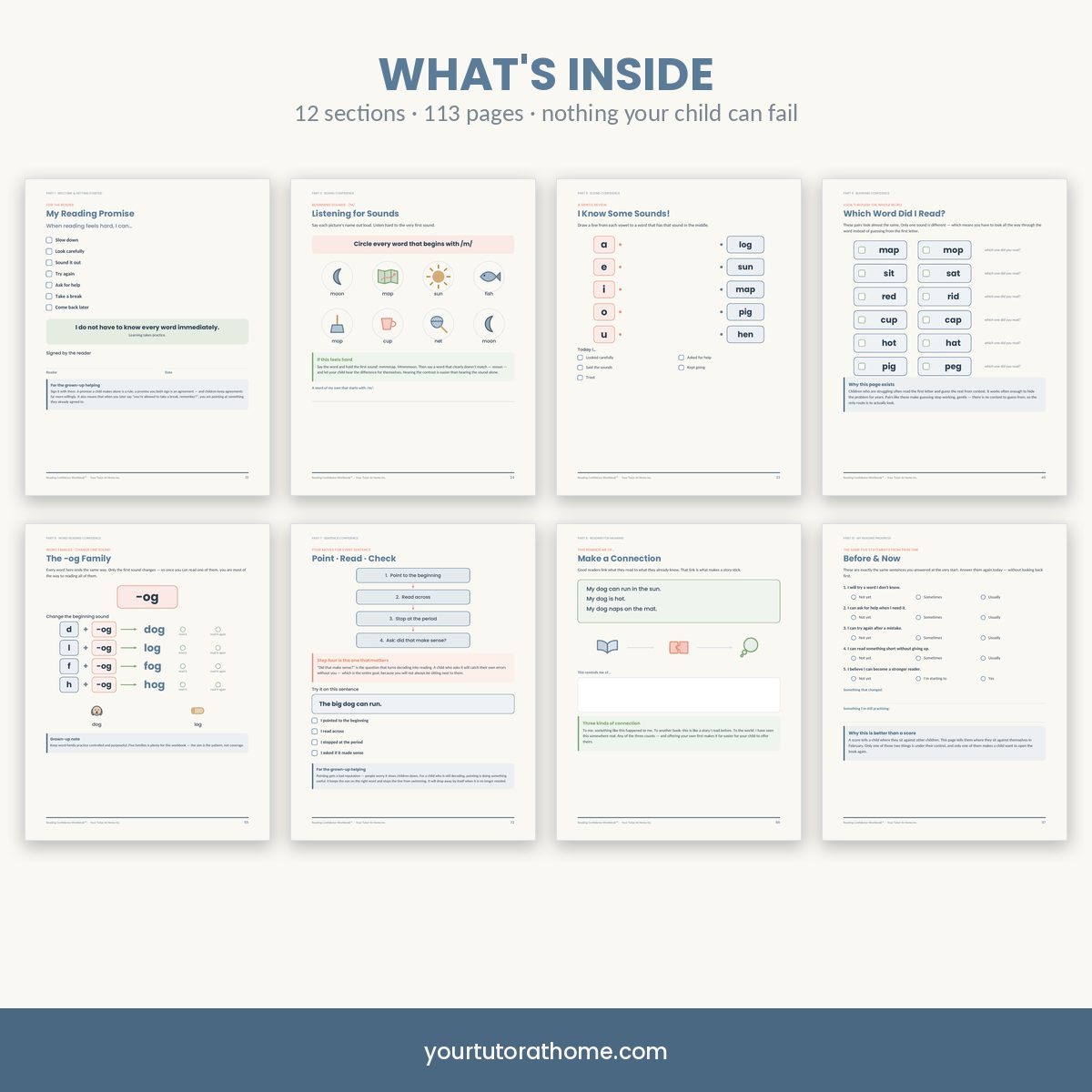
Twelve sections, 113 pages:
- Welcome & Getting Started — including How to Say the Sounds, a plain-English page for parents. If you have ever wondered why “muh-a-puh” never turns into “map,” this page explains it and fixes it.
- Confidence Before Difficulty — mistakes as information, changing the reading thought, help words your child can actually say out loud, and the Win Jar.
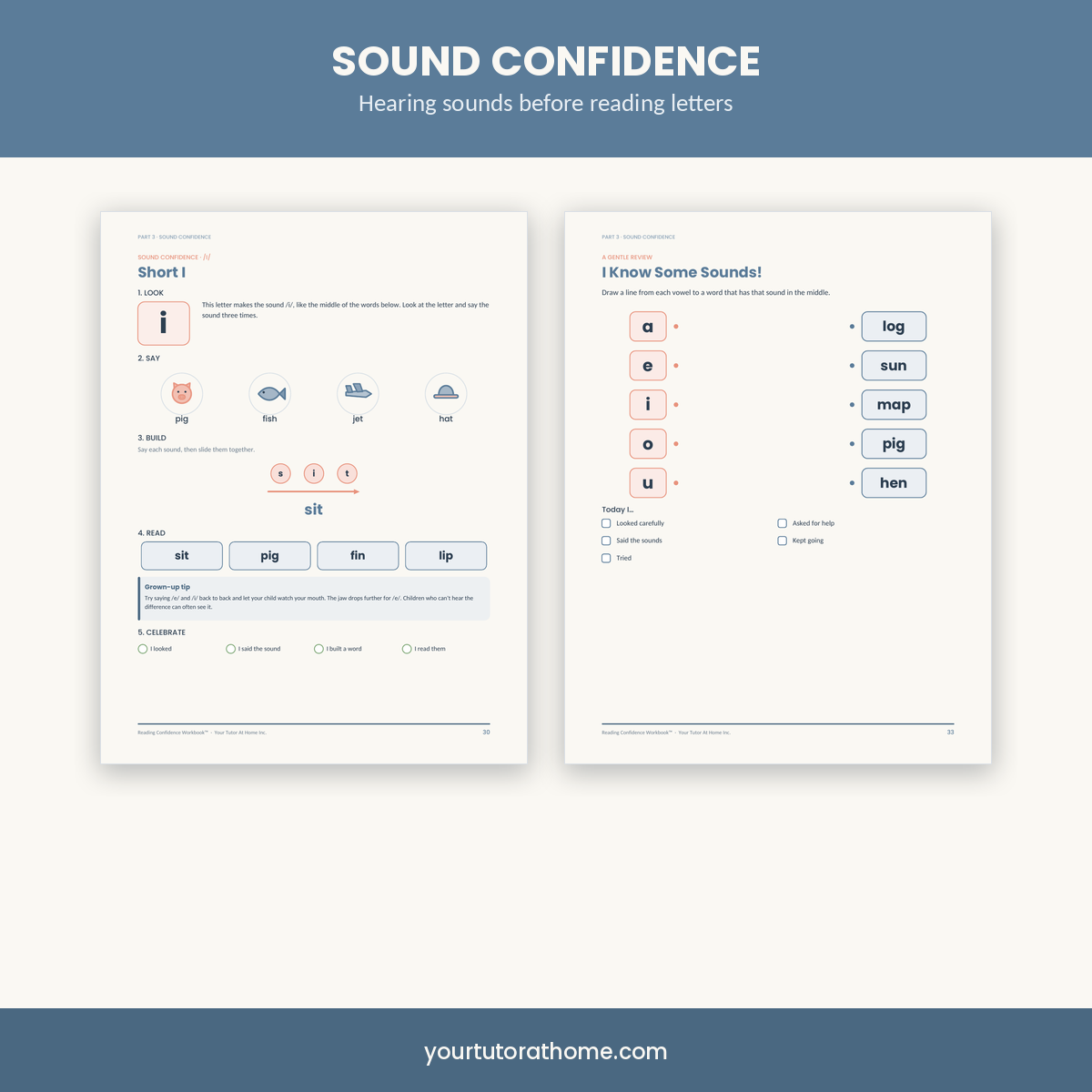
- Sound Confidence — hearing sounds before reading letters. Beginning, ending and middle sounds, then all five short vowels.
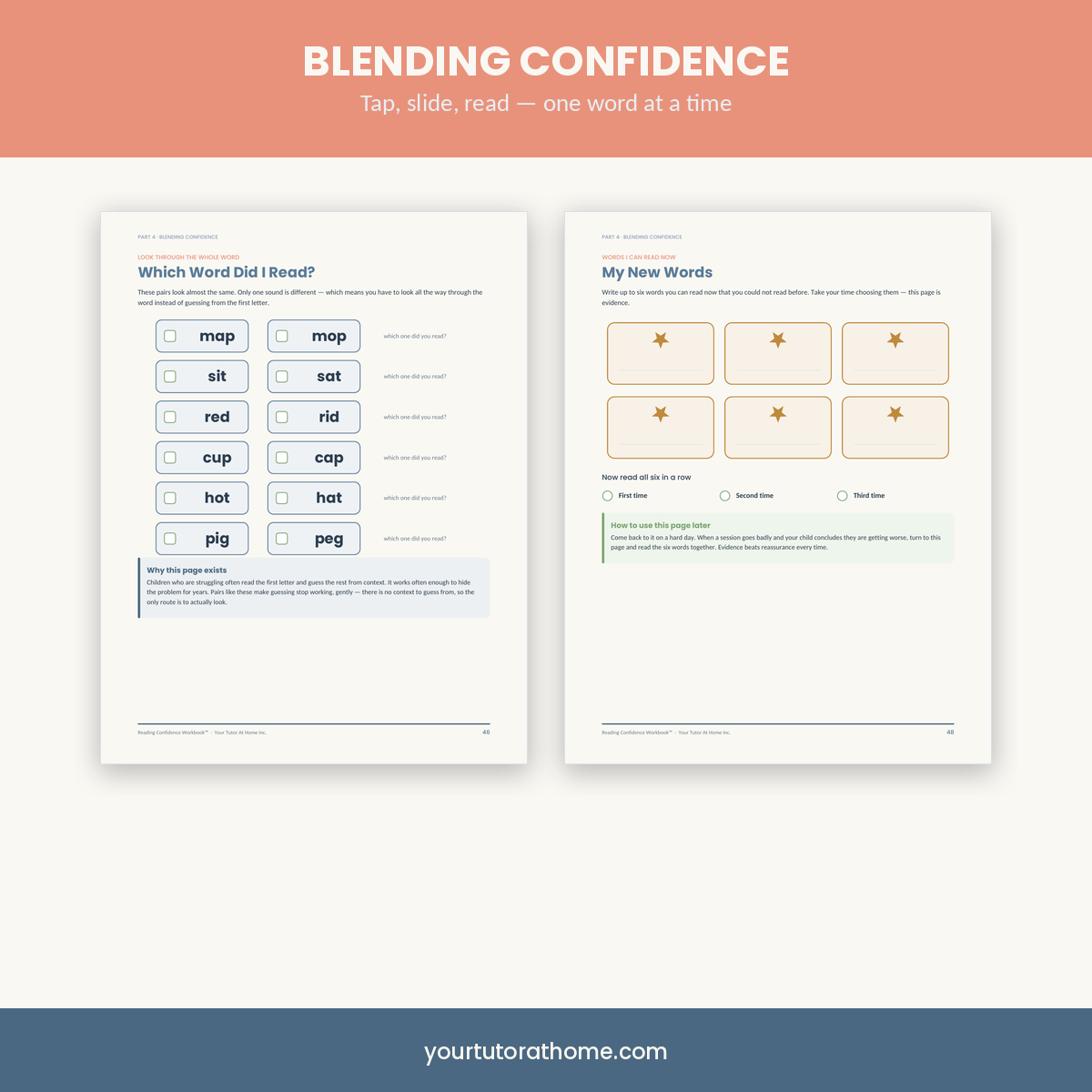
- Blending Confidence — Tap, Slide, Read, with a fully worked example of one word being read that includes a deliberate wrong turn.
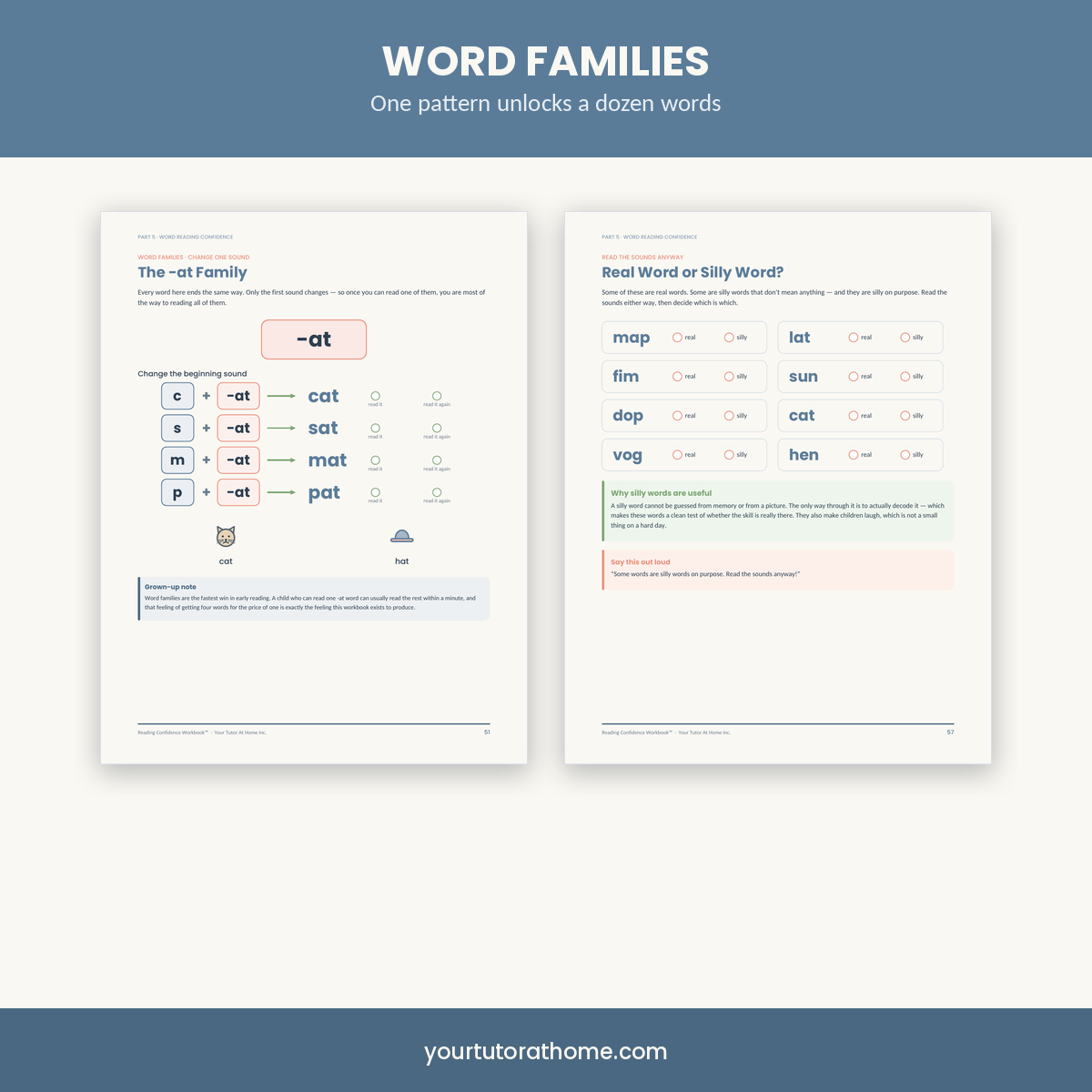
- Word Reading Confidence — the -at, -an, -ap, -it and -og families. One pattern unlocks a dozen words.
- Sight Word Confidence — the five highest-frequency words, taught as words to recognise rather than sound out.
- Sentence Confidence — first calm sentences, point-read-check, reading twice, finishing sentences.
- Reading for Meaning — who, what, where, finding a detail, predicting, connecting.
- Confidence Challenges — five optional challenges, including asking for help.
- My Reading Progress — the growth path, Words I Can Read Now, and a Before & Now page repeating the exact five statements from section one.
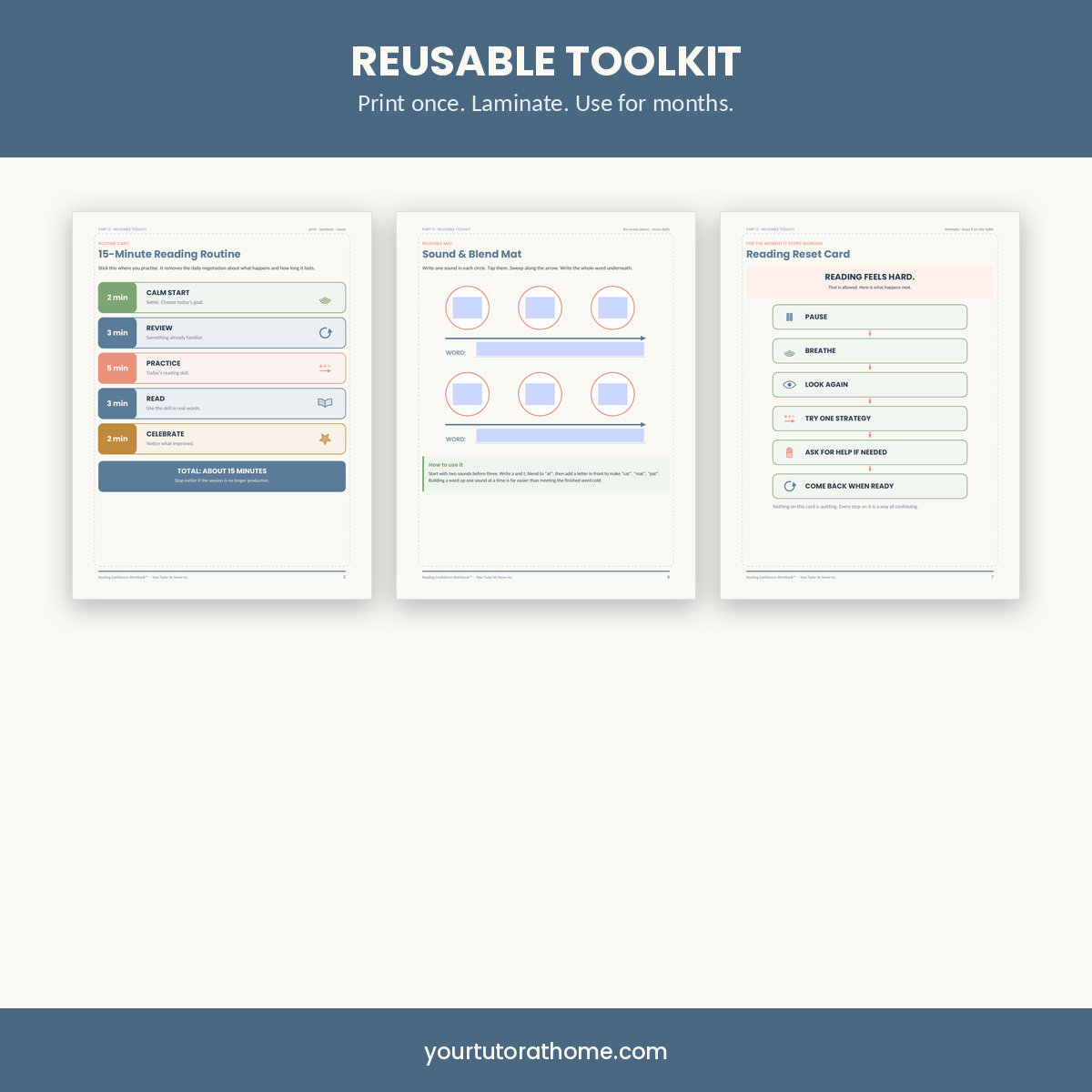
- Reusable Toolkit — seven pages built to be printed once and used for months.
- Parent Answer Key — for checking, not for marking.
Every section of the reading confidence workbook ends the same way: with something the child can point at and say they did.
How a fifteen-minute session works
The whole reading confidence workbook is built around a session shape that never changes, because a predictable shape removes the daily negotiation about what is about to happen.
- Calm start (2 min) — sit down, look at today’s page, agree what you are doing.
- Review (3 min) — something already familiar.
- Practice (5 min) — the new page. The only genuinely hard part.
- Read (3 min) — use the new skill on real words.
- Celebrate (2 min) — name one specific thing that improved.
Stop at fifteen minutes even when it is going well. Especially when it is going well — the extension is where good sessions usually turn.
What you receive
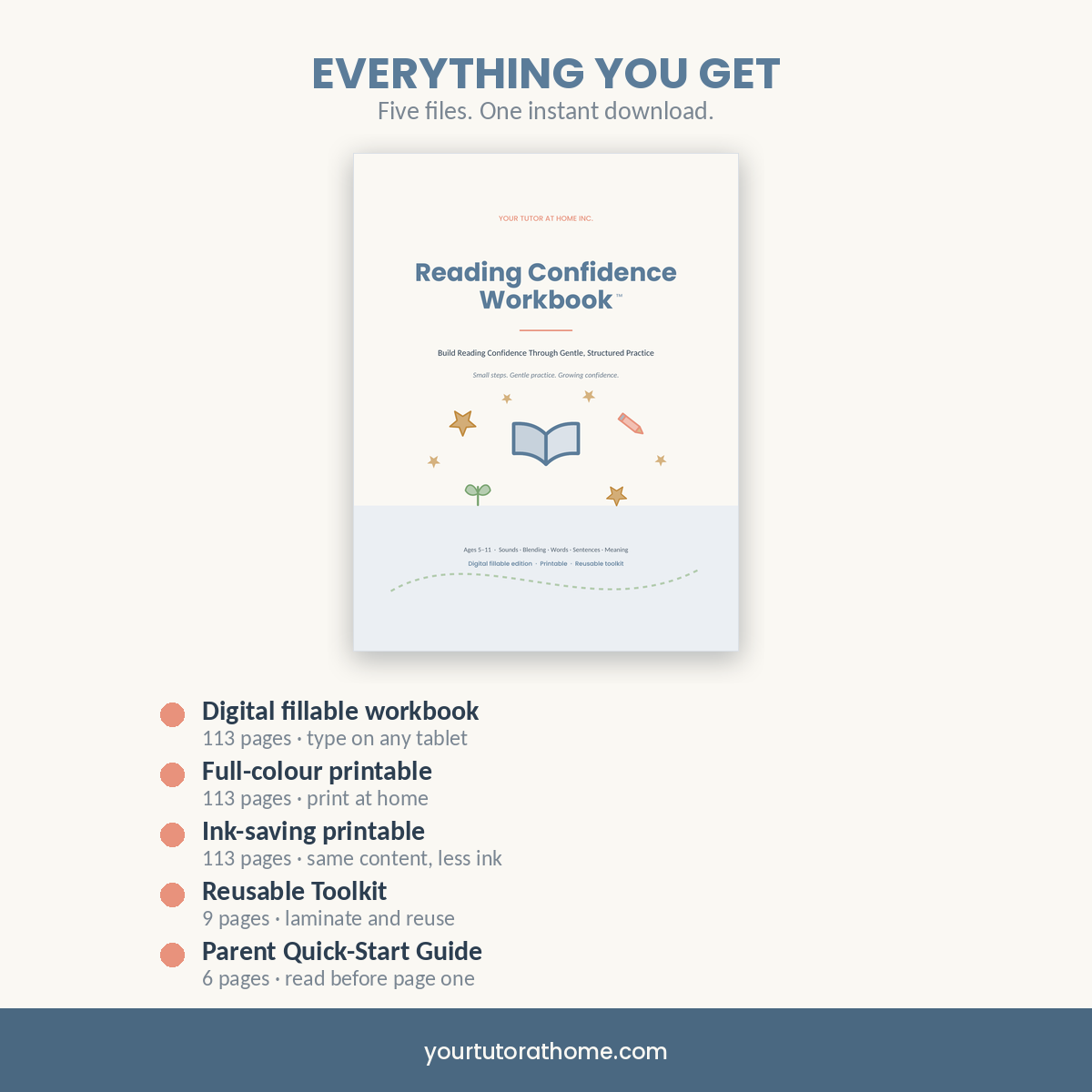
Five files, delivered instantly:
- Digital fillable reading confidence workbook — 113 pages, 206 typed fields and 511 tick boxes. Type straight into it on a tablet or computer; nothing needs printing.
- Full-colour printable edition — the same reading confidence workbook, formatted to print at home.
- Ink-saving edition — identical content, dramatically less ink.
- Reusable Reading Confidence Toolkit — 9 pages: the routine card, the sound and blend mat, the reading reset card, the parent encouragement card and the weekly tracker. Laminate them or use a dry-erase sleeve.
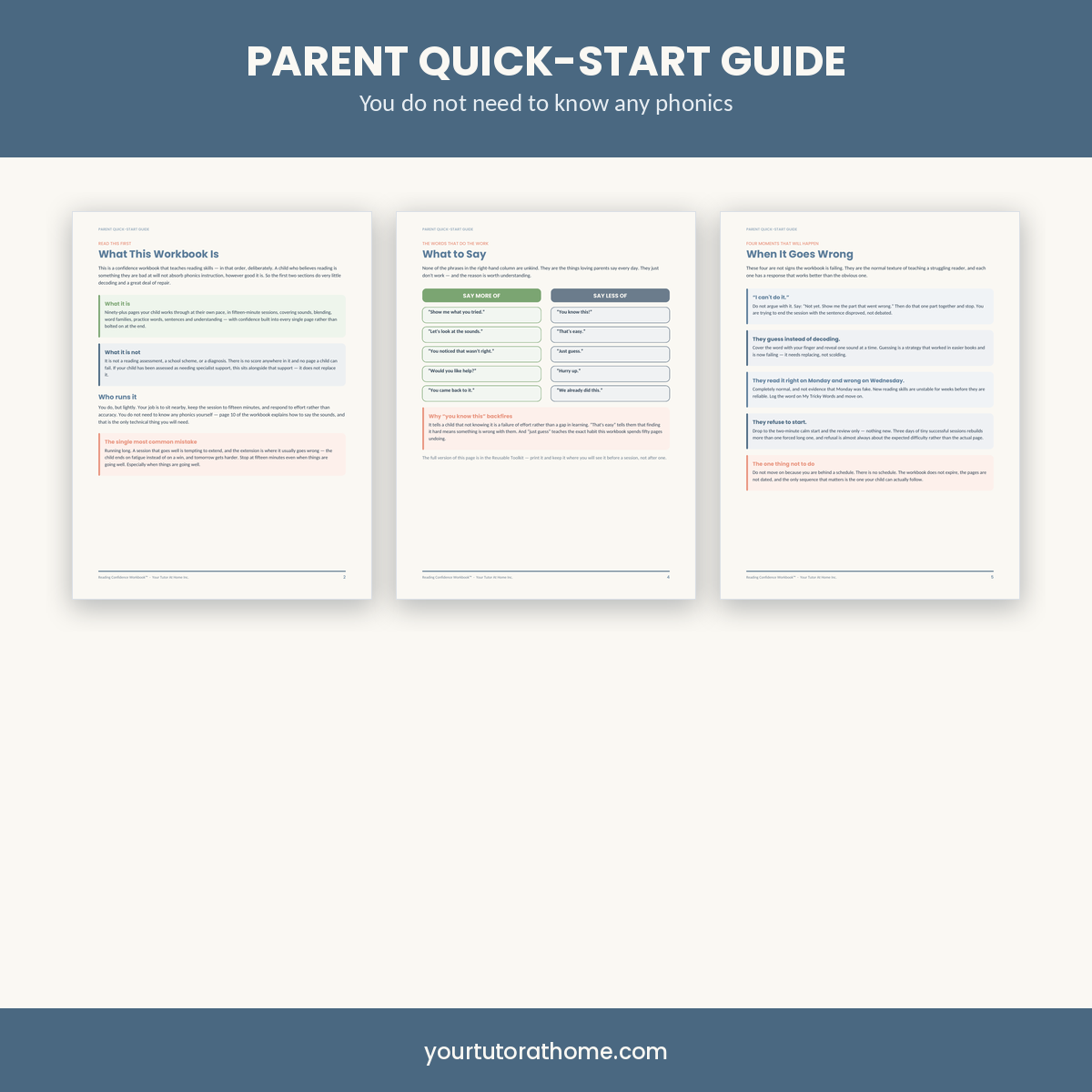
- Parent Quick-Start Guide — 6 pages. Read this before page one.
You do not need to know any phonics yourself. Everything technical you need sits on one page.
Who it’s for — and who it isn’t
This reading confidence workbook suits children aged roughly 5–11 reading below where they would like to be, children who have lost confidence, home-educated children, neurodivergent learners who need predictable structure, and any child who has started saying “I can’t” before looking at the word.
It is not a reading assessment, a diagnosis, or a replacement for specialist support. If your child has been assessed as needing intervention, this sits alongside that intervention rather than standing in for it.
If you are the one who needs the plan, rather than your child needing the practice, the Calm Reading Confidence Builder™ is the parent-facing companion — it teaches you to lead the change, while this reading confidence workbook is where your child practises. You may also want Reading Struggles™ to understand the underlying causes first, or The C.A.L.M. Learning Method™ for the complete framework. To try the approach before buying, start with the free worksheets.
What makes this different from a phonics scheme
A phonics scheme assumes a willing reader and supplies the content. This reading confidence workbook assumes an unwilling one and supplies the conditions first.
That shows up in small decisions on every page. No red crosses anywhere. No timers. No “level” printed in the corner. Every scale runs from “not yet” upward, so there is no category a child can land in that reads as failure. The answer key sits at the very back so the child meets the pages before the answers, and it opens by telling you not to read answers out.
Questions parents ask
My child is 10 and reading at a much younger level. Is this too babyish?
No. Nothing is decorated for very young children, there are no cartoon characters, and the tone speaks to the reader as capable. The content starts at single sounds because that is where the gap usually is — but it does not talk down.
How long does it take?
Fifteen minutes a day. Most families take eight to twelve weeks. There is no schedule and nothing expires.
What if we get partway and it stops working?
The Parent Quick-Start Guide has a page on exactly this — the four moments that will happen, and what to do at each one instead of the obvious thing.
Can I print the reading confidence workbook more than once?
Yes. One family or one classroom, as many copies as you need. Not for resale or redistribution.
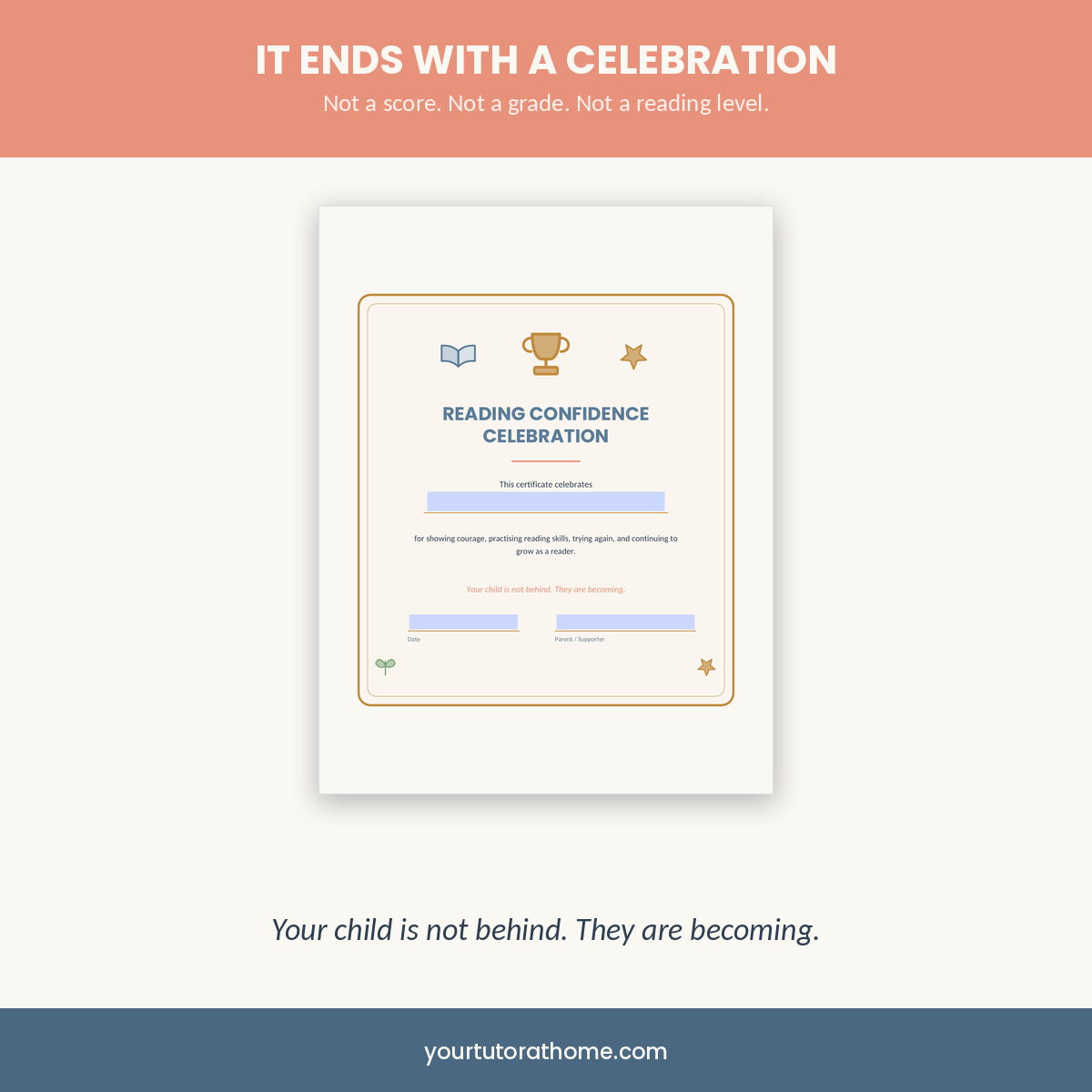
Small steps can build strong readers. Your child is not behind — they are becoming.

Reviews
There are no reviews yet.