
Calm Homework Planner™
$17.00
Homework does not have to take the whole evening.
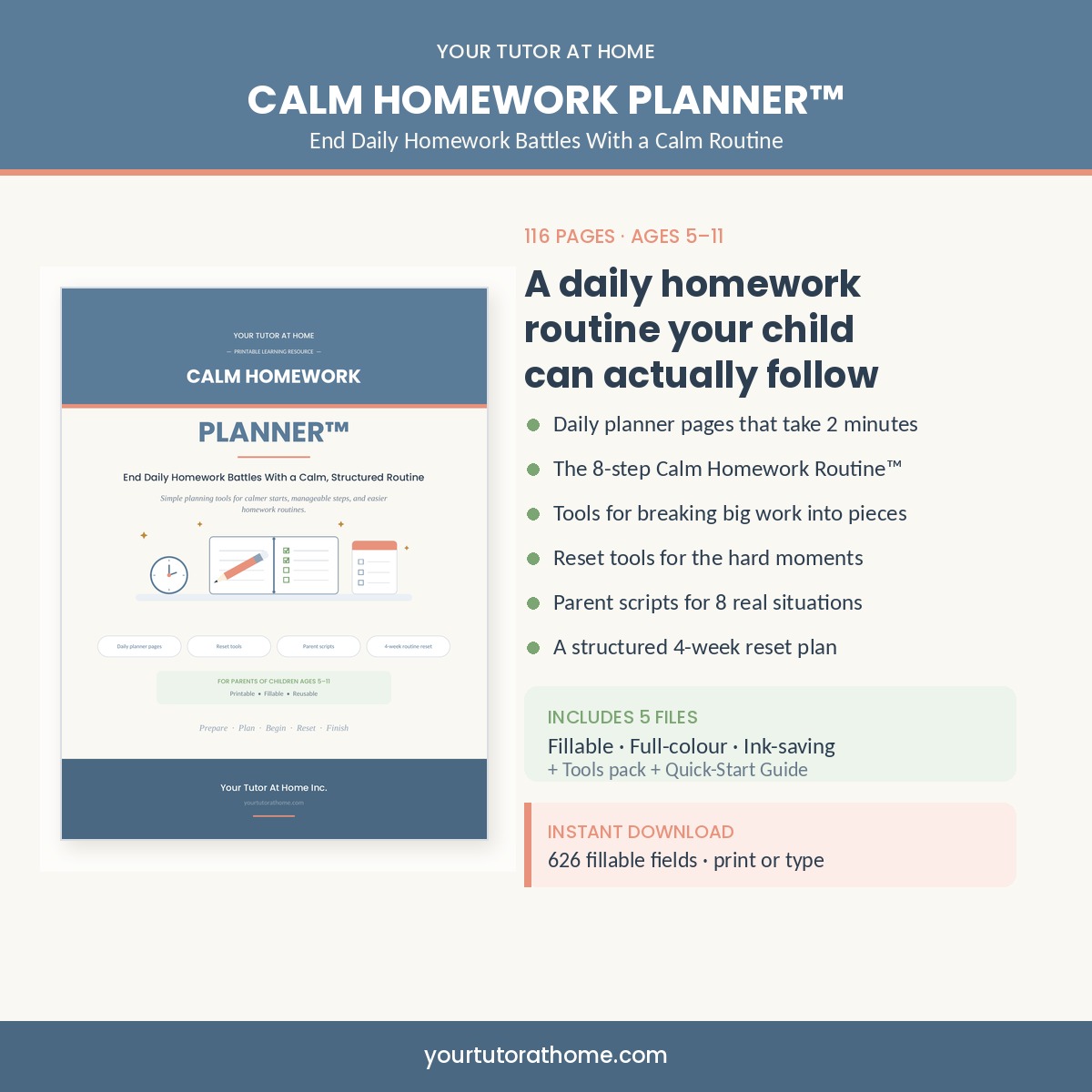
A 116-page printable and fillable homework planner that gives your child the same calm routine every day — and gives you the words to use when it starts going wrong.
Daily planner pages. An eight-step routine. Tools for breaking big assignments into pieces. Reset tools for the hard moments. Parent scripts for the conversations that decide the evening. Plus a structured four-week reset.
Ages 5–11 · 116 pages · 3 editions · Instant download
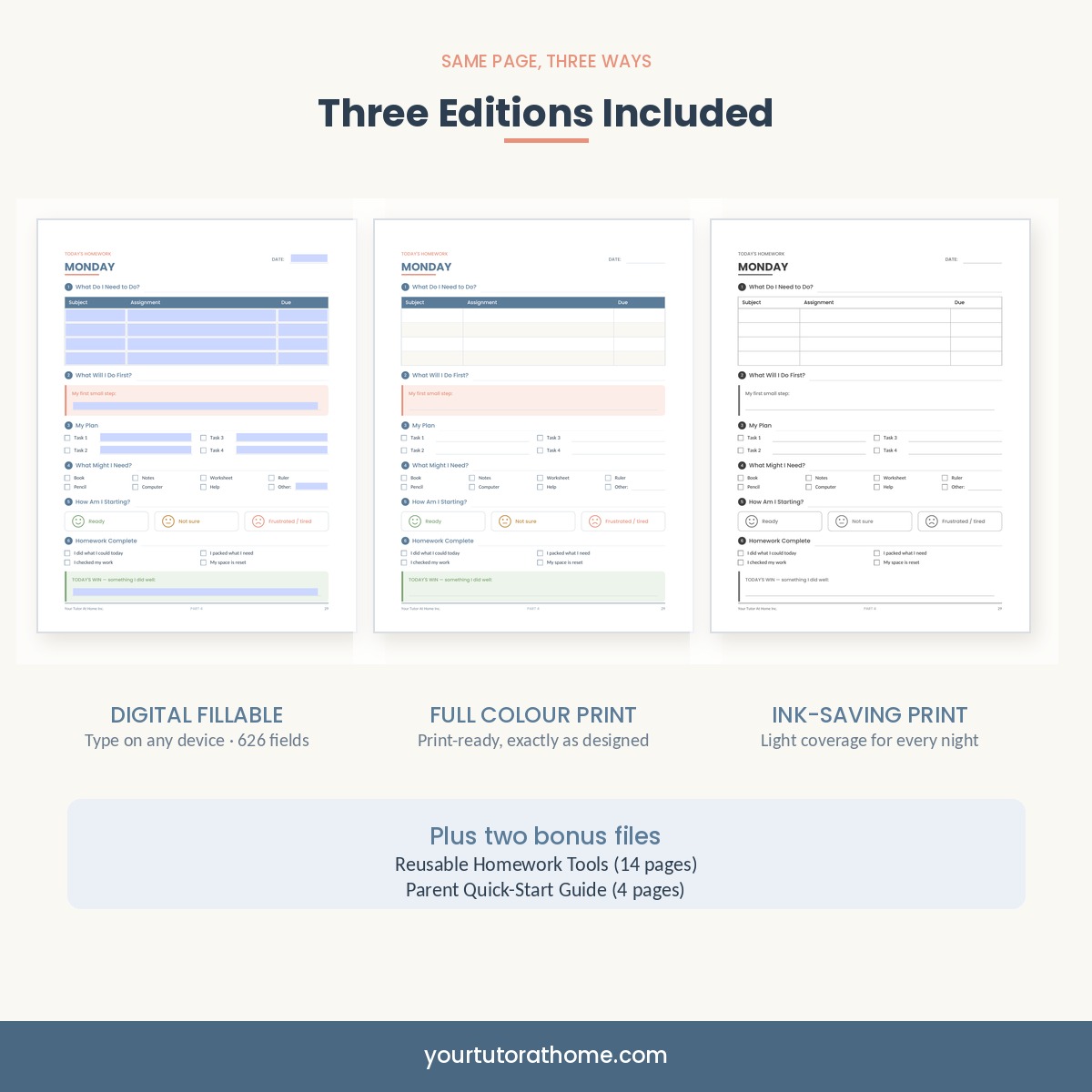
- Digital fillable edition — 626 fields, type on any device
- Full-colour printable edition
- Ink-saving printable edition
- Bonus: Reusable Homework Tools (14 pages)
- Bonus: Parent Quick-Start Guide (4 pages)
Product Description
A calm homework routine your child can follow every night
If homework takes ninety minutes of arguing to produce fifteen minutes of work, the problem is almost never the work. It is that nothing about the evening is predictable. The Calm Homework Planner™ is a 116-page printable and fillable homework planner that gives your child the same structure every school night, and gives you the words to use when it starts going wrong.
Built for children ages 5–11 by Mrs. Nathalie, an experienced tutor with over twenty years working with struggling readers, neurodivergent learners, and children of every learning style.
What this page covers
- Why homework becomes a battle
- What this homework planner does differently
- What is inside the homework planner
- Who it is for
- What you receive
- How to start tonight
- What to expect week by week
- Questions parents ask
Why homework becomes a battle
By four o’clock your child has already spent six hours holding their attention steady, managing their behaviour, and navigating other children. What is left is not their best thinking. It is the tired end of it.
Homework then arrives with no shape attached. Your child does not know what is due, how long it will take, where to begin, or when it will end. That uncertainty is what produces the delay, the negotiation, and the tears. A good homework planner works because it removes the uncertainty before the resistance has anything to attach itself to.
The second reason is scale. A ten-year-old looking at “write a paragraph about the water cycle” is not looking at one task. They are looking at an undefined amount of work with no visible finish line. Children rarely stall because they are lazy. They stall because they cannot see the edges of what is being asked.
What this homework planner does differently
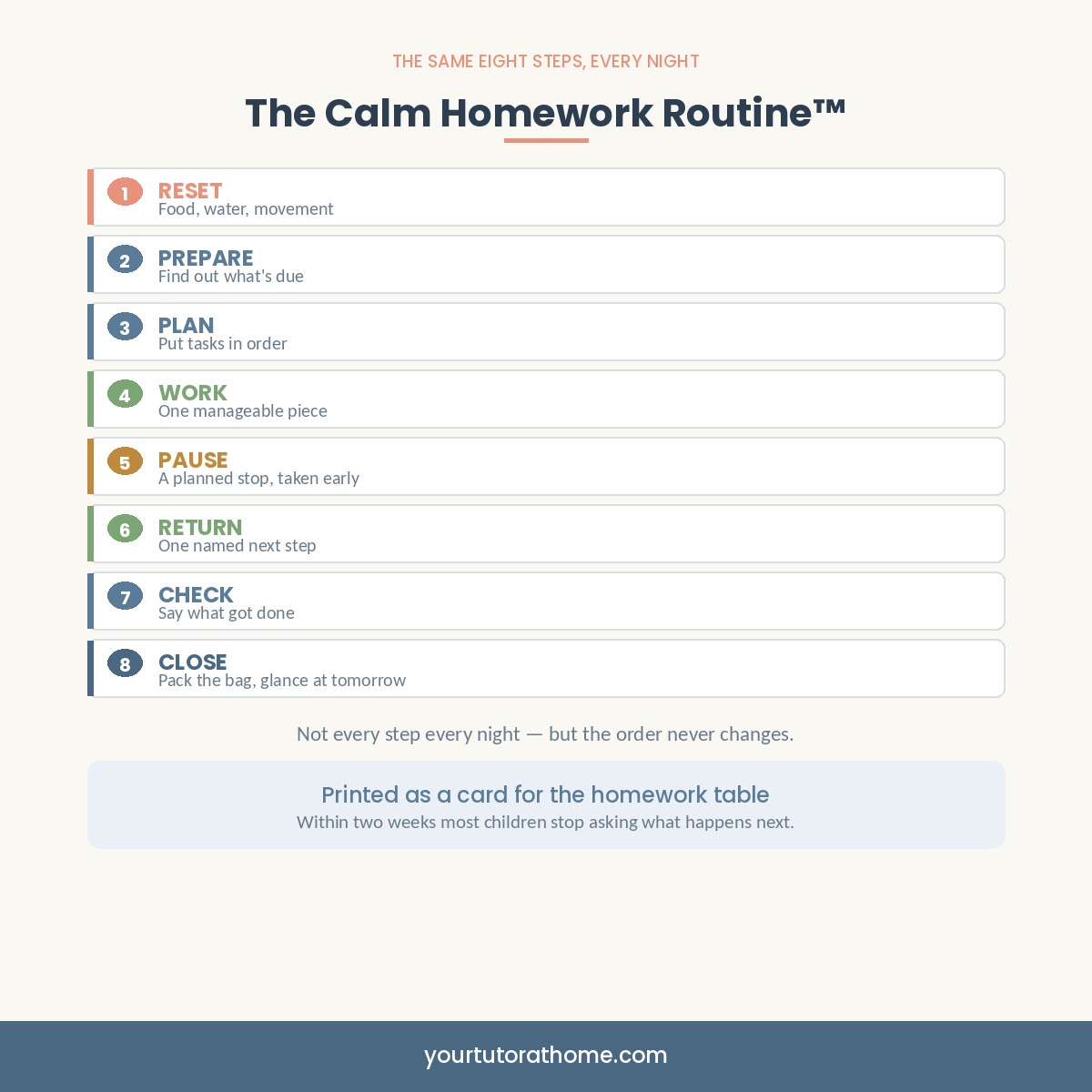
This is not a chore chart and it is not a reward system. It is a daily operating structure — the same eight steps, in the same order, every school night.
The Calm Homework Routine™ moves through Reset, Prepare, Plan, Work, Pause, Return, Check and Close. Not every step is needed every evening, but the order never changes. Within about two weeks most children stop asking what happens next, because the answer has stopped changing.
Every page of the homework planner is built to be used at four o’clock by a tired parent and a tired child, not studied in advance. Instructions sit on the page itself. Nothing needs preparing the night before.
Crucially, this planner assumes hard evenings will still happen. It does not pretend otherwise. It gives you something specific to do when they do — which is the real difference between a difficult evening and a difficult week.
What is inside the homework planner
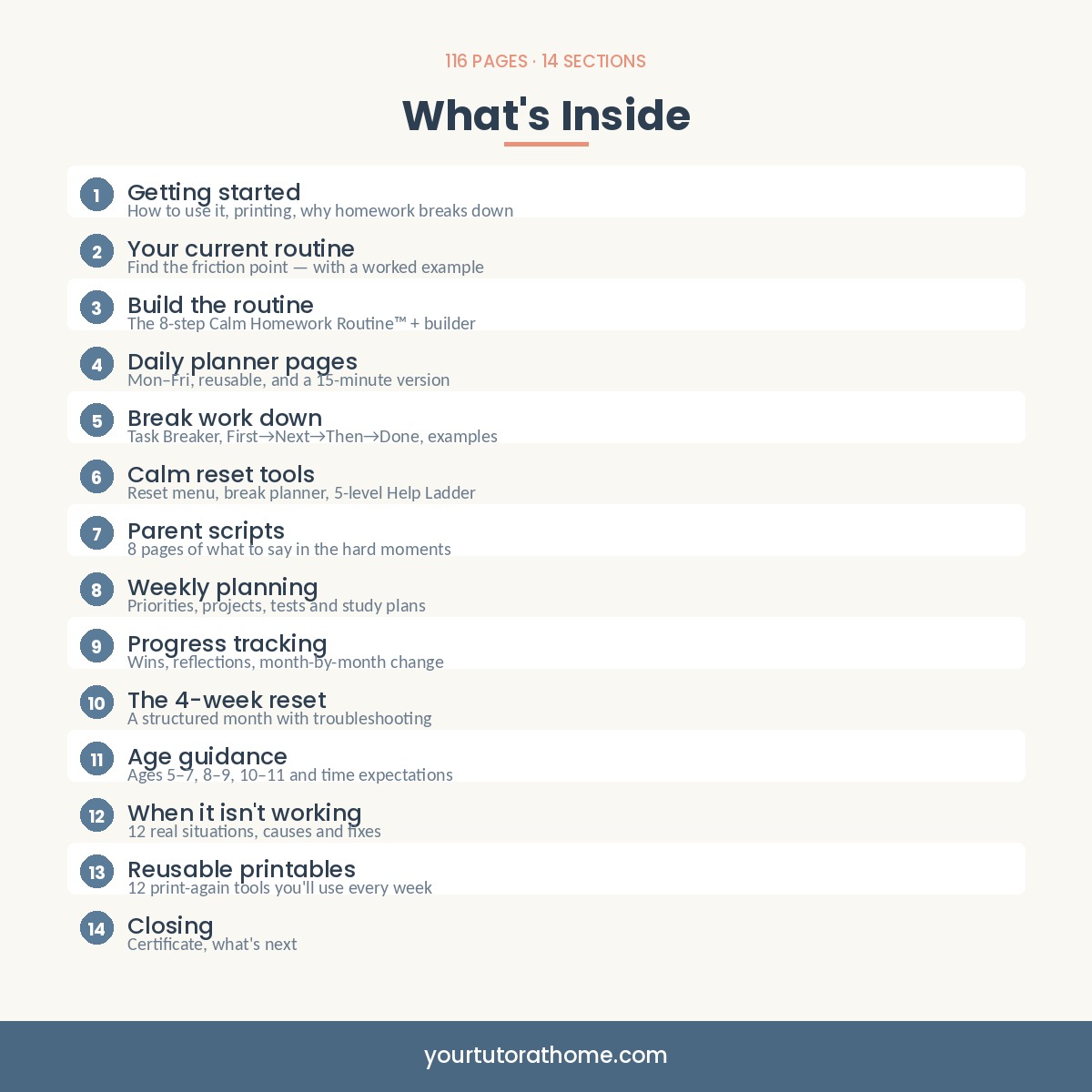
Understanding your current routine. Before changing anything you map what is actually happening: where the friction point sits, what already helps, and which single change to make first. A completed example page shows you what a useful answer looks like.
Building the routine. The eight steps explained in plain language, a routine builder to complete together, a worked example, plus workspace setup, a supply station inventory, and how to choose the homework time.
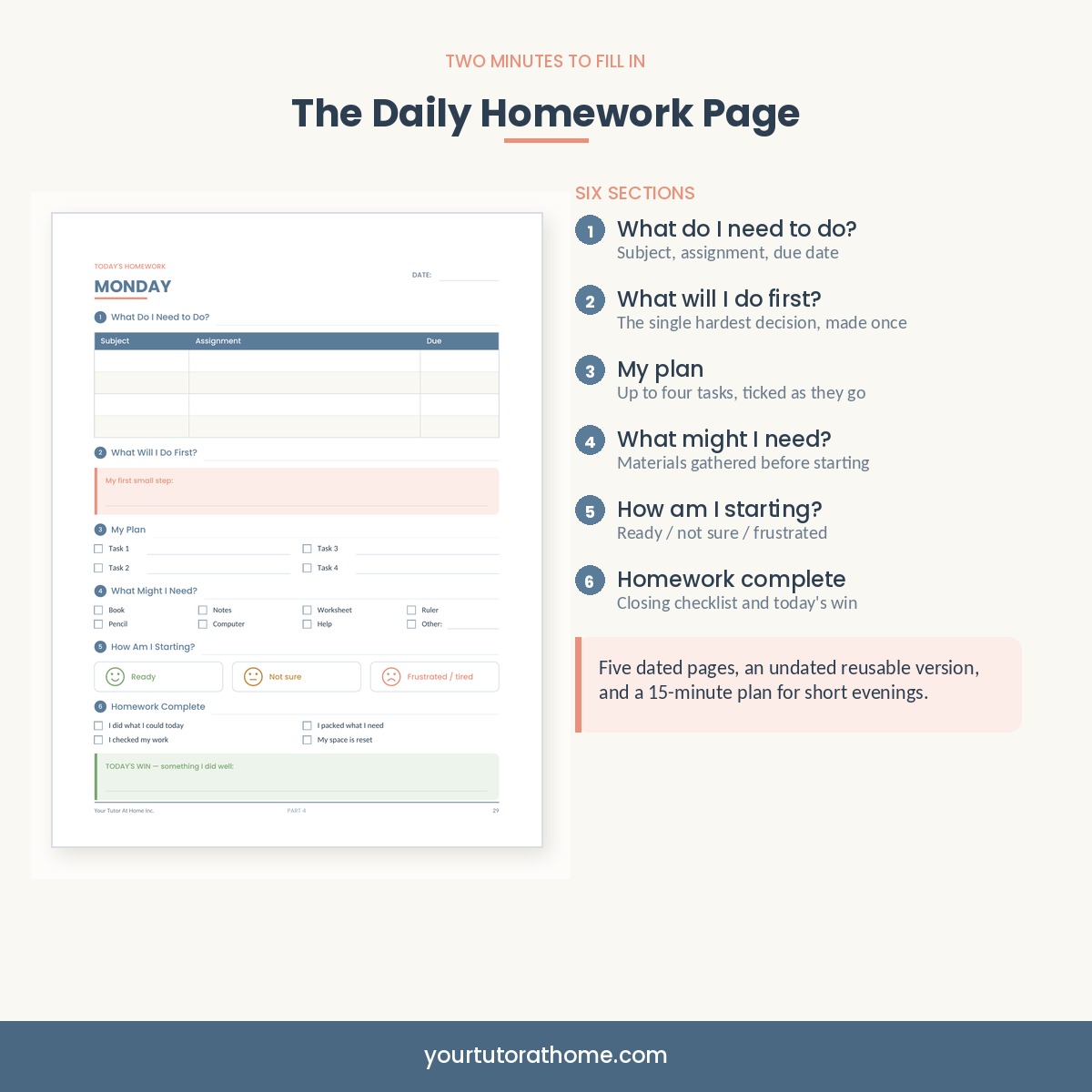
The daily pages. Five dated daily pages, an undated reusable version, and a Quick 15-Minute Homework Plan for evenings that cannot hold a full session. Each page runs six sections: what is due, the first small step, the plan, materials needed, a starting check-in, and a completion review.
Breaking big work into small steps. The “Too Big” Task Breaker, a simpler First → Next → Then → Done tool for younger children, an assignment breakdown sheet, and three real assignments broken down as examples.
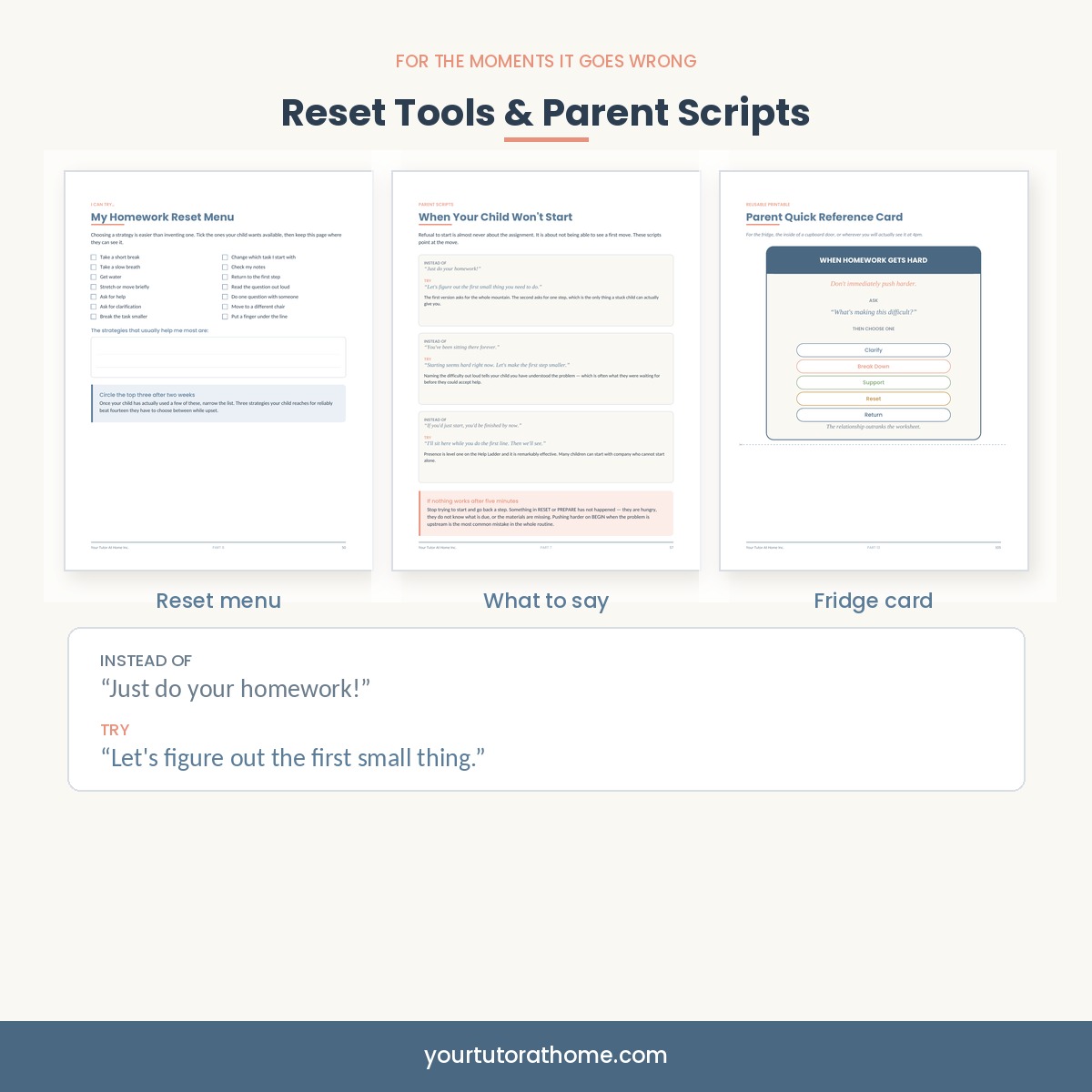
Calm reset tools. A five-part sequence — Notice, Pause, Choose, Reset, Return — with a personal reset menu, a break planner, a decision tree for “I don’t know what to do”, and a five-level Help Ladder showing how to support without taking the pencil.
Parent support scripts. Eight pages covering the moments that decide the evening: won’t start, “I can’t”, rising frustration, needing help, finishing well, homework not finished, notes to the teacher — and one page for when you are the frustrated one.
Weekly planning. A weekly overview, a Must/Should/Could priority planner, an upcoming projects tracker, and a tests and study planner with a worked four-night spelling plan.
Progress without perfection. A wins tracker, weekly reflections for both child and parent, and a progress tracker built to show change across months rather than nights.
The four-week reset. A structured month — Prepare, Start, Work and Reset, Close — with a troubleshooting page facing each week for when that week is not going well.
Age guidance. Realistic nightly homework expectations by grade, with separate sections for ages 5–7, 8–9 and 10–11.
When it is not working. Twelve real situations, each with the likely cause and a specific adjustment.
Reusable printables. Twelve print-again tools including the daily plan, homework checklist, reset card, routine card, parent quick reference card, weekly planner and progress tracker.
Who this homework planner is for
Families with children ages 5–11 where homework regularly runs long, produces conflict, or ends in tears. It works particularly well for children who are overwhelmed by volume, who cannot get started, or who need structure repeated rather than explained.
It is widely used by parents of neurodivergent learners, and by parents of children who find reading effortful and therefore find every written task heavier than it looks. For background on what often sits underneath that, Understood.org and Reading Rockets both publish sound parent-facing guidance, and the CDC child development pages are a reliable reference for age-appropriate expectations.
If the core difficulty is reading rather than organisation, start with Reading Struggles™ instead. If attention is the sticking point, Focus & Attention™ is the better fit.
What you receive
The homework planner arrives as five files, delivered instantly:
- Digital fillable edition — 116 pages, 626 fillable fields. Type straight into it on a tablet, laptop or phone. Nothing to print.
- Full-colour printable edition — the same 116 pages, print-ready.
- Ink-saving printable edition — heavy colour removed for everyday printing.
- Reusable Homework Tools — a 14-page printer-friendly file with every reprintable tool, so you never reprint the whole planner.
- Parent Quick-Start Guide — 4 pages. Read it tonight, start tomorrow.
How to start tonight
You do not need to read the whole homework planner first. Print the Quick-Start Guide and one daily page. That is genuinely it.
For the first week change only the container: same time, same place, same supplies. Add one sentence before any work begins — “What’s the first small thing you need to do?” — and ask it every single day.
What to expect week by week
Week one often feels worse. You are adding a demand at the hardest hour of the day, and resistance means something changed, not that something is wrong.
Week two is uneven. Two good evenings and three difficult ones is normal, and the good evenings are the signal.
Week three usually brings one specific step getting easier — often starting or closing. It will look small. Say it out loud anyway.
Week four feels familiar rather than fixed. Hard evenings still happen. They simply stop taking the whole evening with them.
Questions parents ask
Is this the same as the Calm Homework Reset System™?
No. The Calm Homework Reset System™ is an intervention framework for changing entrenched patterns and parent responses. This homework planner is the daily tool your child actually writes on. Many families use both, and they are designed to fit together.
Do I need a printer?
No. The digital fillable edition works on any device with a PDF reader.
Will it work for a child who has never used a homework planner?
Yes. Begin with the Quick-Start Guide and the daily page only. Everything else exists for when a specific problem appears.
Is this a curriculum?
No. A homework planner does not teach subject content. It organises the evening so the content your child already has stops getting lost in the struggle to begin. For the full framework behind it, see The C.A.L.M. Learning Method™.
Your child is not behind. They are becoming.
Calm routines are built through repetition, not perfection. This homework planner gives you the repetition — and something specific to do on the nights it does not go to plan.
With care, Mrs. Nathalie
Founder, Your Tutor At Home™

Reviews
There are no reviews yet.