
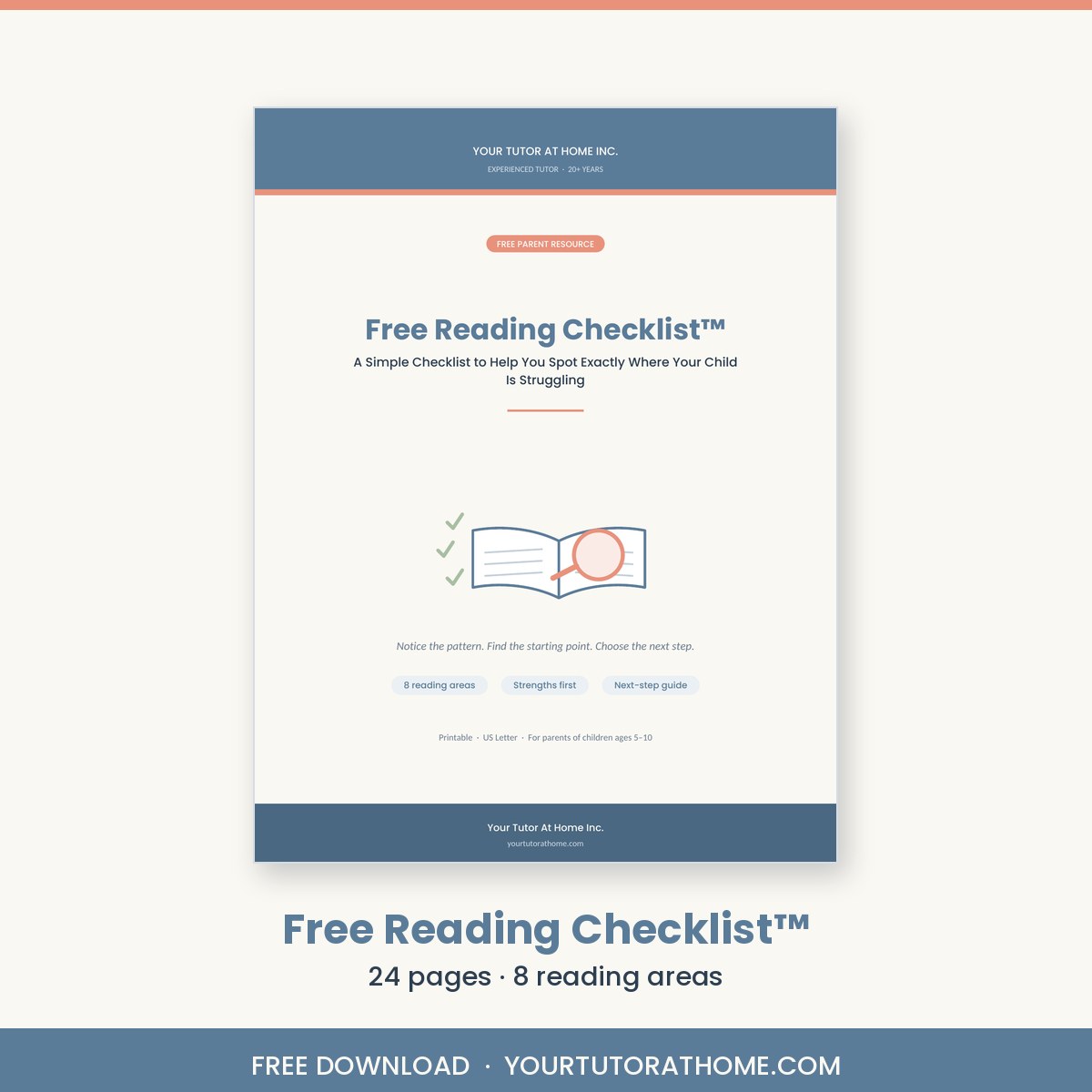
Free Reading Checklist™
$0.00
A simple checklist to help you spot exactly where your child is struggling.
You already know reading is hard. This free reading checklist helps you work out where it breaks down — sounds, letters, blending, word reading, fluency, meaning, confidence, or focus.
- 24 pages · eight reading areas · US Letter
- Strengths page first, difficulties second
- Parent observation pages and a pattern summary
- Next-step guide matched to what you found
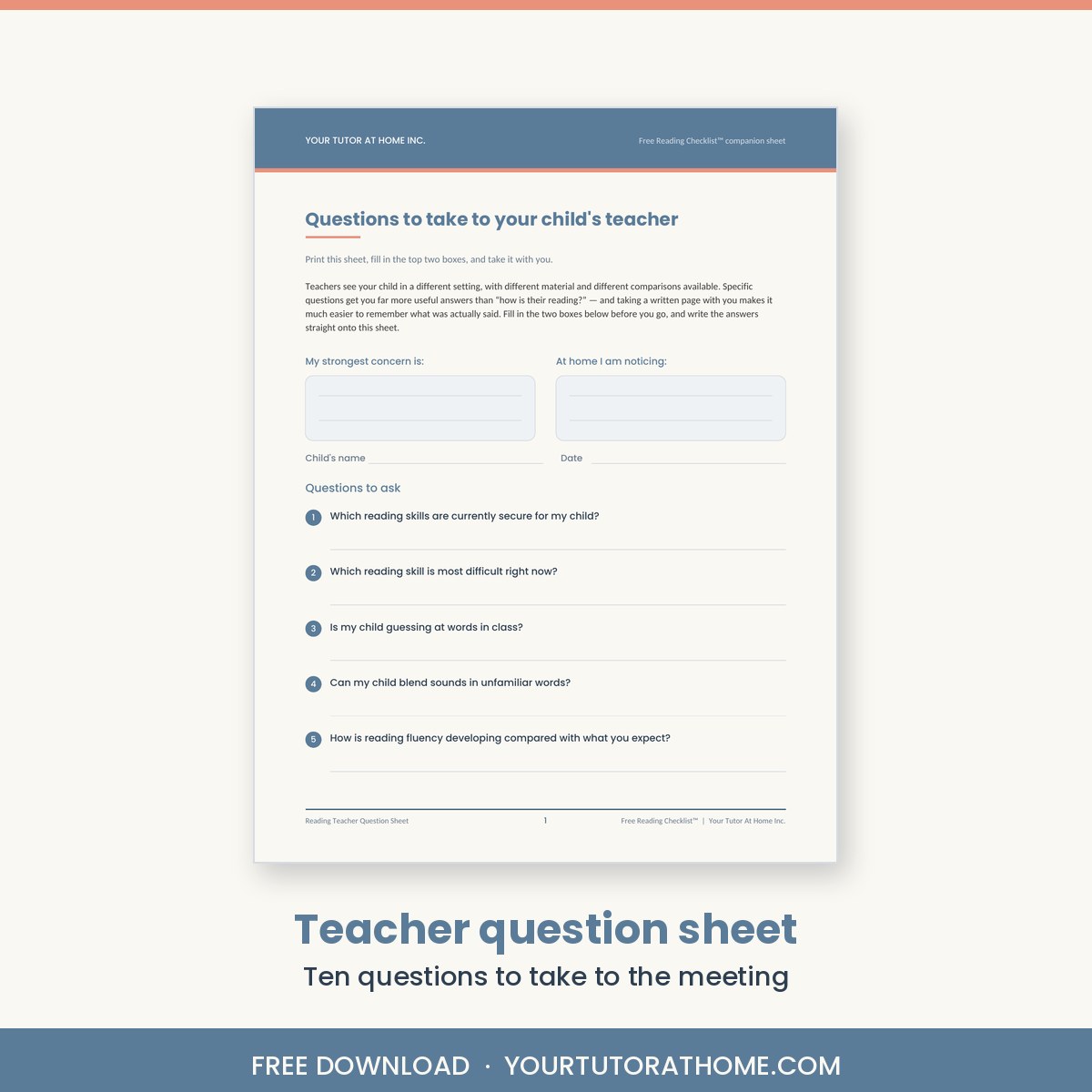
- Ten questions to take to your child’s teacher
- Digital fillable, full-colour print and ink-saving editions
Free download. No cost, no catch.
Product Description
Most parents arrive at the same sentence: something is wrong with my child’s reading, and I don’t know what. That sentence is exhausting, because there is nothing you can actually do with it. This free reading checklist exists to replace it with something far more useful — a clear view of where reading seems to break down for your particular child.
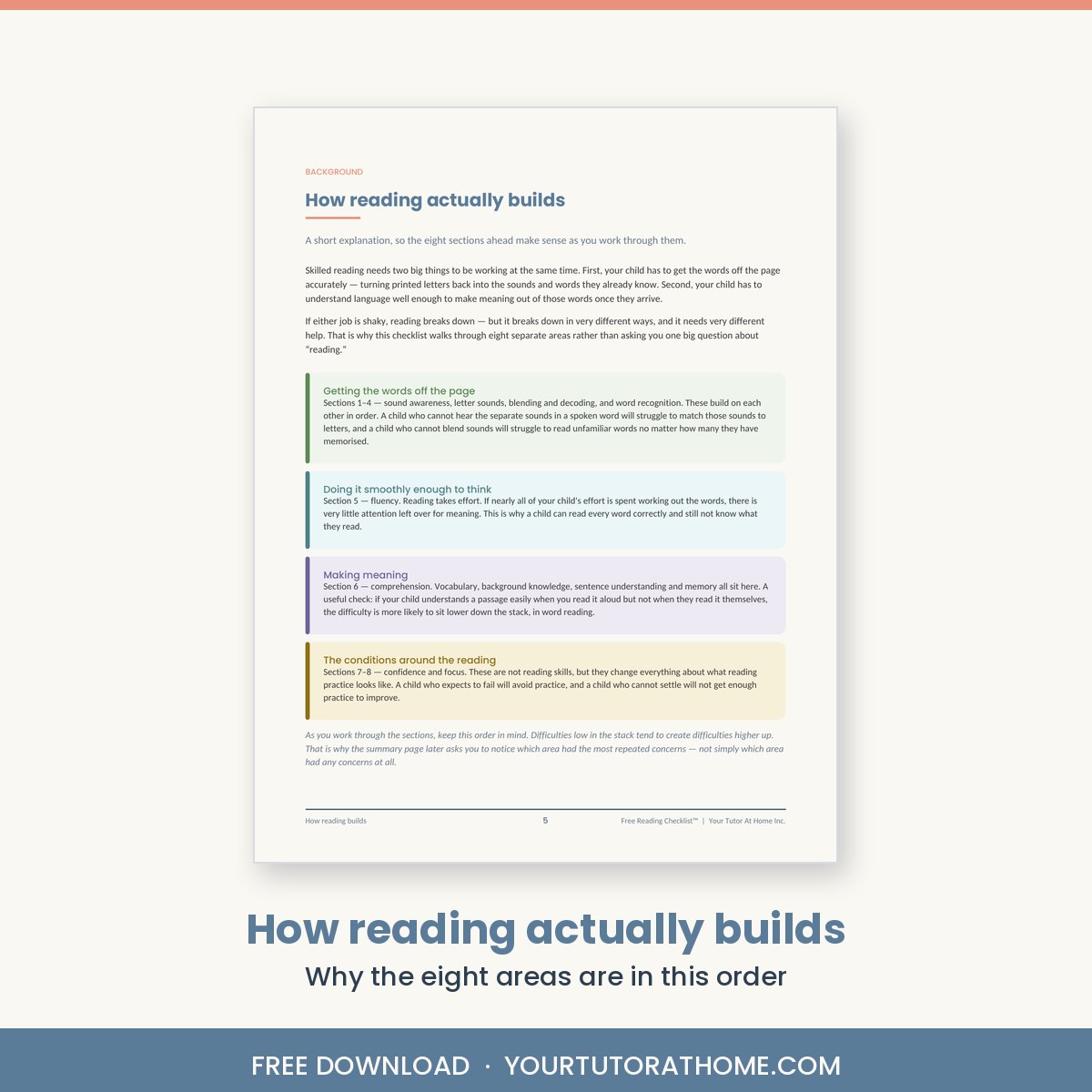
Reading is not one skill. It is a stack of skills that build on each other, and a difficulty low in that stack shows up as trouble everywhere above it. A child who cannot blend sounds will look like a child with poor comprehension, because every scrap of attention is going into working out the words. A free reading checklist that walks through the stack in order helps you tell those two situations apart.
What this free reading checklist covers
- The eight reading areas
- Why it starts with strengths
- How to use the free reading checklist
- The parent observation pages
- The next-step guide
- Questions for your child’s teacher
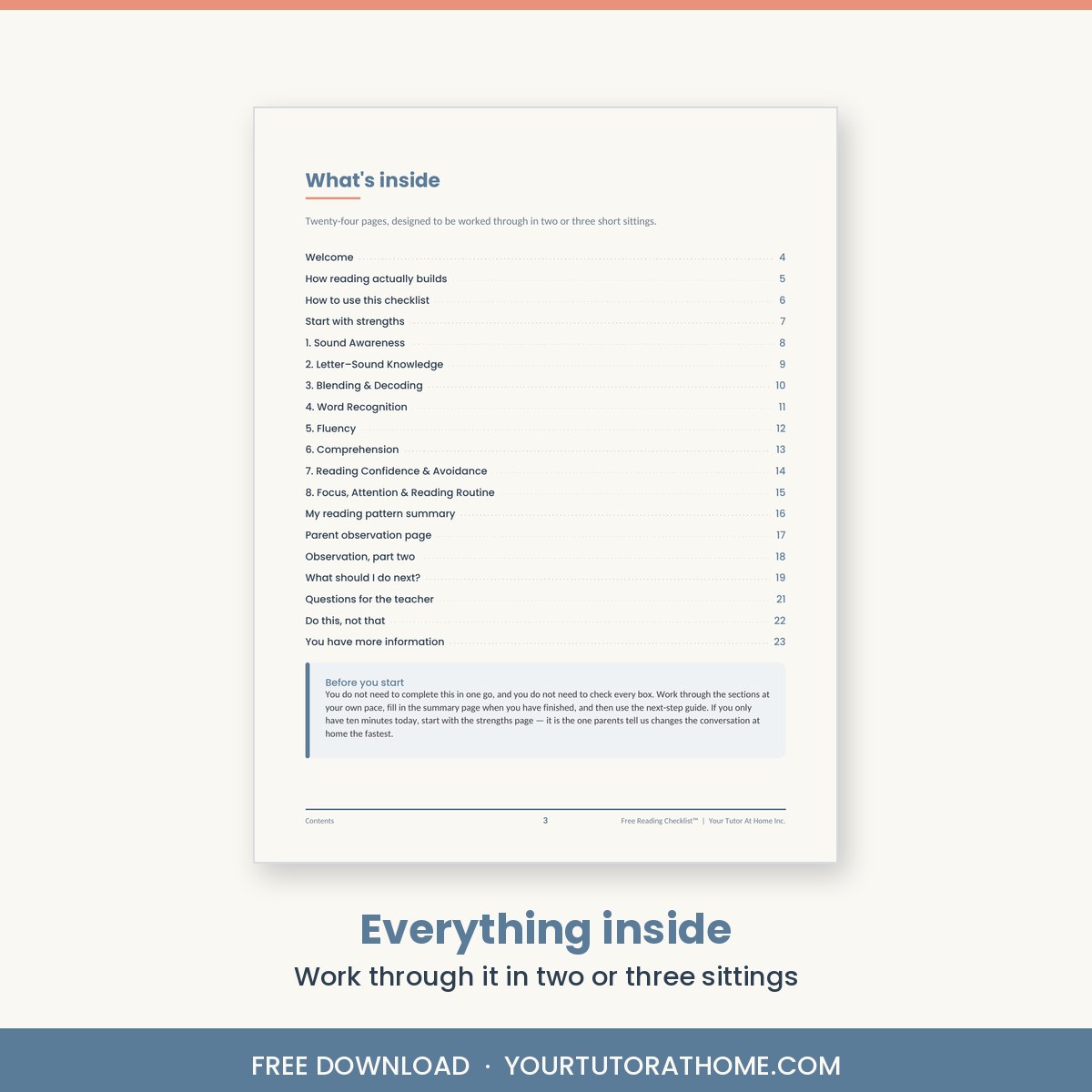
- What is inside the download
- What the free reading checklist is not
- Common questions
The eight reading areas
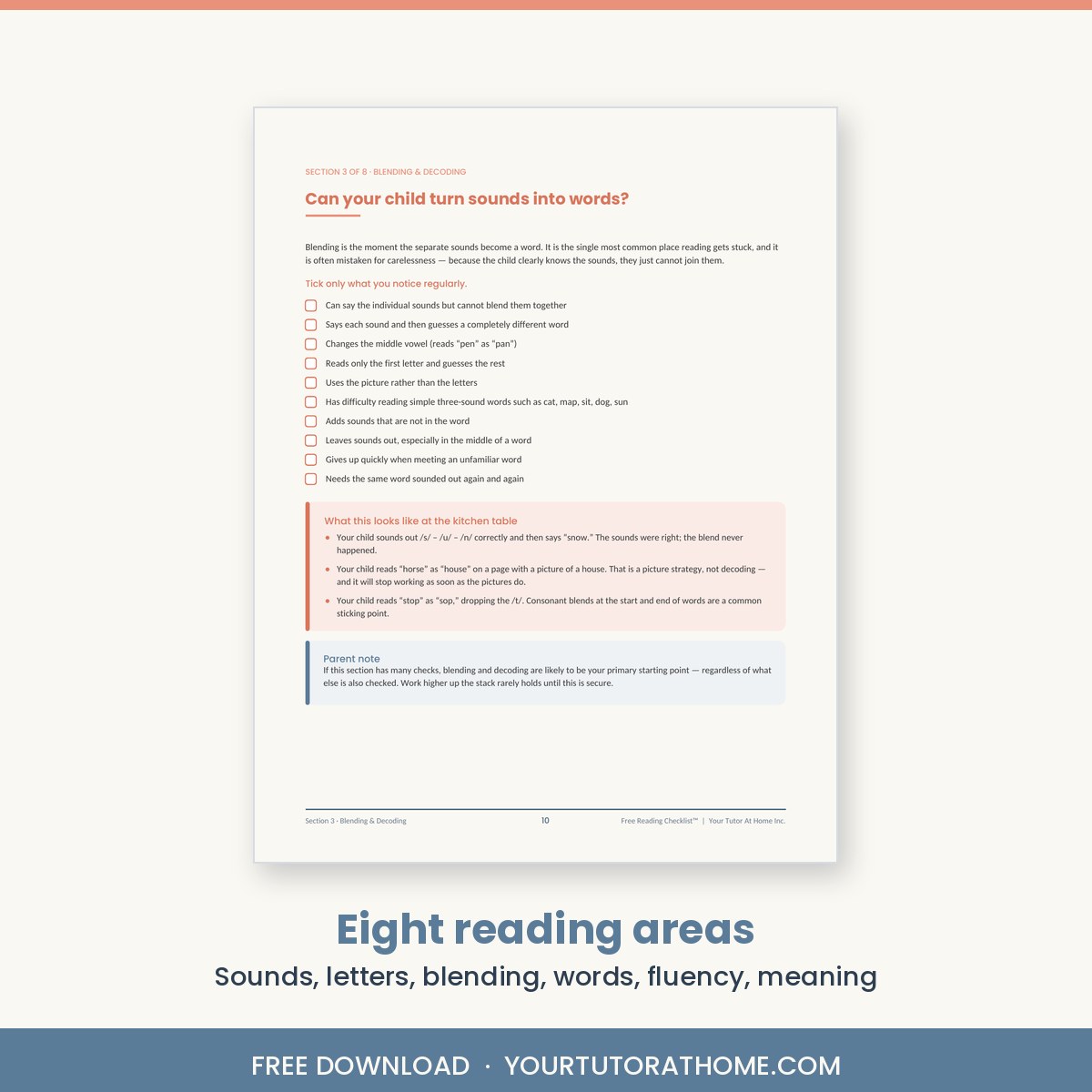
The free reading checklist works through eight areas in the order reading actually develops, so you can see not just that something is wrong but roughly where it begins.
- Sound awareness — hearing and working with spoken sounds, before any print is involved.
- Letter–sound knowledge — knowing which sound each letter represents, reliably and quickly.
- Blending and decoding — turning separate sounds into a whole word. This is the single most common sticking point.
- Word recognition — whether familiar words are becoming automatic or are still rebuilt from scratch every time.
- Fluency — reading accurately and smoothly enough to have attention left over for meaning.
- Comprehension — whether meaning is actually arriving, and how that compares with listening.
- Reading confidence and avoidance — what your child now believes about themselves as a reader.
- Focus, attention and reading routine — the conditions around practice, which change everything.
Each area page gives you the behaviours to tick, three worked examples of what that difficulty looks like at the kitchen table, and a short note on what the pattern usually means. Those examples matter: it is far easier to recognise “my child sounds out s–u–n correctly and then says snow” than to answer an abstract question about blending.
Why it starts with strengths
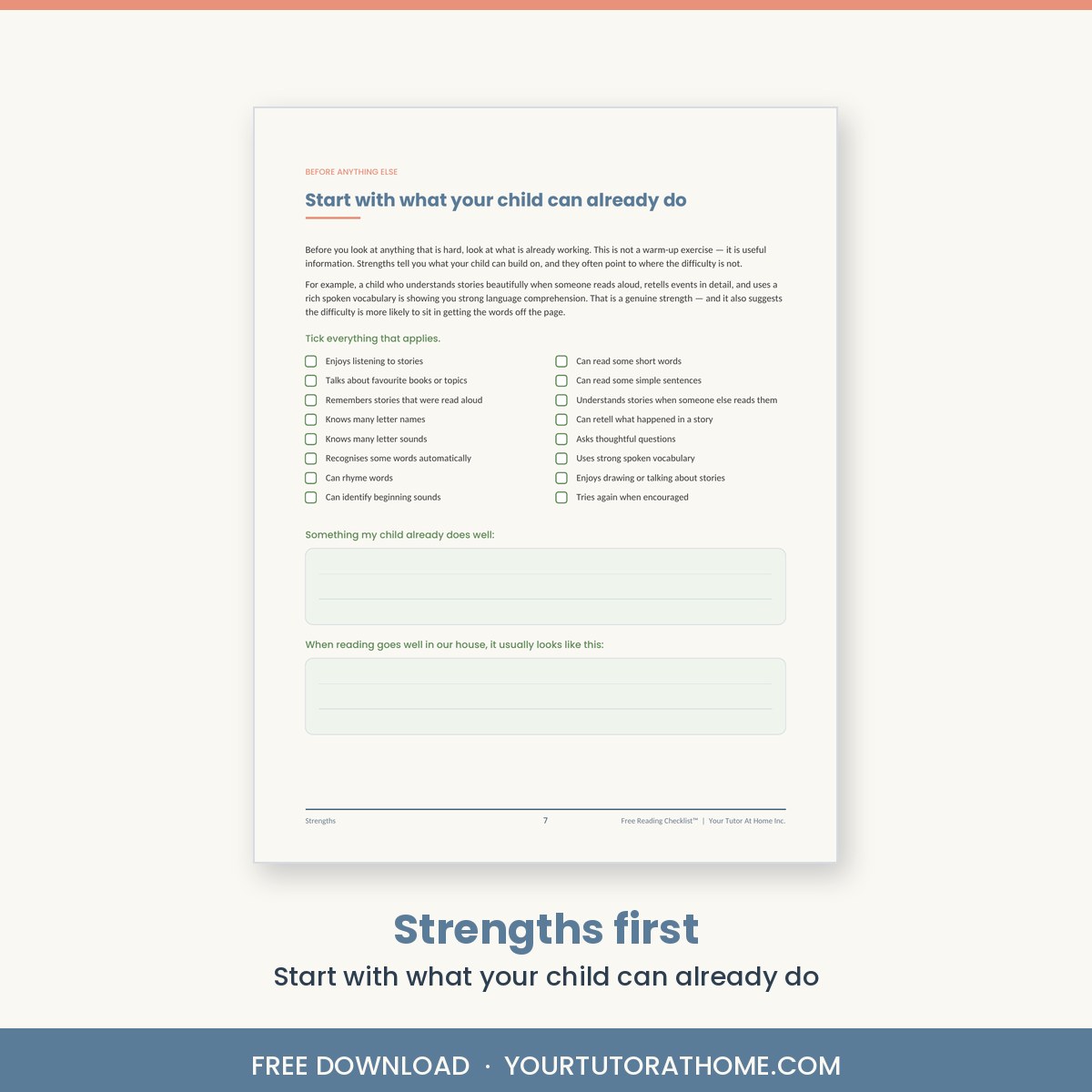
The first list in this free reading checklist is not a list of problems. It is sixteen things your child may already be able to do — listening to stories, rhyming, retelling events, using rich spoken vocabulary, trying again with encouragement.
This is not padding. Strengths tell you what to build on, and they often point to where the difficulty is not. A child who understands stories beautifully when you read aloud is showing strong language comprehension, which quietly suggests the difficulty sits in getting words off the page rather than in understanding them.
How to use the free reading checklist
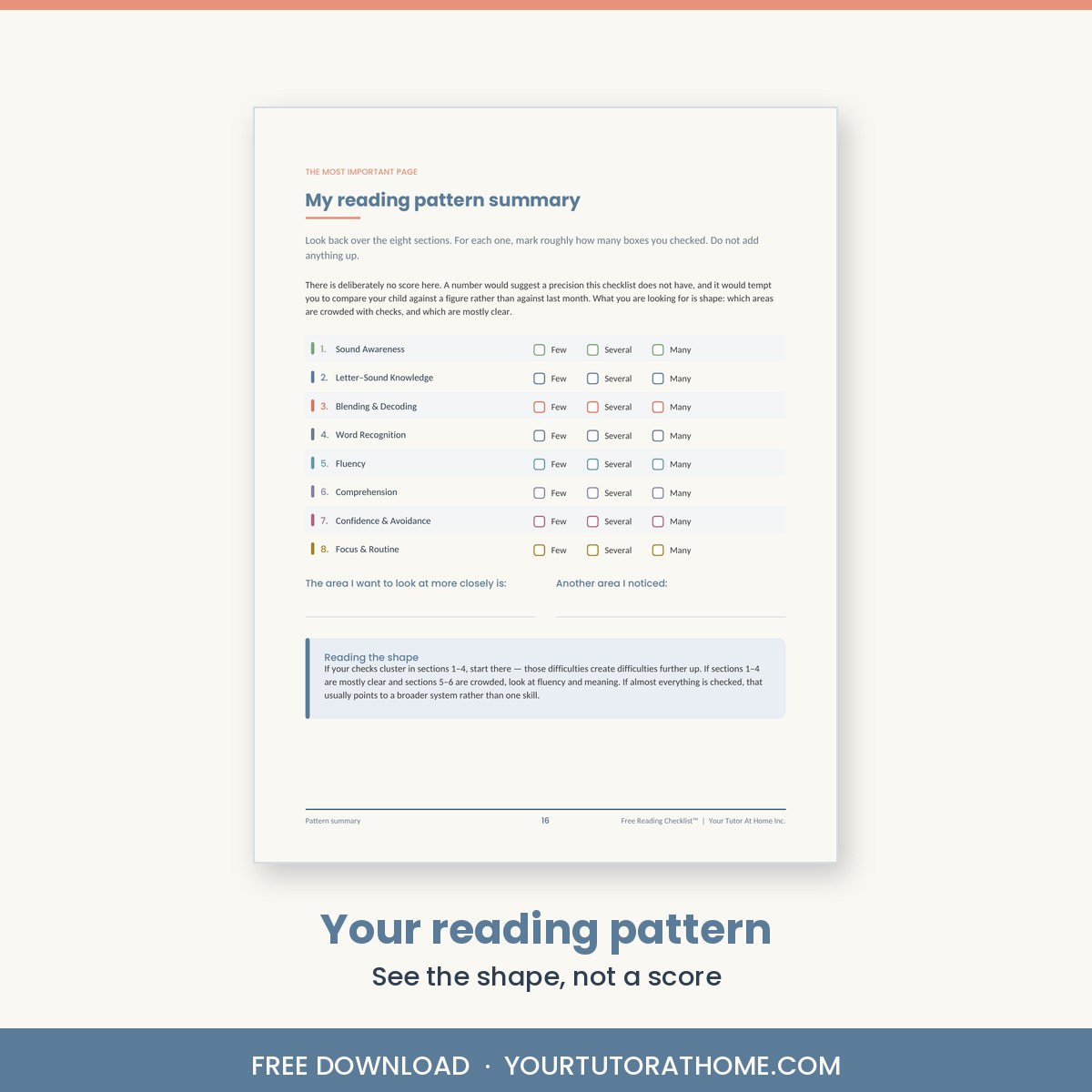
Read each section before you tick anything, then tick only the behaviors you notice regularly — not what happened once on a difficult evening. Do not worry if several sections fill up; that is normal. When you finish a section, glance back and mark it if most boxes are checked.
Fill it in when your child is not in the room. You will observe far more honestly when you are not also managing the reading, and the whole thing is designed to be worked through in two or three short sittings rather than in one sitting.
The parent observation pages
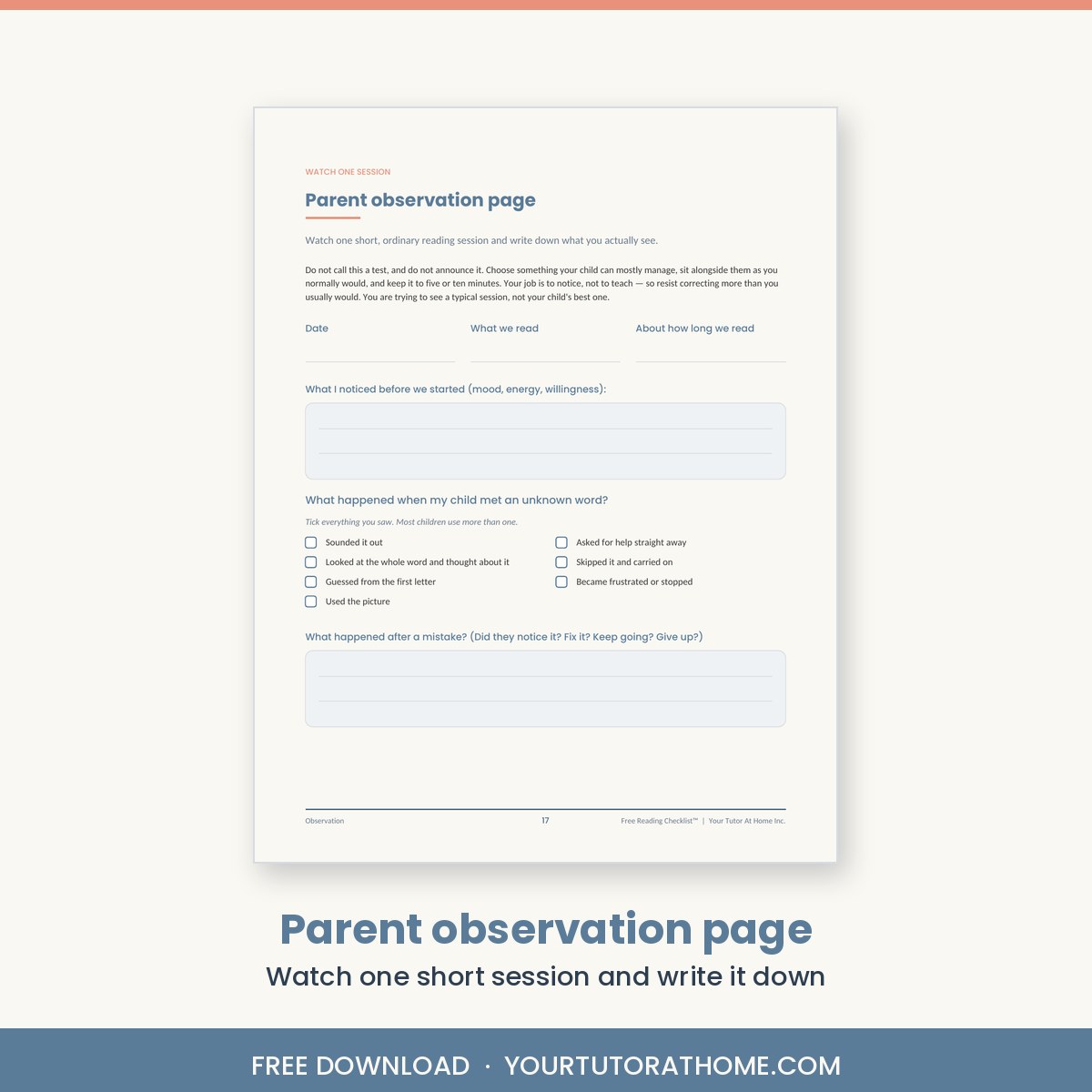
Ticking boxes from memory is useful. Watching one short, ordinary session and writing down what you actually see is better. Two pages of the free reading checklist guide you through it: what happened when your child met an unknown word, what happened after a mistake, what seemed easiest, what seemed hardest, what helped, and the one thing you will change next time.
Ten minutes of careful watching is worth more than an hour of worrying — and if you repeat the observation in a month, you will have something real to compare against instead of a vague sense of whether things are better.
The next-step guide
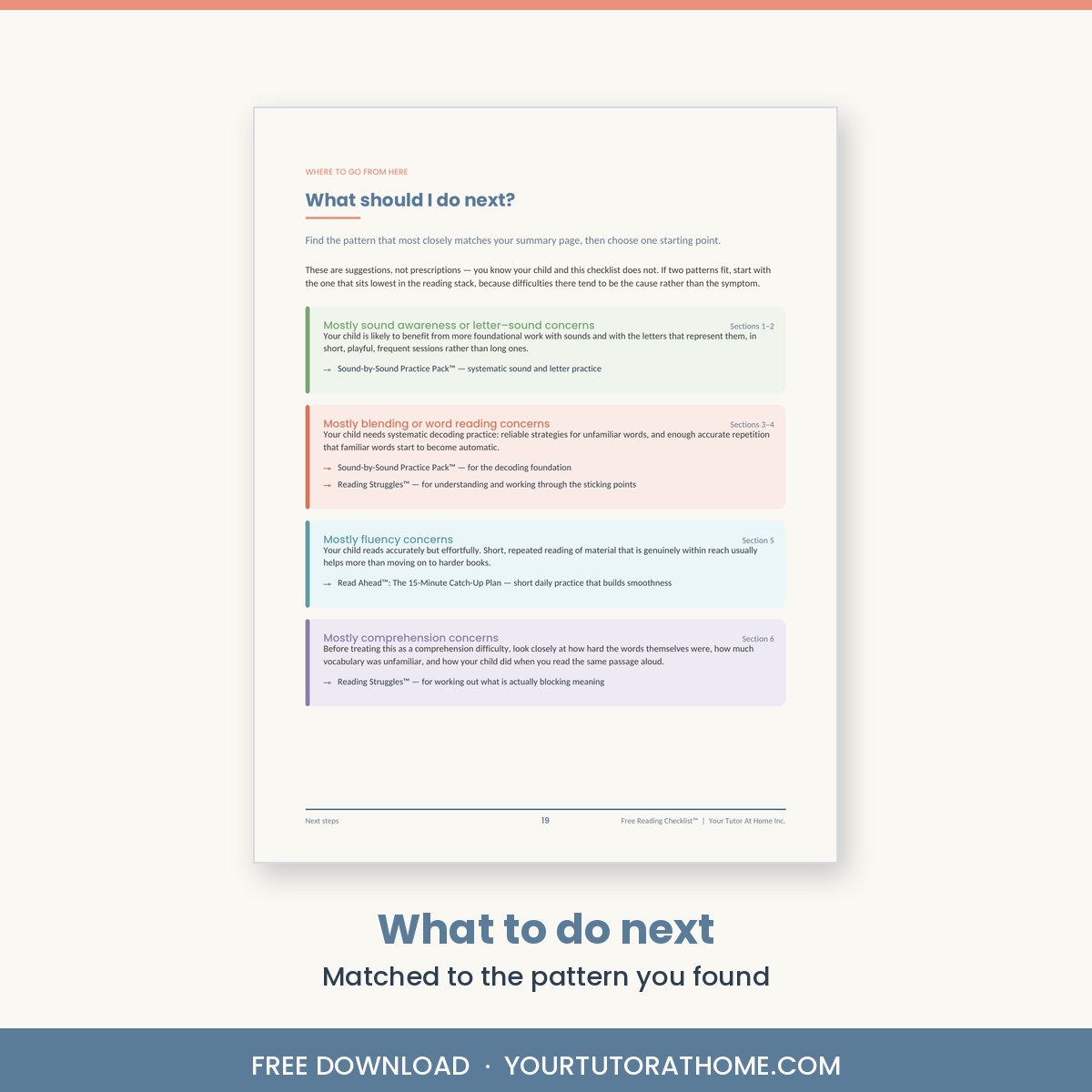
The last working section of the free reading checklist matches the pattern you found to a sensible starting point. Concerns clustered in sounds and letters point somewhere different from concerns clustered in fluency or confidence, and the guide says so plainly rather than pushing everyone toward the same thing.
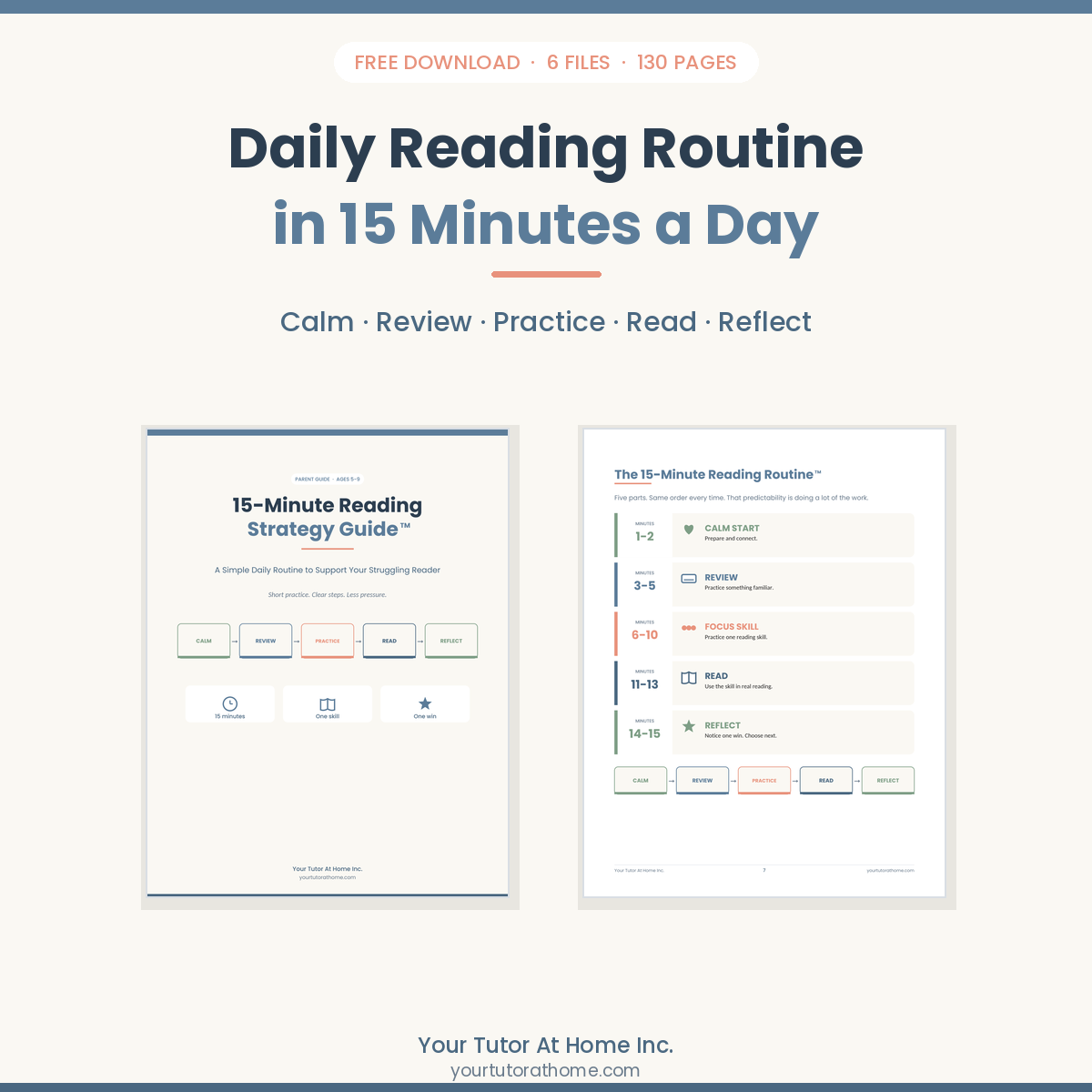
If several areas are affected — which is common, and not a sign that things are worse than you thought — the guide points toward The C.A.L.M. Learning Method™, the complete parent-led system. If the difficulty is narrower, Reading Struggles™ or Read Ahead™: The 15-Minute Catch-Up Plan may be the better fit. You are never asked to buy anything in order to use this checklist.
Questions for your child’s teacher
Teachers see your child in a different setting with different comparisons available, and specific questions get far better answers than “how is their reading?” The free reading checklist includes a standalone printable sheet with ten questions and space to write the answers while you are still in the room.
What is inside the download
- Digital fillable edition — 24 pages, type directly into every box, tappable contents.
- Full-colour printable edition — 24 pages, US Letter.
- Ink-saving printable edition — the same 24 pages using roughly 69% less ink.
- Reading Teacher Question Sheet — a two-page standalone printable.
Every edition of the free reading checklist is suitable for parents and caregivers of children roughly ages 5–10, including children who are neurodivergent or who have been struggling for a long time.
What the free reading checklist is not
It is an educational observation tool, not an assessment. There is no score, no risk rating, and nothing here can tell you whether your child has dyslexia, ADHD, a language disorder, or any other condition. Children show these behaviours for many reasons, including tiredness, the difficulty of the book in front of them, and simply being at an earlier stage than the child next to them at school.
If your concerns are persistent or are affecting school progress or emotional well-being, speak to your child’s teacher or another qualified professional. Organisations such as Understood, Reading Rockets and the British Dyslexia Association publish reliable background reading. This checklist is designed to help you have those conversations with better information, not to replace them.
Common questions
How long does it take? About twenty minutes, and the free reading checklist is designed to be worked through in two or three short sittings rather than all at once.
What if I tick boxes in every section? That is normal. Reading difficulties rarely stay tidily inside one box. The summary page asks you to notice which areas are crowded, not to count.
Do I need to print it? No. The fillable edition of the free reading checklist lets you type into every field and save it. Printing is there if you prefer paper, and the ink-saving edition exists so that printing does not cost a fortune.
My child is older than ten. The areas still apply, though some of the example wording is aimed at younger children. Use your judgement.
What does it cost? Nothing. Enter your email, download the files, and use them for the children in your own home for as long as they are useful.
The free reading checklist was created by Mrs. Nathalie, an experienced tutor with more than twenty years of work alongside struggling readers, neurodivergent learners and children of every learning style. Browse the rest of the library in the full shop when you are ready for the next step.
Reviews
There are no reviews yet.