
Reward Sticker Charts™
$7.00
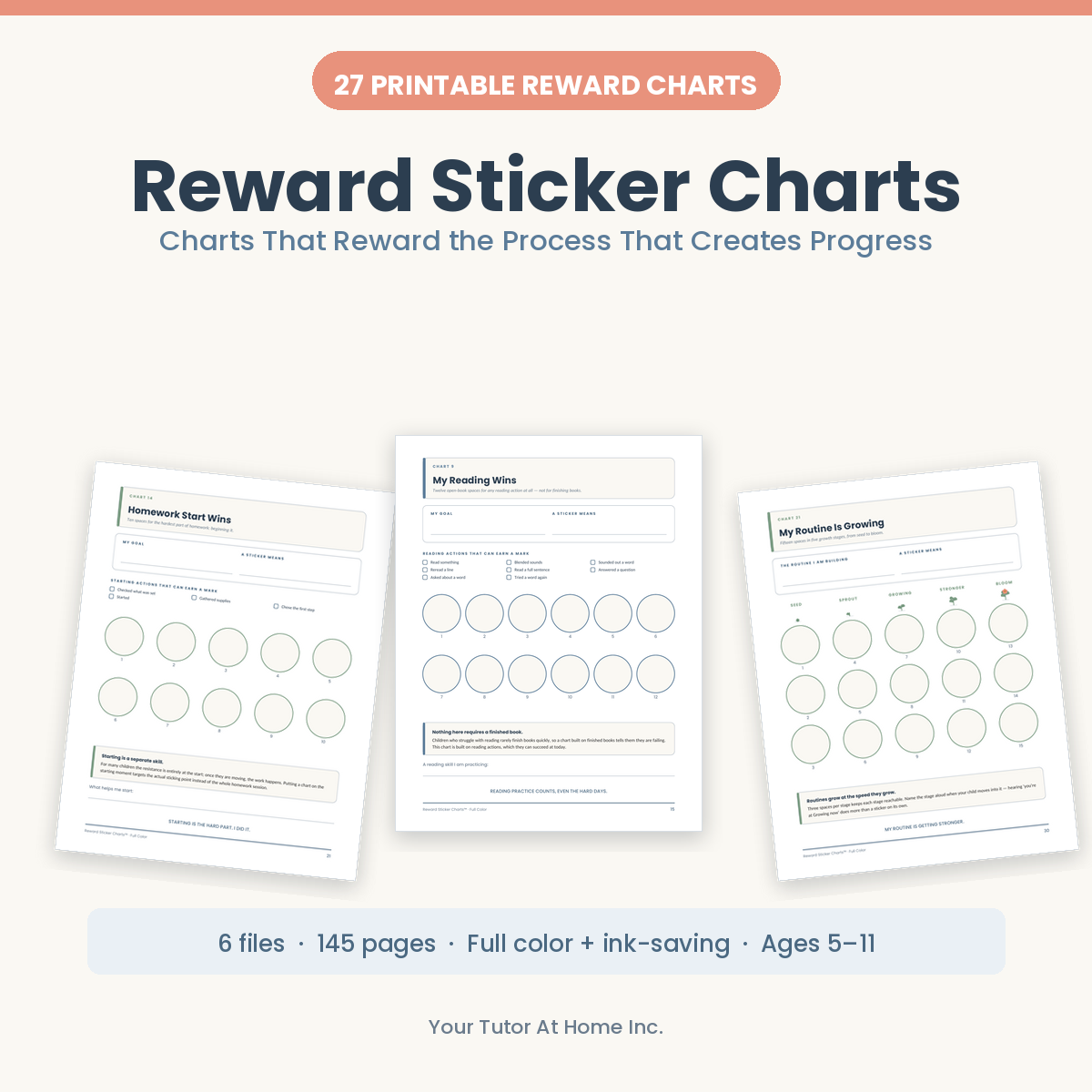
27 printable sticker charts that recognize what your child can actually control — starting, trying again, asking for help, using a strategy, coming back after a break. Reading, homework, focus, routines and confidence. Six files, 145 pages, full color and ink-saving, with a 29-page parent guide. Ages 5–11.
Product Description
Printable Reward Sticker Charts That Recognize Effort, Not Just Results
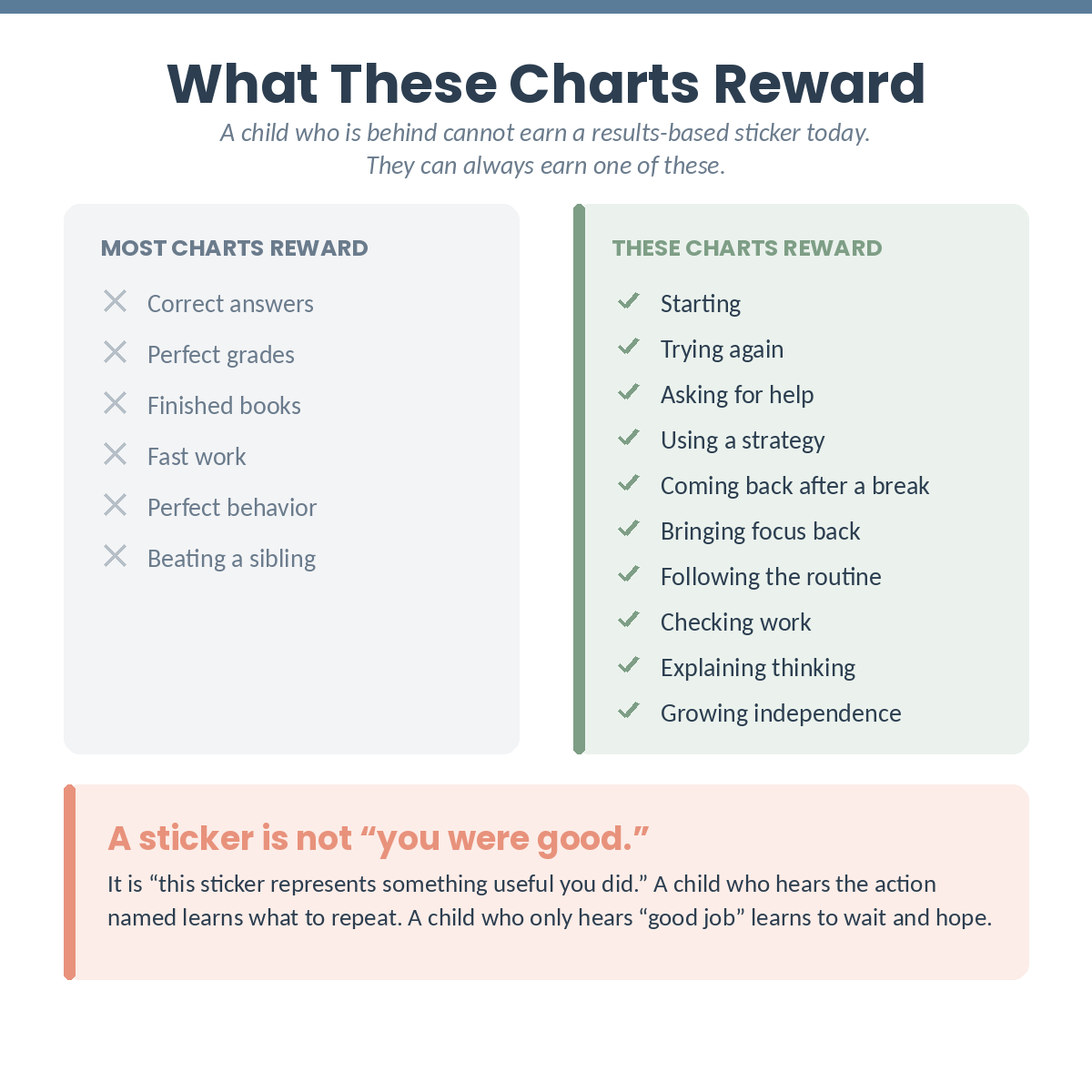
Most sticker charts hand out a sticker for a correct answer, a finished book or a good grade. That works fine for a child who is already keeping up. For a child who is behind, it quietly delivers the opposite message every single day: whatever you did today, it wasn’t enough.
These printable sticker charts do something different. They recognize the actions that create progress — starting, trying again, asking for help, using a strategy, coming back after a break, following the routine. Those are the only parts of learning a struggling child can control today, and they are exactly the behaviors that eventually produce the results.
Built by Mrs. Nathalie, an experienced tutor with more than twenty years supporting struggling readers and children with learning differences, the pack contains 27 themed charts, blank charts you fill in yourself, mini charts for a desk or a book, and everything you need for the moment a chart is finished.
Why These Reward Sticker Charts Work
A sticker on its own means very little. What teaches your child is the sentence you say when you hand it over: “That’s for asking for help.” “You came back after your break.” “You tried that word again.”
Two seconds, one sentence, always naming the action. A child who hears the action named learns what to repeat. A child who only hears “good job” learns to wait and hope.
Everything in this pack is built around one cycle — notice, mark, reflect, grow — and one rule that never bends:
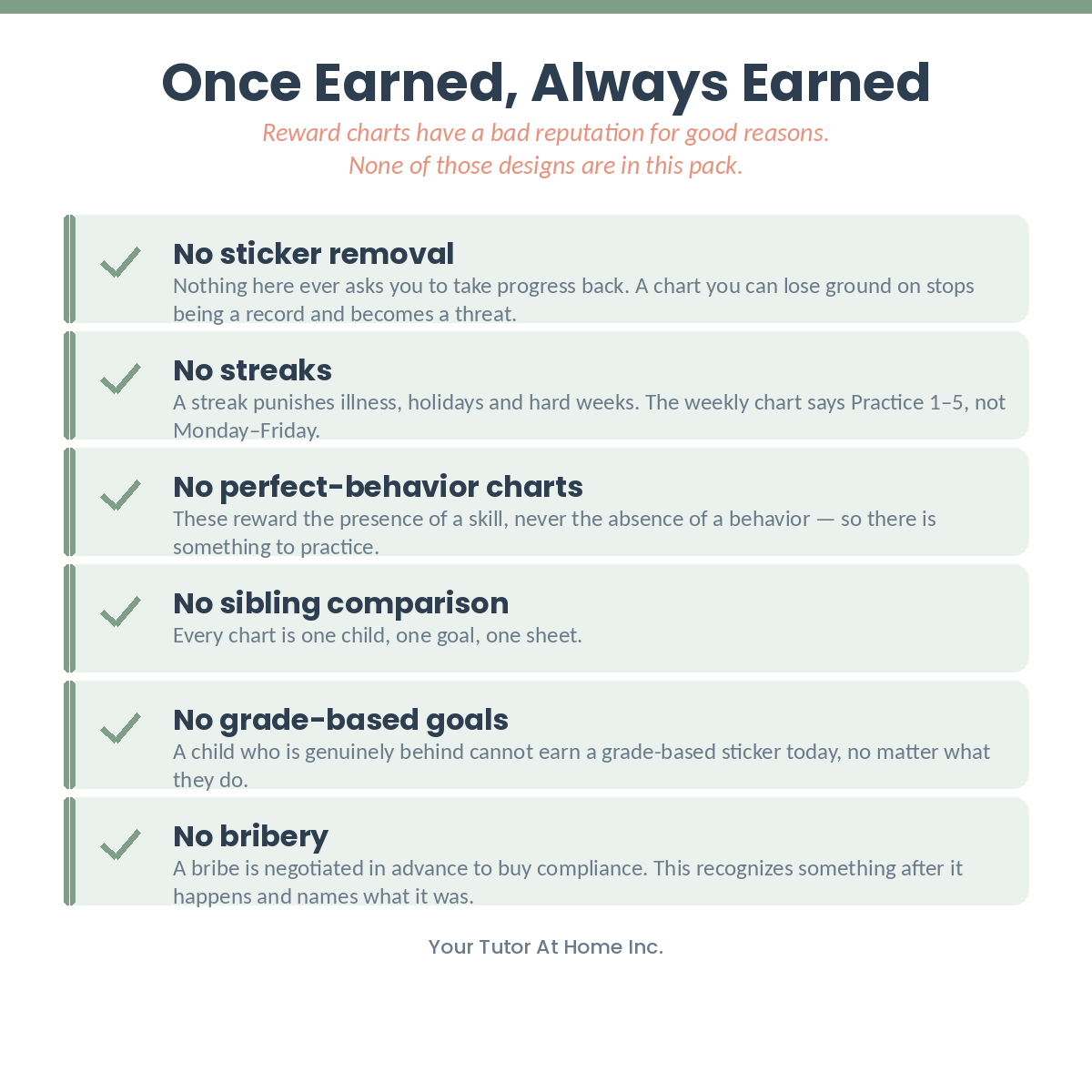
- Once a sticker is earned, it stays earned. Nothing here ever asks you to take progress back. A bad Tuesday does not un-happen a good Monday, and a chart you can lose ground on stops being a record and becomes a threat.
What These Sticker Charts Will Never Do
Sticker charts have a bad reputation, and most of the damage comes from a handful of specific designs. None of them appear here.
- No sticker removal — earned progress is never taken away as a punishment
- No streaks — the weekly chart says Practice 1 to 5, not Monday to Friday, so illness and hard weeks cost nothing
- No perfect-behavior charts — these reward the presence of a skill, never the absence of a behavior
- No sibling comparison — one child, one goal, one sheet
- No grade-based goals — a child who is genuinely behind cannot earn one of those today, no matter what they do
- No bribery — a bribe is negotiated in advance to buy compliance; these charts recognize something after it happens and name what it was
The 27 Themed Sticker Charts
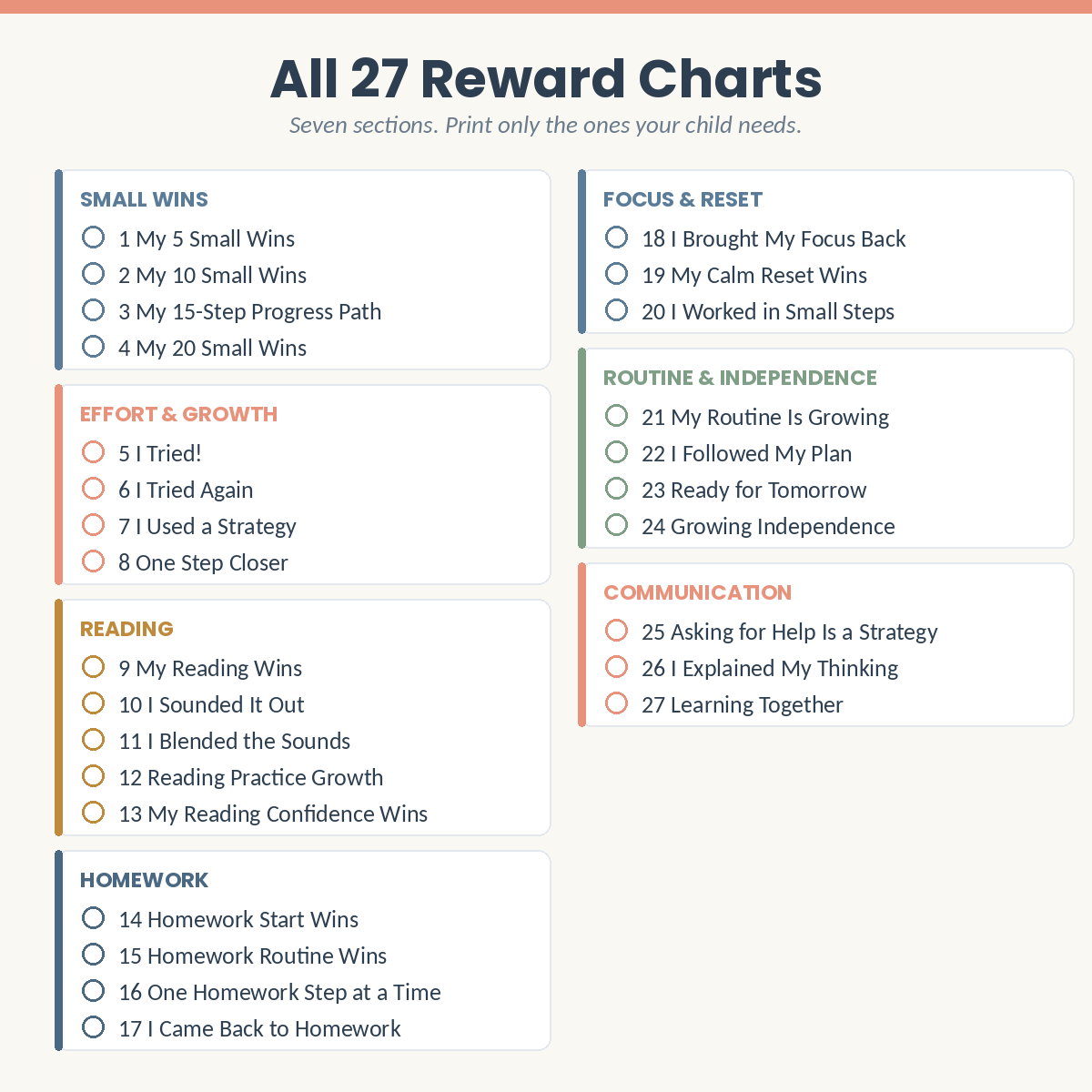
Seven sections of sticker charts. You are not meant to print all 27 — one or two charts used properly will do far more than the whole set admired once.
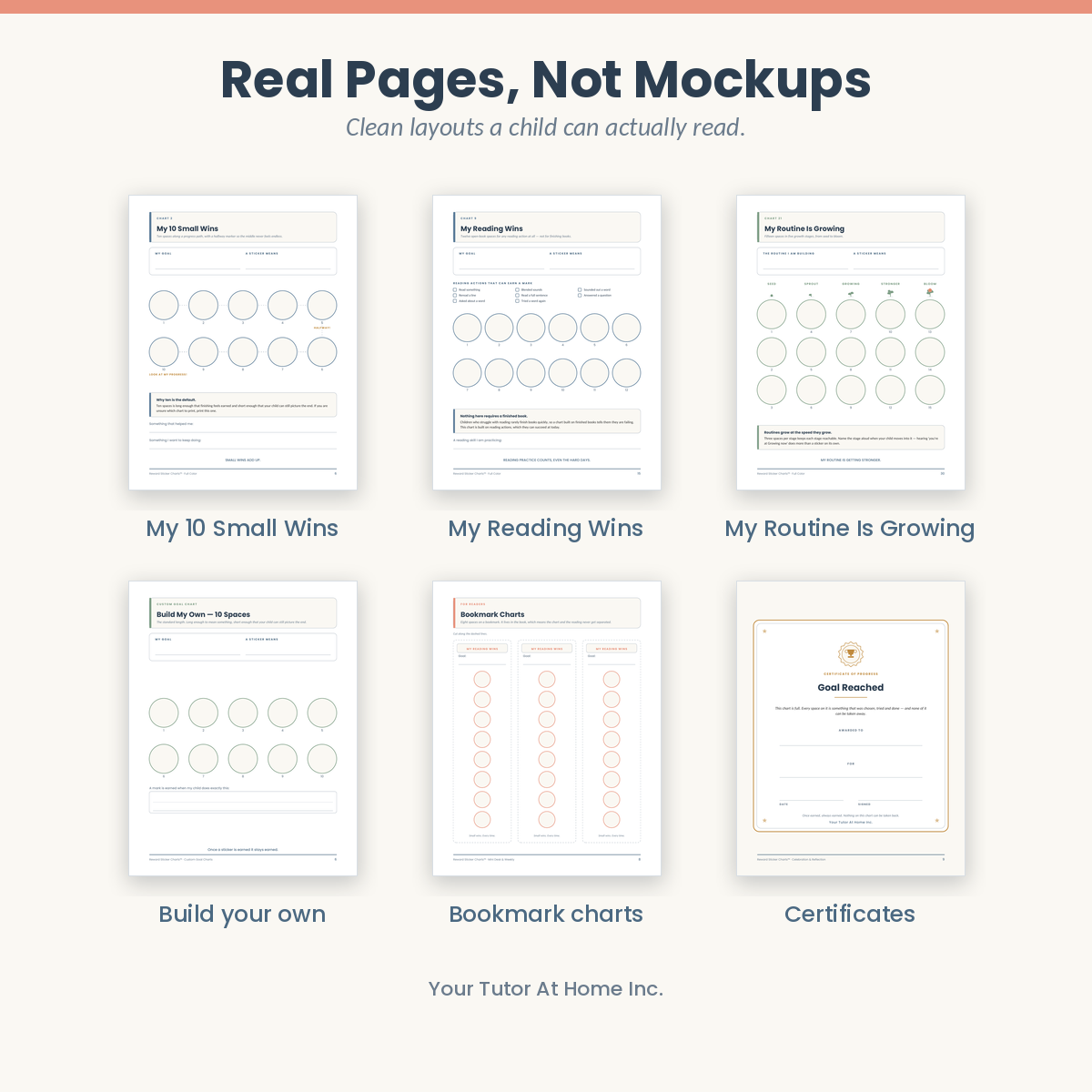
- General small wins (charts 1–4) — 5, 10, 15 and 20-space charts for any goal you choose
- Effort and growth (charts 5–8) — I Tried!, I Tried Again, I Used a Strategy, One Step Closer
- Reading (charts 9–13) — My Reading Wins, I Sounded It Out, I Blended the Sounds, Reading Practice Growth, My Reading Confidence Wins
- Homework (charts 14–17) — Homework Start Wins, Homework Routine Wins, One Homework Step at a Time, I Came Back to Homework
- Focus and reset (charts 18–20) — I Brought My Focus Back, My Calm Reset Wins, I Worked in Small Steps
- Routine and independence (charts 21–24) — My Routine Is Growing, I Followed My Plan, Ready for Tomorrow, Growing Independence
- Communication (charts 25–27) — Asking for Help Is a Strategy, I Explained My Thinking, Learning Together
Sized for Real Stickers, and Deliberately Empty
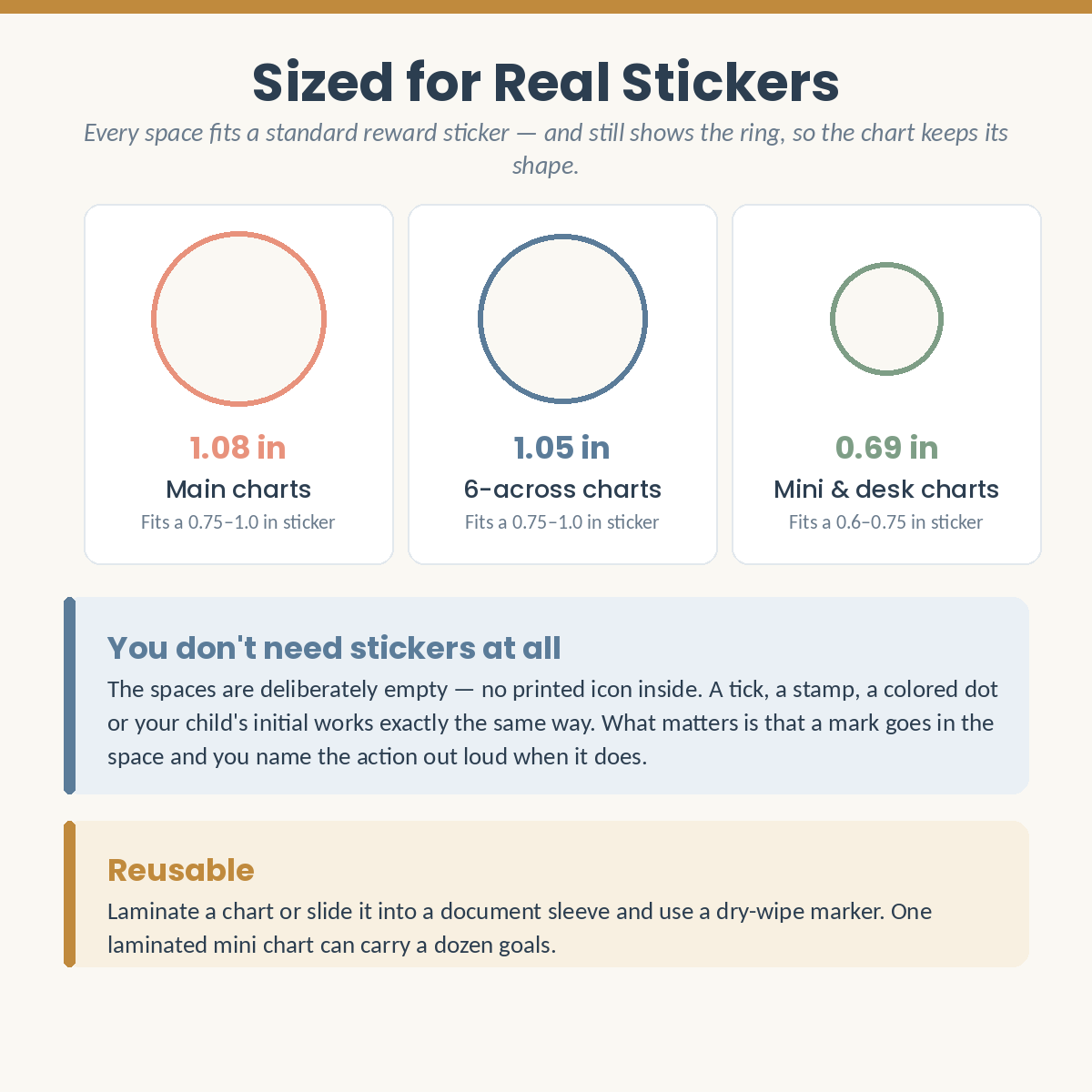
Every sticker space on the main sticker charts measures just over an inch across, which comfortably takes a standard 0.75 to 1.0 inch reward sticker while still leaving the ring visible so the chart keeps its shape. The mini and desk charts use smaller spaces for 0.6 to 0.75 inch stickers.
The spaces are also completely empty — no printed icon inside. That is a deliberate design decision. A sticker would cover an icon anyway, and a child drawing or ticking instead should not have to work around a picture. A tick, a stamp, a colored dot or your child’s initial all work exactly the same way.
The 29-Page Parent Guide
The guide is the part that makes sticker charts help rather than quietly become pressure. It covers how to choose a goal your child can actually hit, how many spaces to use, the exact words to say when you hand over a sticker, and what to do on the days nothing is earned.
It includes three fully worked examples with real dialogue — Amara, age 7, who would not start reading practice; Jonah, age 9, who took forty minutes to get to the homework table; and Ruby, age 10, who asked for breaks constantly and never came back from them. Each one ends with two lines for you to fill in about your own child.
There is also a first-two-weeks plan, scripts for the harder conversations, nine troubleshooting entries, eleven parent questions, and a decision guide that matches fourteen things parents actually say to the chart that fits.
Everything You Download
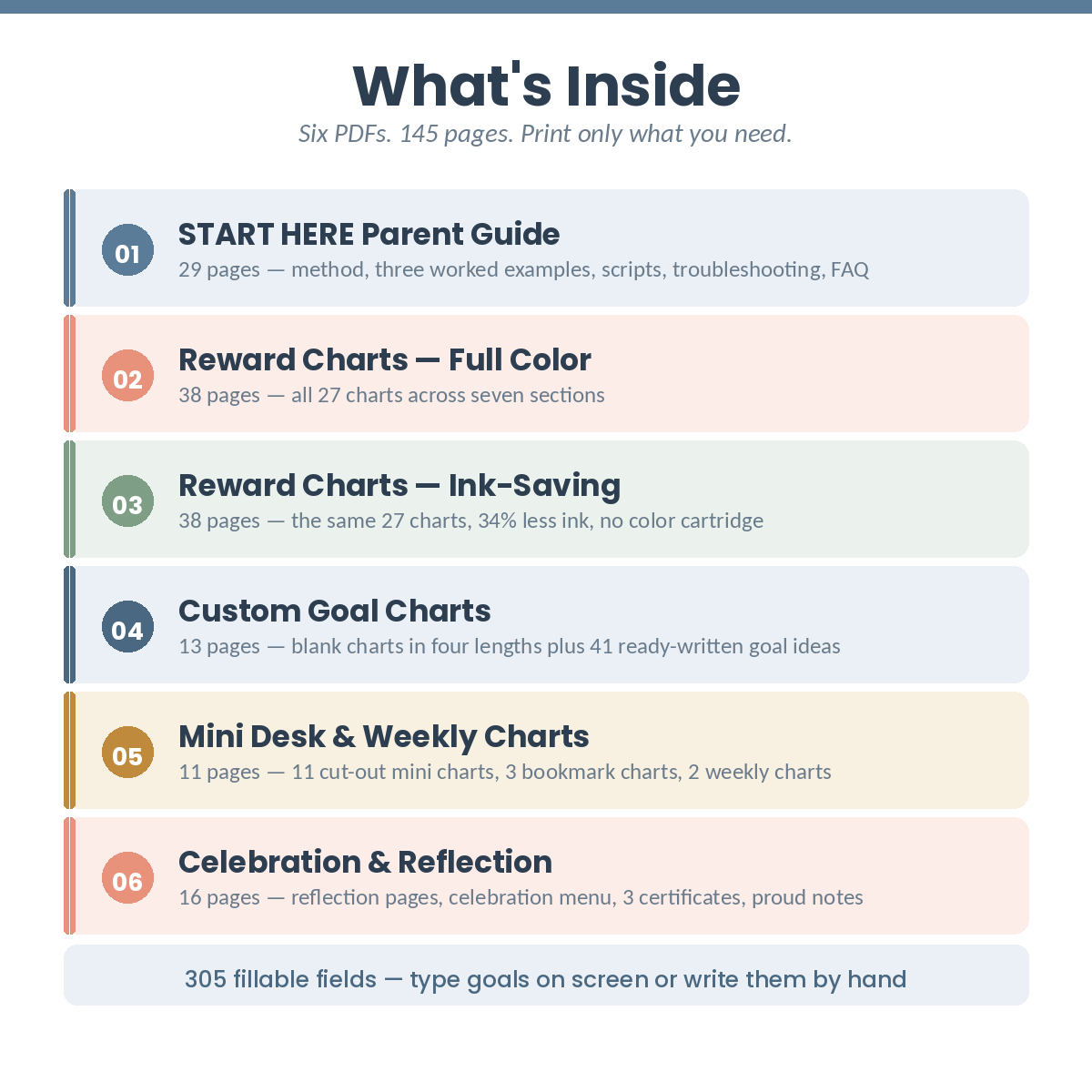
- 01 — START HERE Parent Guide (29 pages)
- 02 — Reward Charts, Full Color (38 pages, all 27 charts)
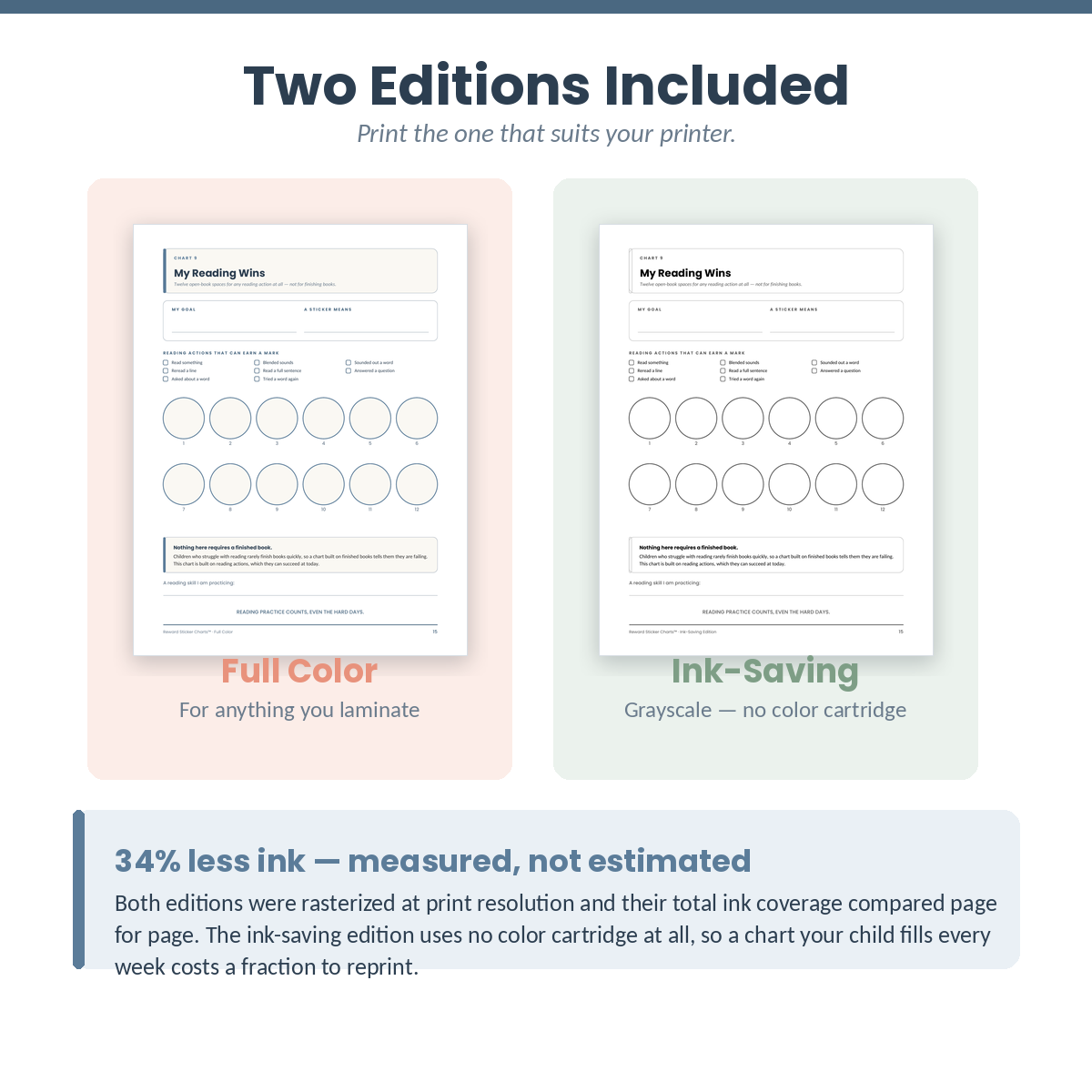
- 03 — Reward Charts, Ink-Saving Edition (38 pages, grayscale)
- 04 — Custom Goal Charts (13 pages, blank charts plus 41 goal ideas)
- 05 — Mini Desk and Weekly Charts (11 pages, cut-out and bookmark charts)
- 06 — Celebration and Reflection (16 pages, certificates and reflection pages)
That is 145 pages of printable sticker charts and supporting material in total, with 305 fillable fields you can type into on screen before printing. The ink-saving edition was measured at 34% less total ink than the color pages and uses no color cartridge at all.
What Happens When Sticker Charts Are Full
Reflection first, celebration second. If a chart ends with a prize, your child learns to want prizes. If it ends with a conversation about what got easier and what helped, they learn to notice their own progress — and that is the part they can carry into a classroom where nobody is handing out stickers.
File 06 covers exactly this for every one of the sticker charts: reflection pages for younger and older children, a celebration menu weighted toward connection and choice rather than spending, three certificates, six cut-out proud notes, and a private page for you.
Who These Sticker Charts Are For
Children roughly aged five to eleven. They are especially useful for the child who gives up the moment something is hard, the child who will not start, the child who takes a break and never returns, and the child who has quietly decided they are bad at reading.
These sticker charts are motivation and tracking tools, not a diagnostic or therapeutic product. If your child’s learning difficulty is persistent or causing real distress, these charts belong alongside — never instead of — a conversation with their teacher or a qualified specialist. For background reading, Understood.org and Reading Rockets both maintain excellent free parent libraries, and the CDC publishes plain-language guidance on children’s developmental wellbeing.
Where This Fits
These sticker charts are the tracking system. The Calm Learning Motivation Sticker Pack™ supplies the printable stickers that go on them — the two are built as companions. If homework planning is your sticking point, the Calm Homework Planner™ decides what the work is and what order it happens in, while chart 15 recognizes your child running that routine. If breaks are the problem, Focus Break Cards™ pair directly with charts 17 and 19. You can also browse the full range of learning resources.
Download the pack, read the first few pages of the guide, print one chart, and tell your child exactly what earns a mark before the first sticker goes on.


Reviews
There are no reviews yet.