
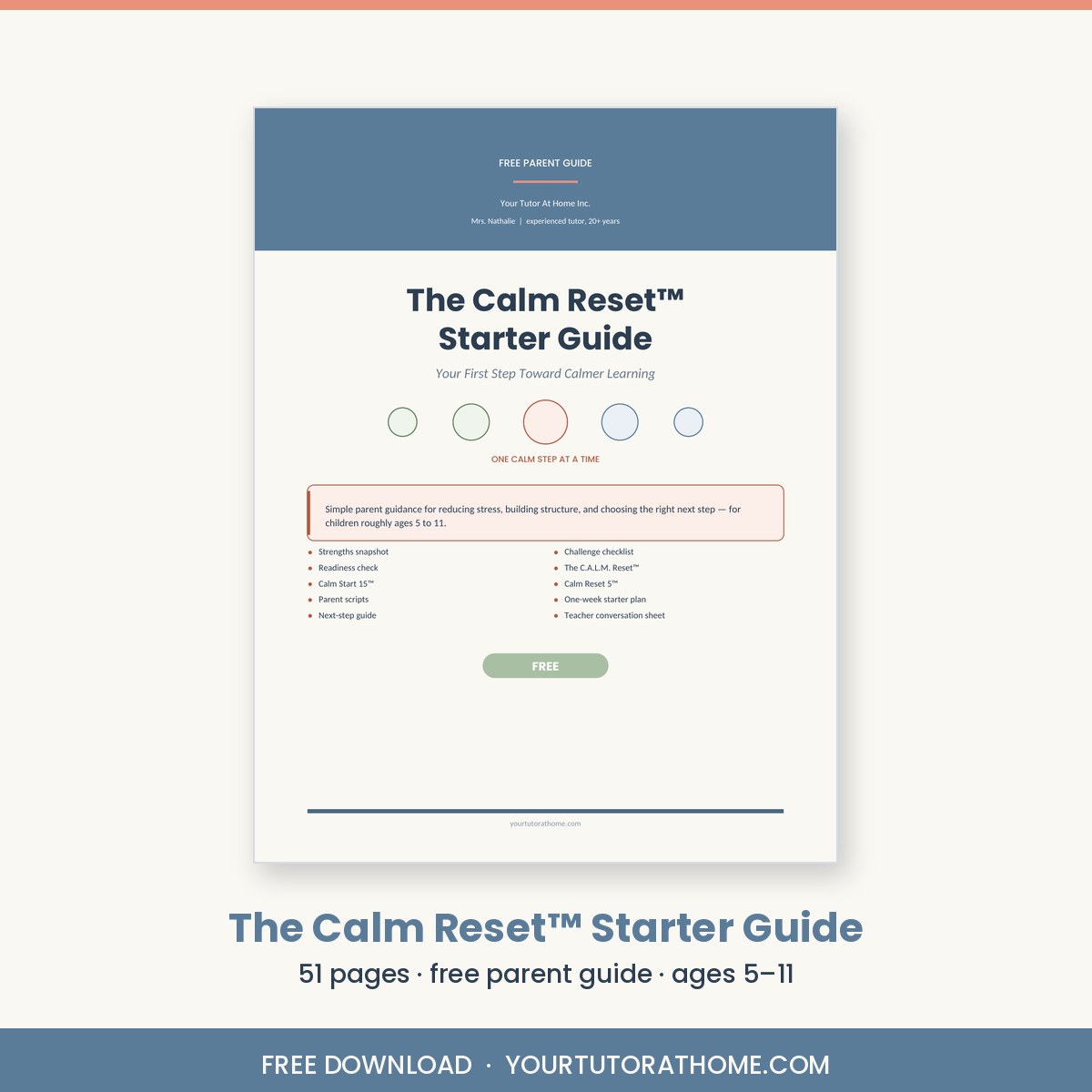
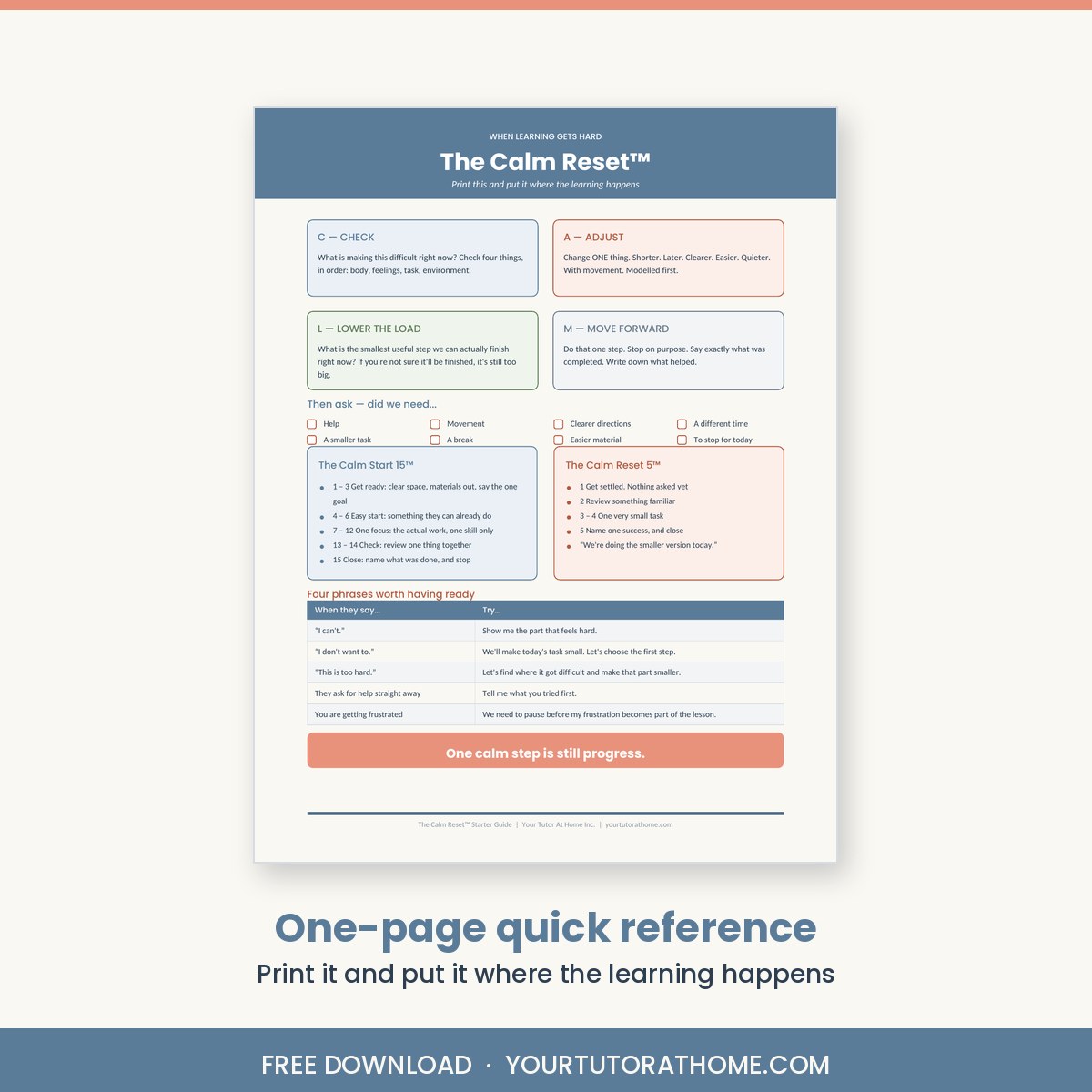
The Calm Reset™ Starter Guide
$0.00
Not sure where to start? Begin here.
If reading, homework, focus or routines have become stressful, this free calm learning at home guide helps you work out which problem is worth solving first — usually the reason the last few things you tried did not stick.
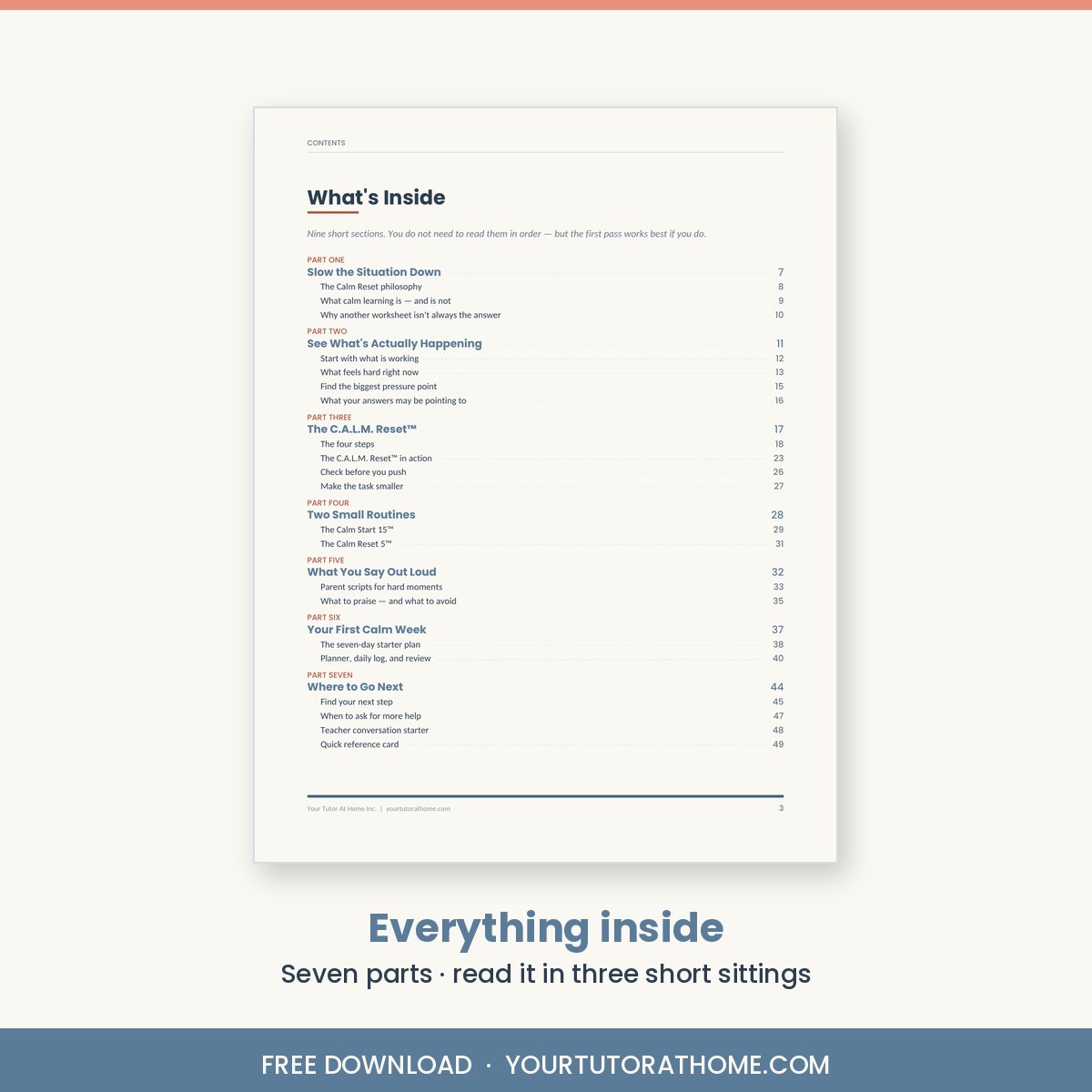
- 51 pages · seven short parts · US Letter
- Strengths snapshot first, difficulties second
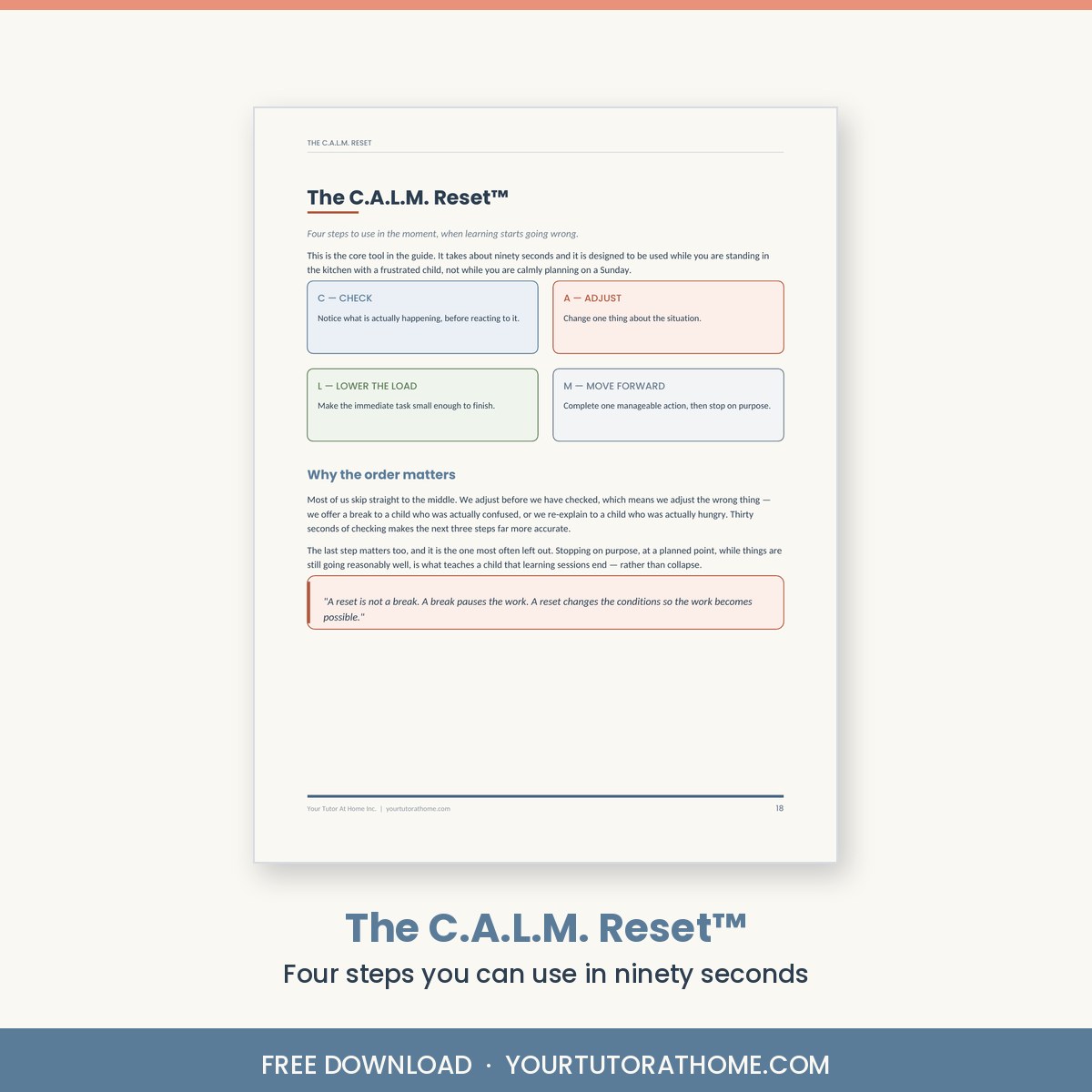
- The C.A.L.M. Reset™ — a four-step framework for hard moments
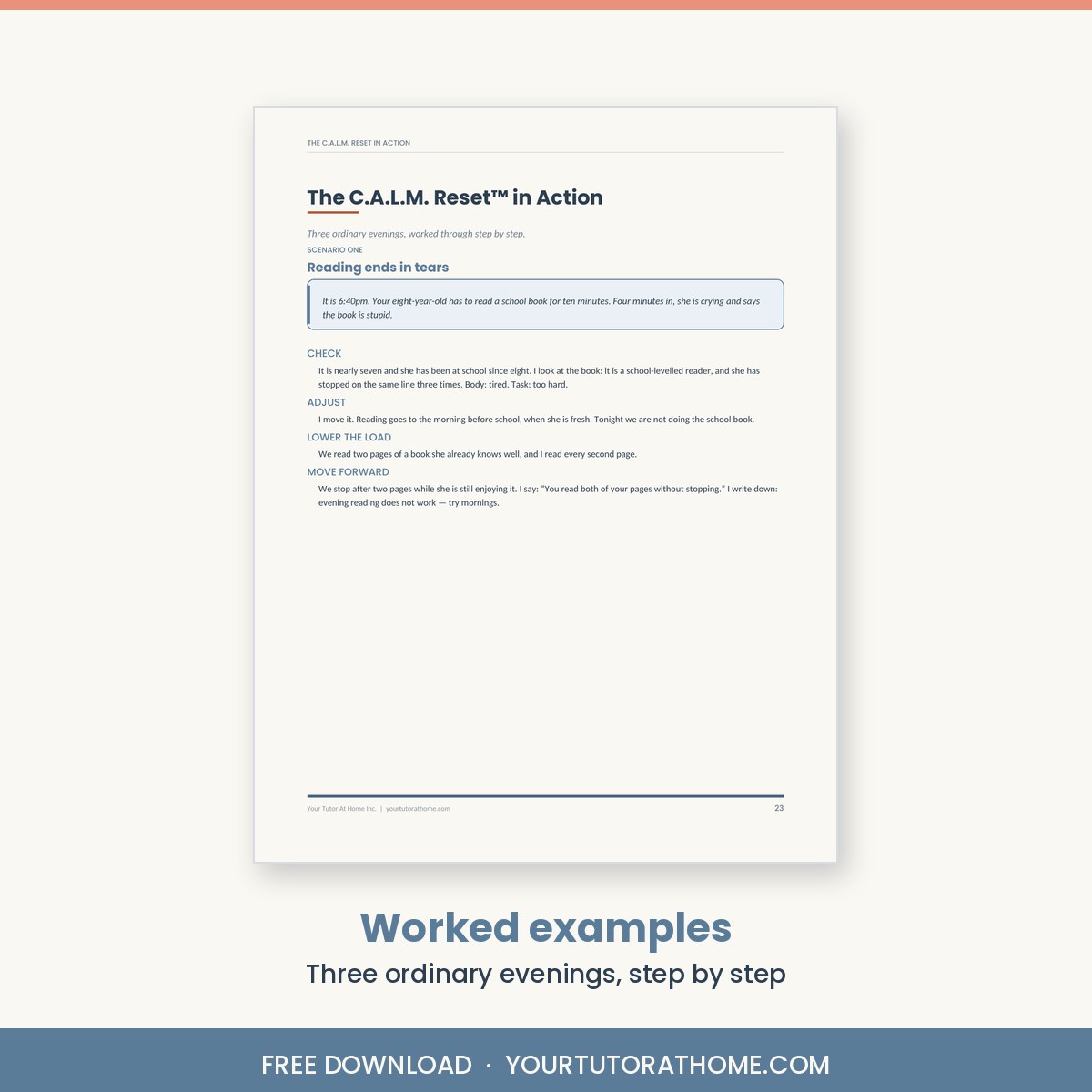
- Three fully worked examples from real evenings
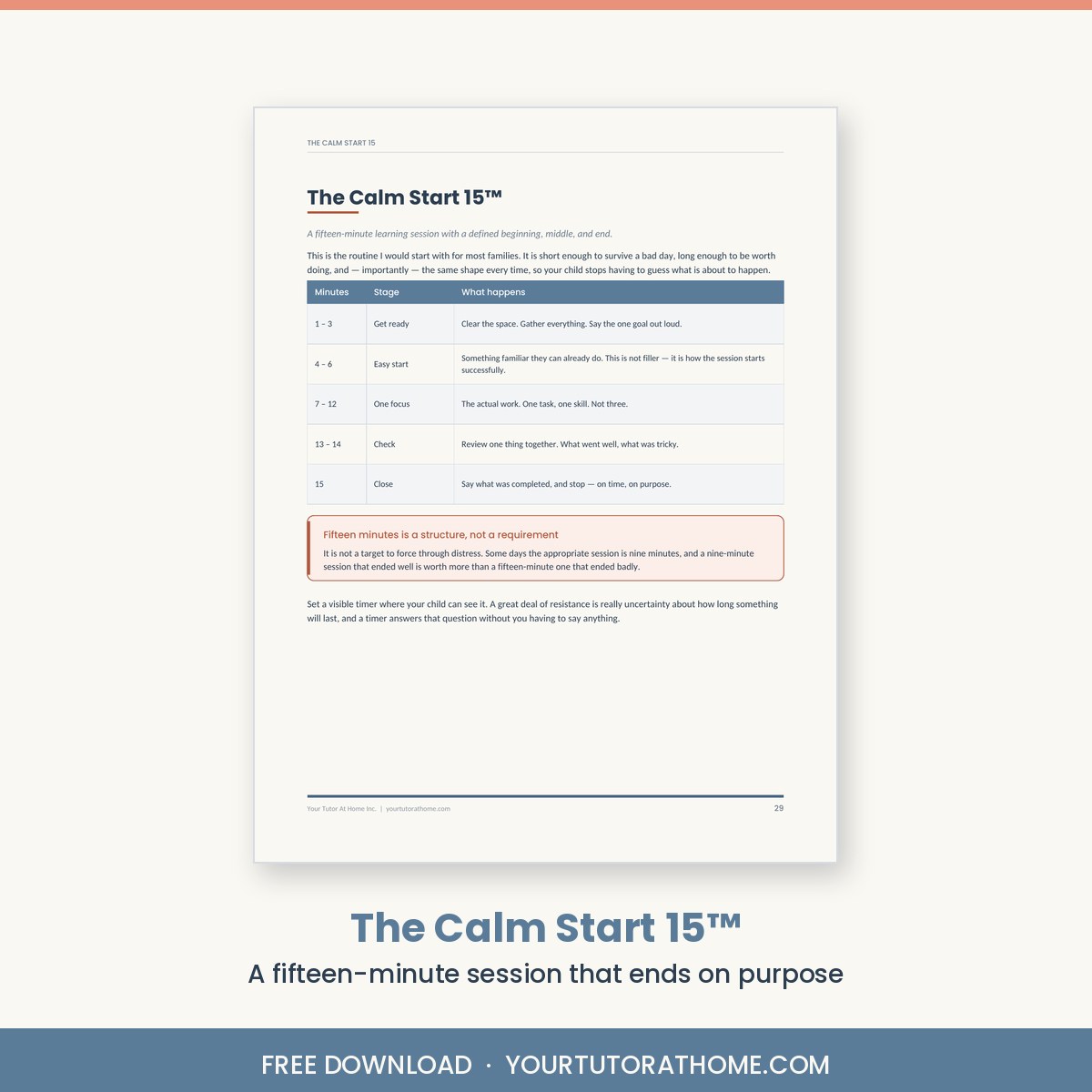
- The Calm Start 15™ and the Calm Reset 5™ routines
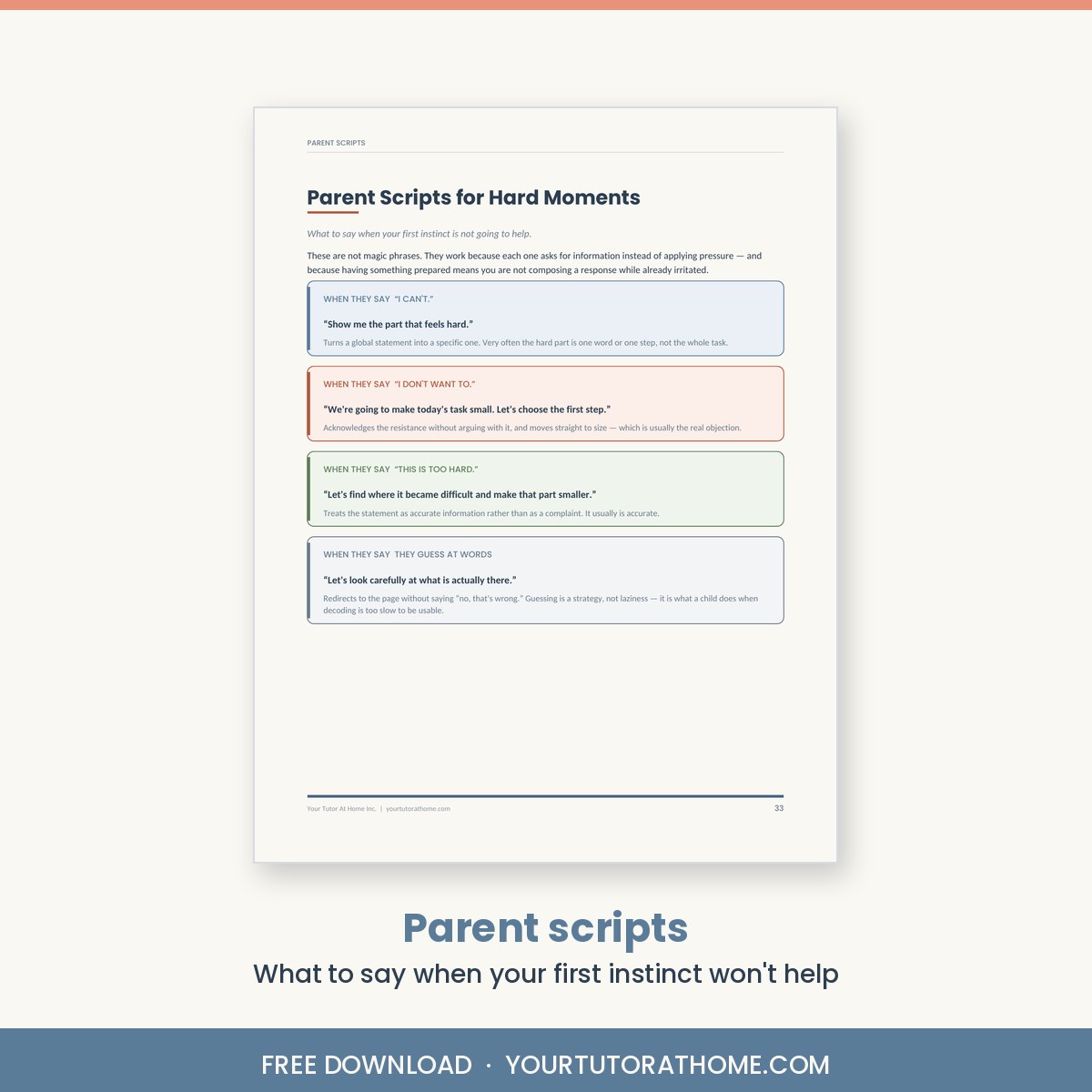
- Eight parent scripts, a seven-day plan and a weekly planner
- Next-step guide and a teacher conversation sheet
- Digital fillable, full-colour print and ink-saving editions
Free download. No cost, no catch.
Product Description
Most parents reach the same point eventually: everything about learning has become an argument, and nobody can remember when it started. You have tried worksheets, reminders, sitting beside them, a new schedule — and it is still hard. This free guide exists because calm learning at home rarely fails for the reason parents assume.
It usually fails because the effort is aimed at the wrong layer of the problem. A child who cannot yet blend sounds will look like a child who will not concentrate. A child asked for forty minutes when they have twelve in them will look like a child who argues about everything. More practice does not fix either situation — it repeats it.
What this guide covers
- Why calm learning at home breaks down
- Starting with strengths, not problems
- Finding your biggest pressure point
- The C.A.L.M. Reset™ framework
- Two routines: fifteen minutes and five
- Parent scripts for hard moments
- How to start calm learning at home this week
- What is inside the download
- What calm learning at home is not
- Common questions
Why calm learning at home breaks down
There are three completely different problems that look identical from the kitchen table, and each one needs a different response.
- A skill gap. Your child genuinely cannot do it yet. The material sits above their current level, or a foundation step was missed. Repeating the same task will not close that gap.
- A load problem. Your child can do it, but not this much of it, not at this time of day, not with a sibling in the room, and not without a visible finish point. Shorten it or move it and the same child performs.
- A confidence problem. Your child can do it and knows they can, but has failed publicly enough times that avoiding it feels safer than trying. Here the first job is a run of easy wins, not a harder push.
Most families I have worked with have already spent money in the wrong category — not on a bad resource, but on a good one aimed at a problem their child did not have. Working out which of the three you are looking at is the single highest-value thing you can do this month, and it is where calm learning at home actually begins.
Starting with strengths, not problems
The first checklist in the guide is not a list of difficulties. It is fourteen things your child may already do well: listening to stories, remembering everything about a favourite subject, explaining ideas out loud, learning better when shown first, working well in short bursts.
This is not padding. Every adjustment in calm learning at home works better when it is built on something that already works, and strengths quietly tell you where the difficulty is not. A child who explains ideas beautifully out loud but freezes when writing is showing you something specific about where to intervene.
Finding your biggest pressure point
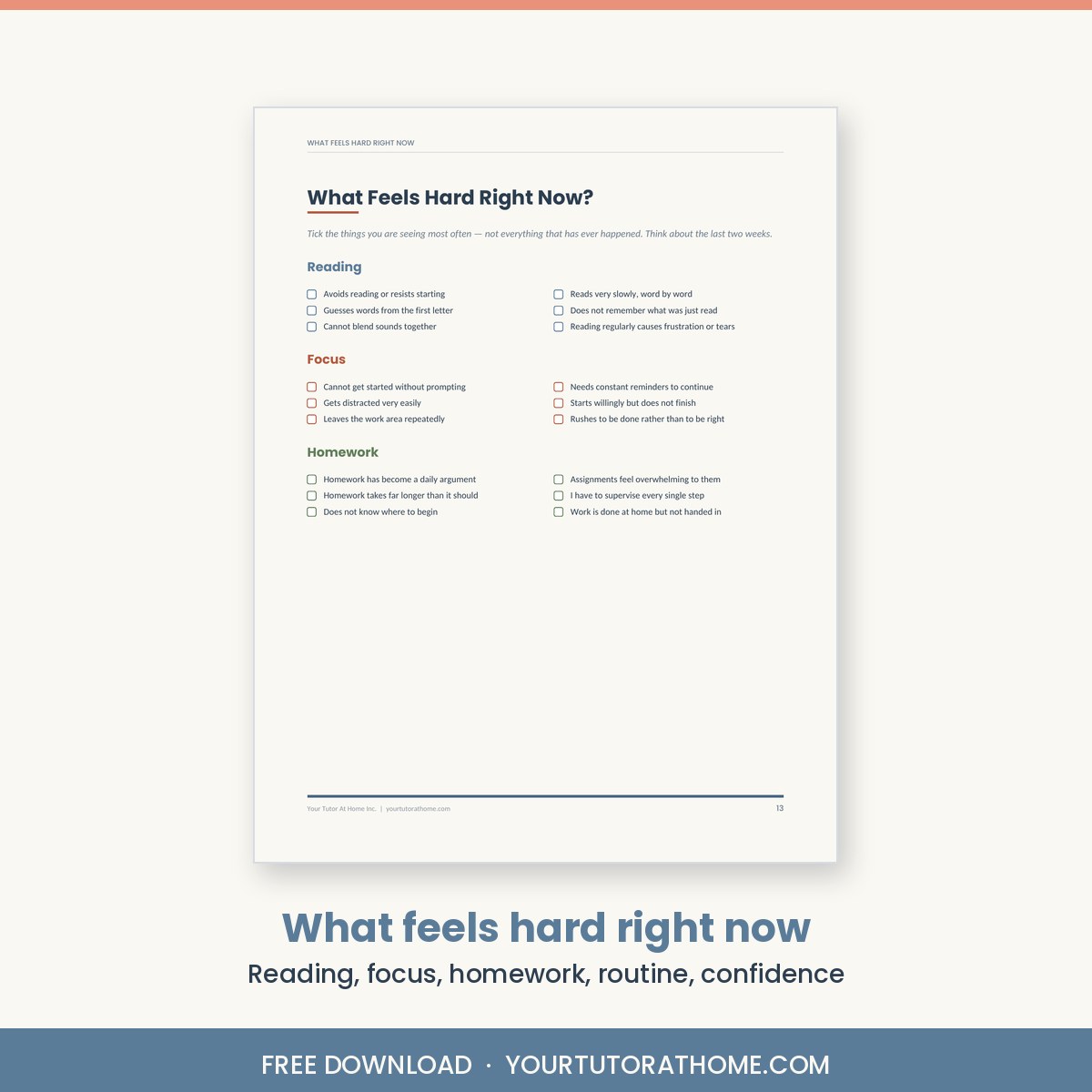
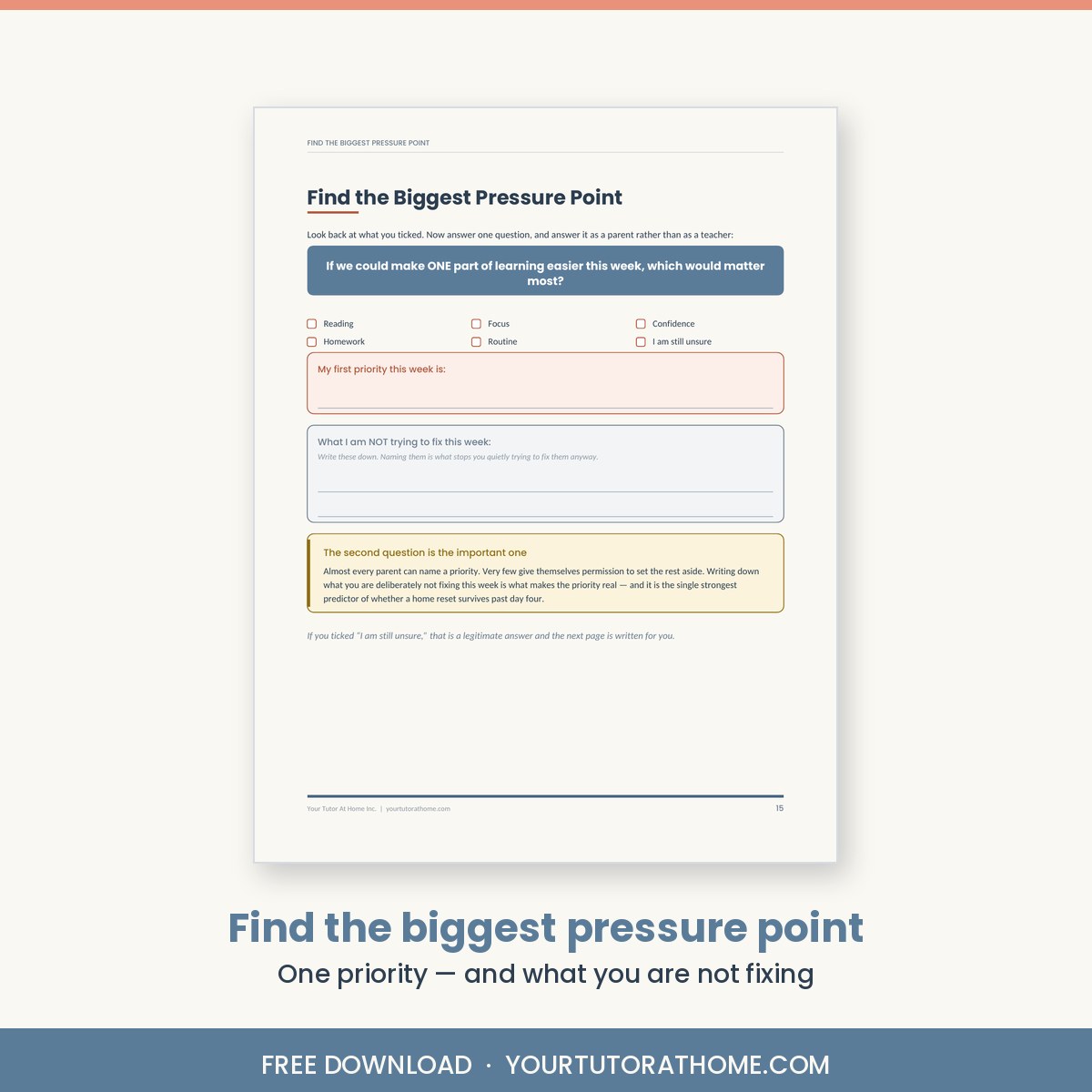
The guide then walks you through five areas — reading, focus, homework, routine and confidence — with the behaviours to tick under each. You finish by naming one priority, and then writing down what you are deliberately not fixing this week.
That second question is the one that matters. Almost every parent can name a priority. Very few give themselves permission to set the rest aside, and in my experience it is the strongest single predictor of whether calm learning at home survives past day four.
The C.A.L.M. Reset™ framework
The core tool of calm learning at home takes about ninety seconds and is designed to be used standing in the kitchen with a frustrated child, not while planning calmly on a Sunday.
- C — Check. What is making this difficult? Body, feelings, task, environment — in that order.
- A — Adjust. Change one thing. Shorter, later, clearer, easier, quieter, modelled first.
- L — Lower the load. What is the smallest useful step you can actually finish right now?
- M — Move forward. Do that one step, stop on purpose, and say exactly what was completed.
Three fully worked examples follow — reading that ends in tears, homework that becomes an argument, and a six-year-old who says “I can’t” before anything has started. Each is walked through step by step, showing what the adult actually said and did.
Two routines: fifteen minutes and five
The Calm Start 15™ is a fifteen-minute session with a defined beginning, middle and end: get ready, easy start, one focus, check, close. It is short enough to survive a bad day and always the same shape, so your child stops having to guess what is about to happen.
The Calm Reset 5™ is the version for hard days, and it is the reason calm learning at home survives a difficult week. Five minutes keeps the habit alive, which over a school term matters far more than any single long session.
Parent scripts for hard moments
Eight prepared responses for the moments when your first instinct will not help — including what to say when you are the one becoming frustrated. Each one asks for information instead of applying pressure — which is the whole principle of calm learning at home, reduced to a single sentence. Each comes with a short note on why it works.
How to start calm learning at home this week
The guide closes with a seven-day plan for putting calm learning at home into practice: observe, prepare, make it smaller, run the routine, practise one script, review, plan. Roughly fifteen minutes a day, nothing to buy. A weekly planner, a daily reset log and an honest end-of-week review are all included as fillable pages.
If you miss a day, you skip it and carry on. There is no catch-up marathon. The families who succeed are not the ones who never miss — they are the ones who miss a day and then simply do the next one.
What is inside the download
- Digital fillable edition — 51 pages, type into every box, tappable contents.
- Full-colour printable edition — 51 pages, US Letter.
- Ink-saving printable edition — the same pages using almost no coloured ink.
- Calm Reset™ Quick Reference Sheet — a one-page card for the fridge or desk.
- My First Calm Week Planner — a reusable three-page planner, daily log and review.
Every edition covers the same calm learning at home approach, written for parents and caregivers of children roughly ages 5–11, including neurodivergent learners and children who have been struggling for a long time.
What calm learning at home is not
Calm learning at home does not mean no expectations, no boundaries, no practice, or never feeling frustrated. In practice this approach is usually more structured than what came before it: the task is defined, the length is defined, the ending is defined. What is removed is the ambiguity and the escalation, not the work.
This guide is also an educational tool, not an assessment. There is no score and no result. Nothing here can tell you whether your child has dyslexia, ADHD, a language difficulty or anything else. If your concerns are persistent or are affecting school progress or emotional well-being, speak to your child’s teacher or another qualified professional. Organisations such as Understood, Reading Rockets and the CDC publish reliable background reading.
Common questions
How long does it take? You can be doing calm learning at home within a day. Around three short sittings in total: Twenty minutes for the checklists, fifteen for the framework, then you use it during the week.
Fifty-one pages sounds like a lot. It is a guide, not homework. The delivery email tells you exactly which two pages to open first, and you can be usefully underway inside twenty minutes.
What if I tick boxes in every section? That is normal and not a measure of severity. Difficulties spread — one root cause shows up as four symptoms, which is exactly why calm learning at home starts with finding the root rather than treating each symptom.
Do I need to print it? No. The fillable edition lets you type into every field and save it. The ink-saving edition exists so that printing does not cost a fortune.
What happens after the week? The final section matches what you found to a sensible next step, so calm learning at home continues past day seven. If one area stands out, something like Calm Homework Reset System™ or Focus & Attention™ may fit. If several areas are connected, The C.A.L.M. Learning Method™ is the complete parent-led system. You are never asked to buy anything to use this guide.
What does it cost? Nothing. Enter your email, download the files, and use them with the children in your own home for as long as they are useful.
Created by Mrs. Nathalie, an experienced tutor with more than twenty years of work alongside struggling readers, neurodivergent learners and children of every learning style. Everything she publishes rests on the same calm learning at home principle: one clear task, reasonable support, and a visible ending. Browse the rest of the library in the full shop when you are ready.


Reviews
There are no reviews yet.