
Focus & Attention™
$27.00
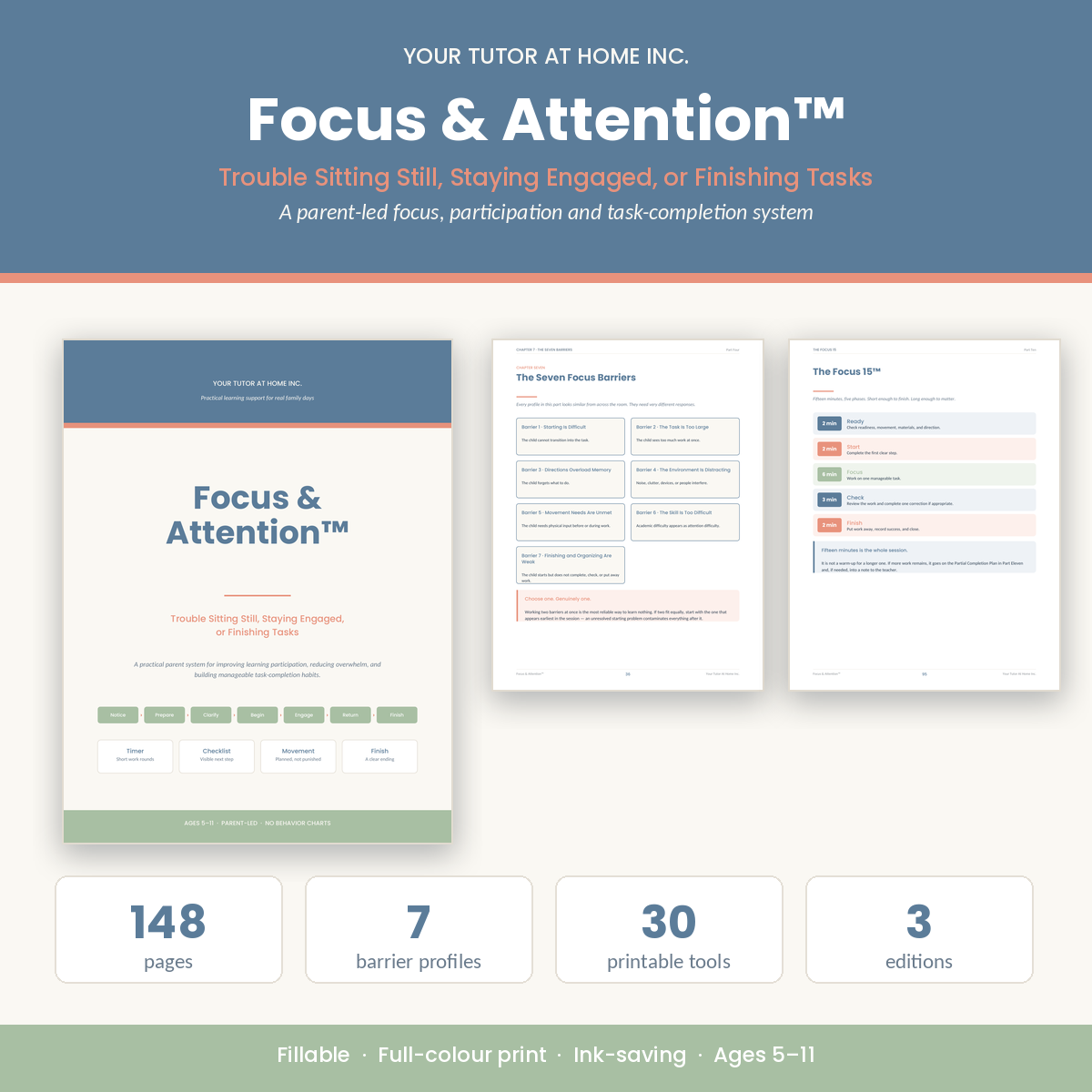
Your child may not need more reminders. They may need a clearer first step, a smaller task, fewer distractions, or a planned way to move and return. Focus & Attention™ is a 148-page parent system for finding what is actually disrupting focus and attention — then building routines your child can begin, stay with, and finish. Fillable, full-colour and ink-saving PDFs. Instant download, ages 5–11.
Product Description
Is your child not lazy, but stuck?
“Sit down.” “Pay attention.” “Stop moving.” “Finish your work.”
You have probably said all four this week. You may have said all four before breakfast. And you have almost certainly noticed that saying them again changes very little. If focus and attention are a nightly battle in your house, more repetition is not the missing piece.
That is not because your child is ignoring you, and it is not because you are saying it wrong. A reminder tells a child to do something. It does not teach them how to begin, how to hold a direction in mind, how to come back after a distraction, or how to recognise that a task is actually finished.
Jump to:
Why focus and attention break down ·
Your child is not being difficult ·
What is inside ·
The F.O.C.U.S. Framework™ ·
The Focus 15™ ·
Who this is for ·
Three editions ·
An honest note
Why focus and attention break down
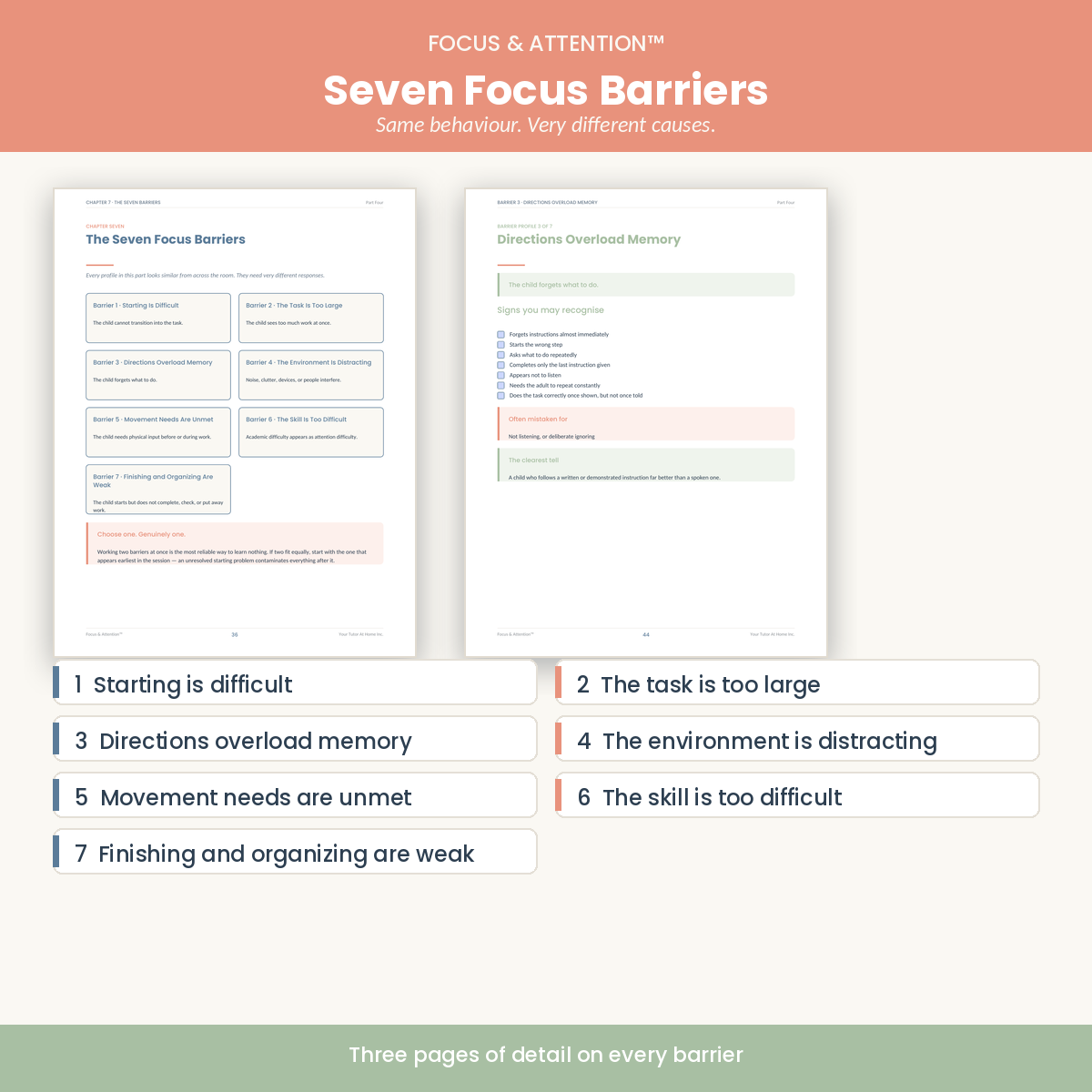
Here is what makes this so hard to solve: the same outward behaviour has at least seven different causes. A child may look unfocused because the activity is too difficult, the directions are too long, the environment is distracting, the body needs movement, or the task demands more working memory than they can currently hold.
Five causes. One picture. Completely different solutions.
This matters enormously, because the wrong solution makes things worse. Adding pressure to a child who cannot read the worksheet does not build focus and attention. It builds avoidance.
Your child is not being difficult
“He can play that game for two hours, so he clearly can focus when he wants to.”
It feels like proof of choice. It is not. It is a difference in task design. Preferred activities give immediate feedback, short levels, visible goals and almost no writing. Homework offers delayed rewards, long pages, genuine difficulty and a real fear of being wrong.
The good news is that several of those design features can be borrowed. Short levels become short work rounds. Visible progress becomes a checklist. A clear goal becomes a finish point. This system helps you build all three. Organisations such as Understood make the same point: what looks like a motivation problem is very often a skills problem wearing a motivation costume.
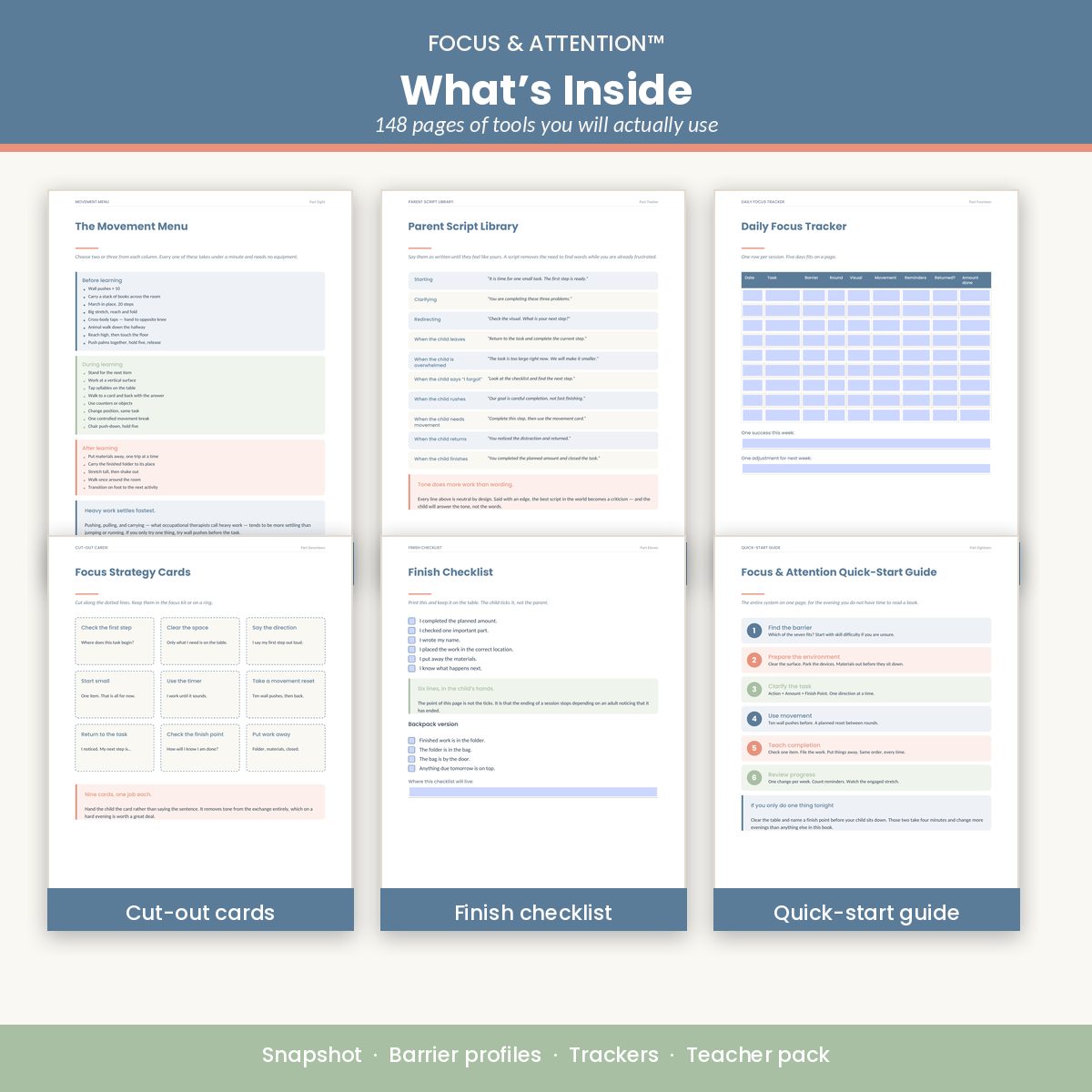
What is inside the Focus and Attention system
Every part points back at one question: what is disrupting focus and attention for this particular child, in this particular house?
- Part One — Understand focus. Why focus and attention are not the same as sitting still, why games hold attention when homework does not, and the seven separate parts of attention.
- Part Two — The snapshot. A three-stage observation checklist covering before, during and after a task, plus a focus history page you will be glad to have if you ever meet a specialist.
- Part Four — The seven barriers. Three full pages on each: signs you may recognise, what often helps, what it is commonly mistaken for, what the first week realistically looks like, and a five-day decision log.
- Part Five — Observe objectively. Attention duration, reminder and completion logs, with a worked example showing the same six-minute session written as a feeling and then as a record.
- Parts Six to Eight — Environment, directions, movement. A distraction audit, a device plan, the Action + Amount + Finish Point formula, a movement menu, and visual supports that replace spoken reminders.
- Parts Nine to Eleven — Begin, engage, return, finish. The task-starting routine, the Two-Minute Start, short work rounds, the return-after-distraction sequence, and the Independence Ladder.
- Parts Twelve to Eighteen. A parent script library, a four-week plan, six trackers, eight troubleshooting chapters, a teacher communication pack, thirty printable tools, cut-out cards and forty five-minute activities.
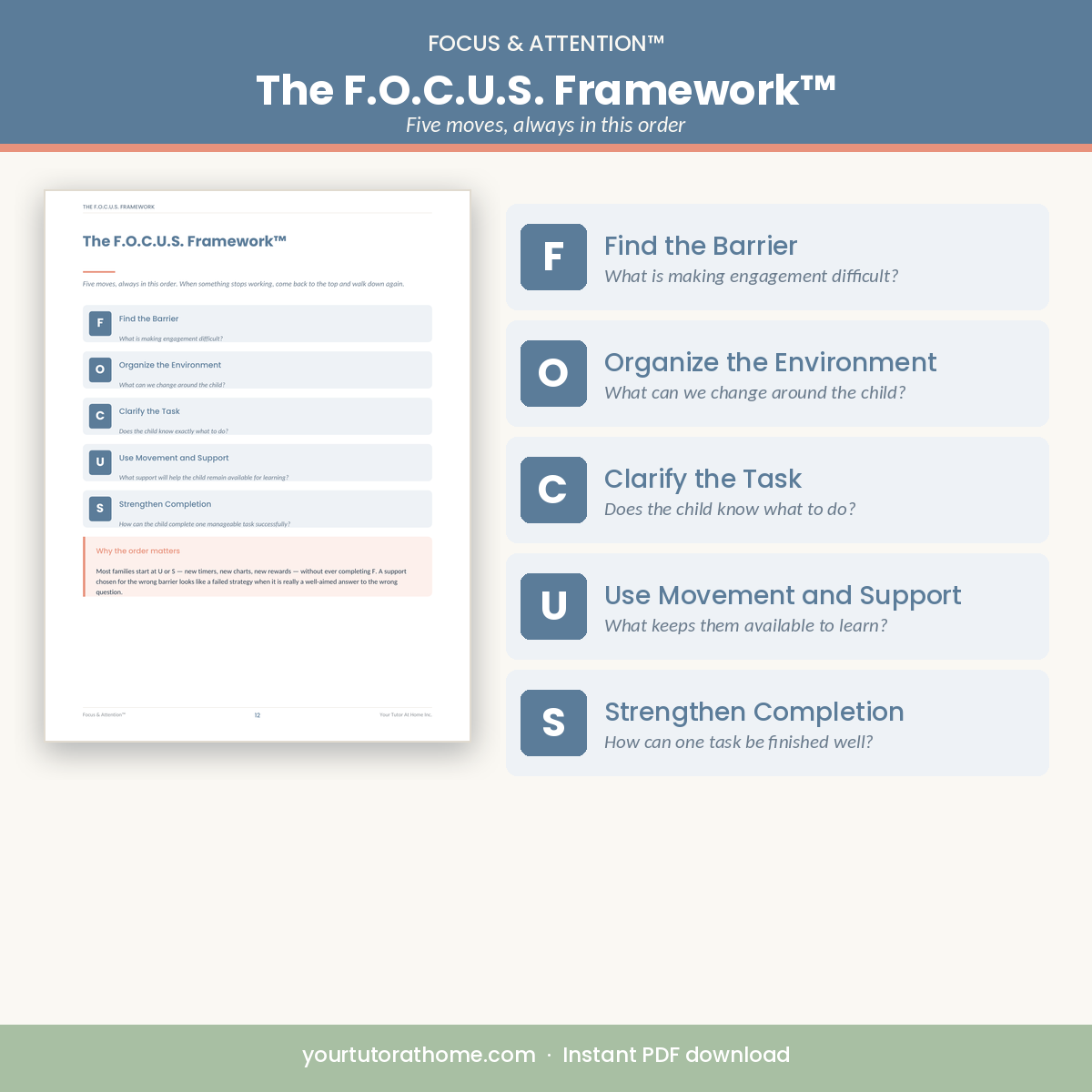
The F.O.C.U.S. Framework™
Five moves, always in this order:
- F — Find the barrier. What is making engagement difficult?
- O — Organize the environment. What can we change around the child?
- C — Clarify the task. Does the child know exactly what to do?
- U — Use movement and support. What keeps them available for learning?
- S — Strengthen completion. How can one manageable task be finished well?
Most families start at U or S — new timers, new charts, new rewards — without ever completing F. A support chosen for the wrong barrier looks like a failed strategy when it is really a good answer to the wrong question. Work the five letters in order and your focus and attention plan stops being guesswork.
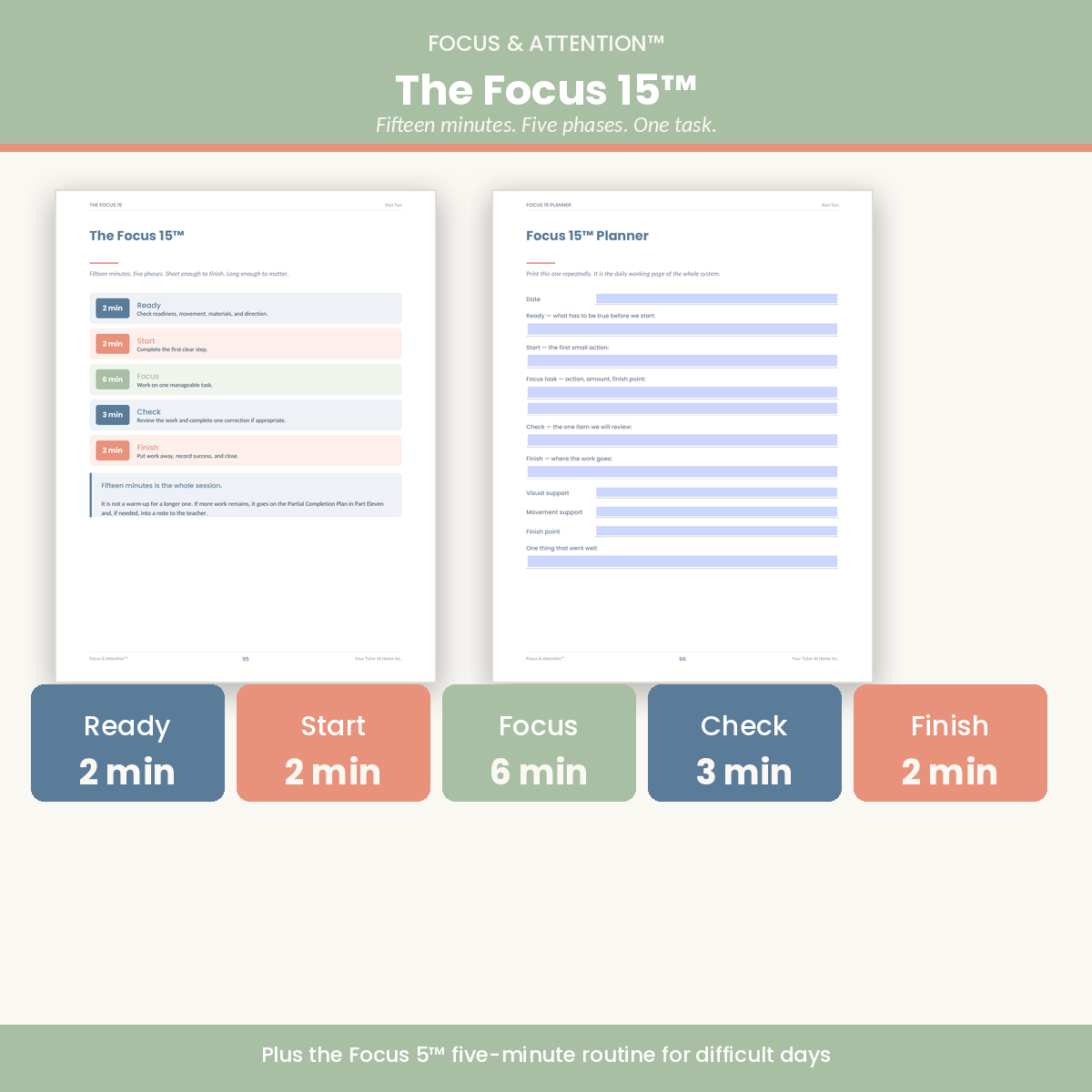
The Focus 15™ routine
Fifteen minutes. Five phases. One manageable task.
Ready (2 min) · Start (2 min) · Focus (6 min) · Check (3 min) · Finish (2 min).
There is also the Focus 5™ — a five-minute version for illness, exhaustion, upheaval, or an evening that has already gone wrong. Because a smaller completed task is more useful than a larger unfinished battle. Both routines are built to protect focus and attention rather than test it. For the reading-specific version of this idea, Reading Rockets has a large free library on short, structured practice at home.
Who this is for
This is built for parents of children aged 5–11 who:
- Have trouble sitting still or leave the learning area repeatedly
- Start tasks but do not finish them
- Need reminder after reminder
- Forget directions partway through
- Rush, or stare at the page without beginning
- Become overwhelmed by a full worksheet
- Lose materials, or never hand in work that was actually done
- May have ADHD, autism, anxiety, learning differences or executive-functioning challenges
Focus and attention difficulties look different in every household, which is why this system starts with observation rather than strategy.
If you are wondering whether what you are seeing is typical for your child’s age, the CDC’s ADHD pages are a calm, non-commercial place to read more.
If reading is the underlying difficulty rather than focus and attention, start with the free reading quiz or Reading Struggles™ instead. If the conflict is specifically about homework, the Calm Homework Reset System™ is the better first step. To build the surrounding daily routine, see the 15-Minute Calm Learning Routine™ Workbook.
Three editions included
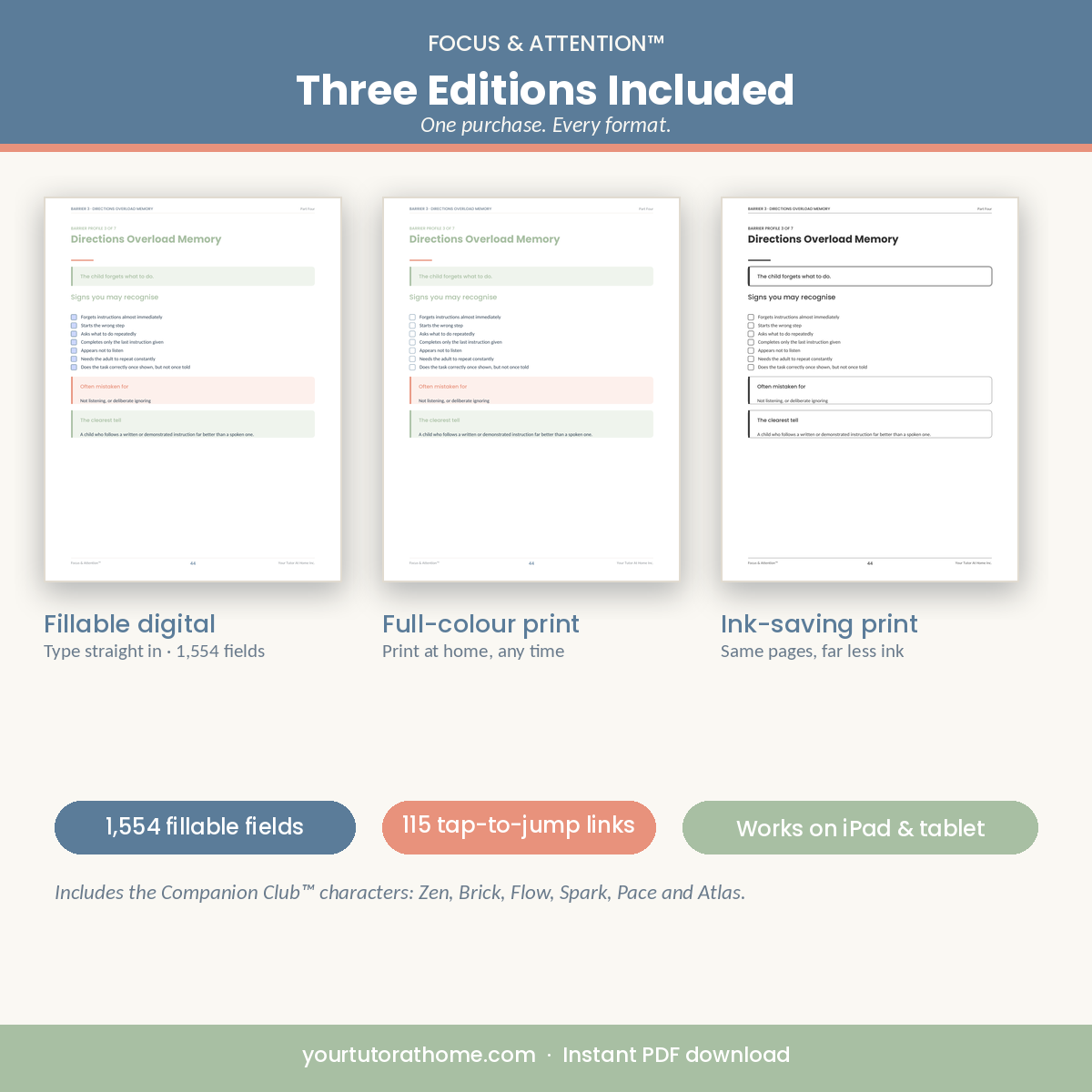
One purchase gives you all three: a digital fillable workbook with 1,554 form fields and tap-to-jump navigation, a full-colour print edition, and an ink-saving edition with the same 148 pages and far less ink coverage. Print the focus and attention trackers as often as you need them.
An honest note about what this will not do
This is not an ADHD diagnosis, a behaviour-control programme, or a punishment chart. It will not make your child sit still for long periods, and it does not promise that every task will be completed independently.
It is a practical system for understanding what is disrupting focus and attention in your house, and for making learning tasks clearer, smaller and easier to complete. If concerns are persistent, present across settings, or increasing, Part Sixteen will help you bring written observations to your child’s teacher or doctor — which is a far stronger starting point than a description from memory.
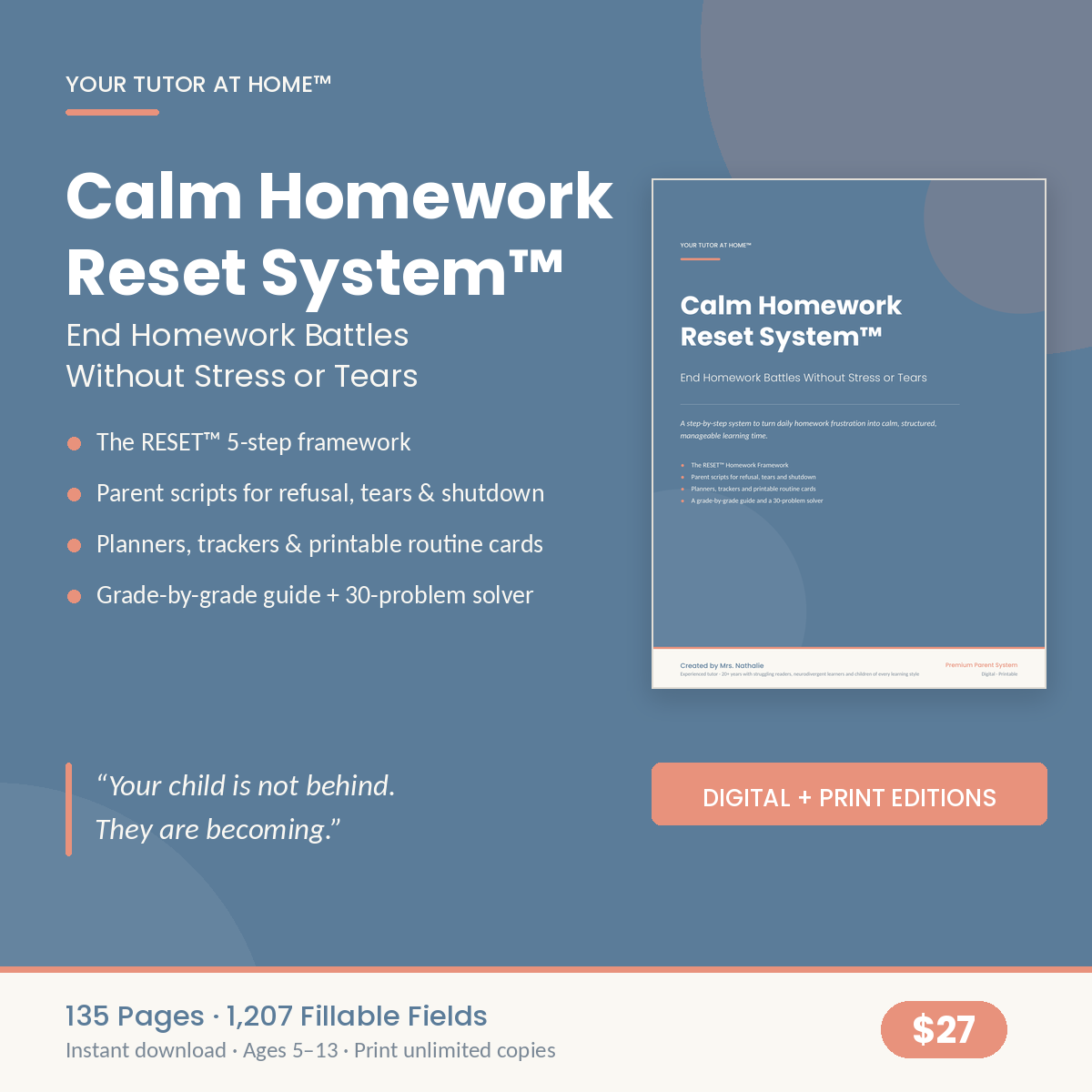
Your child is not behind. They are becoming.
Reviews
There are no reviews yet.