
Parent Daily Planner™
$8.00
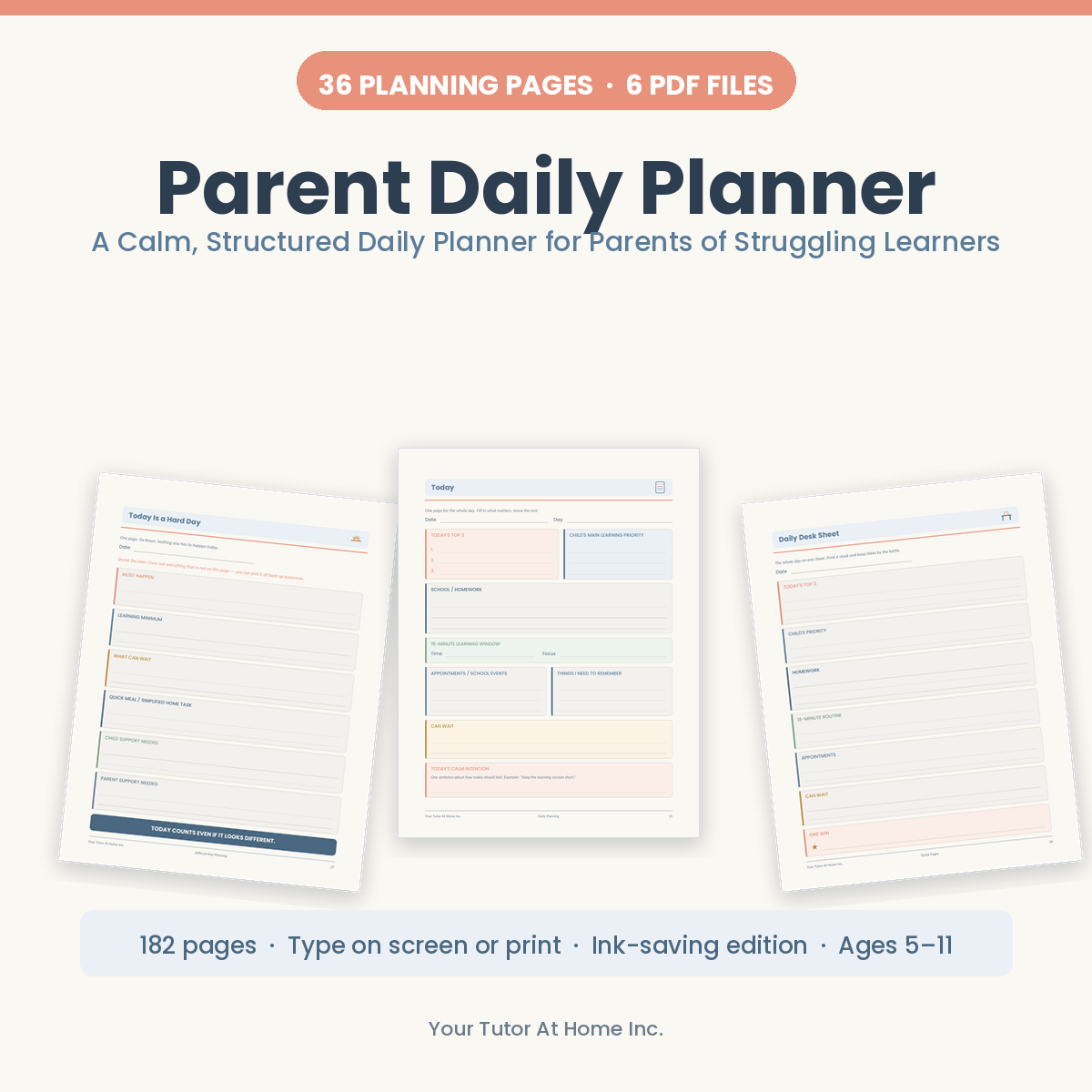
A printable parent daily planner for families where learning is hard. One page organises your top three, your child’s single learning priority, homework, and the 15-minute practice window — plus weekly pages, difficult-day pages and a parent guide. Six PDFs, 182 pages, fillable or print. Ages 5–11.
Product Description
A Parent Daily Planner Built Around a Struggling Learner
You are not just running a household. You are running a household with an extra job inside it — the reading practice, the homework negotiation, the school emails, the form nobody mentioned until this morning, and the constant background question of whether any of it is helping.
Ordinary planners assume that if you write a task down, it gets done. That assumption breaks the moment learning is hard. This parent daily planner was built for the version of the day where the plan has to survive being wrong.
It was written by Mrs. Nathalie, an experienced tutor with more than twenty years supporting struggling readers and children with learning differences. It is a planner for the adult, not a workbook for the child. Nothing in it is designed to be handed over, marked, or completed by a child.
You Do Not Need to Fit More Into the Day
You need a clearer plan for what matters today. That is the whole idea, and it shows up on every page.
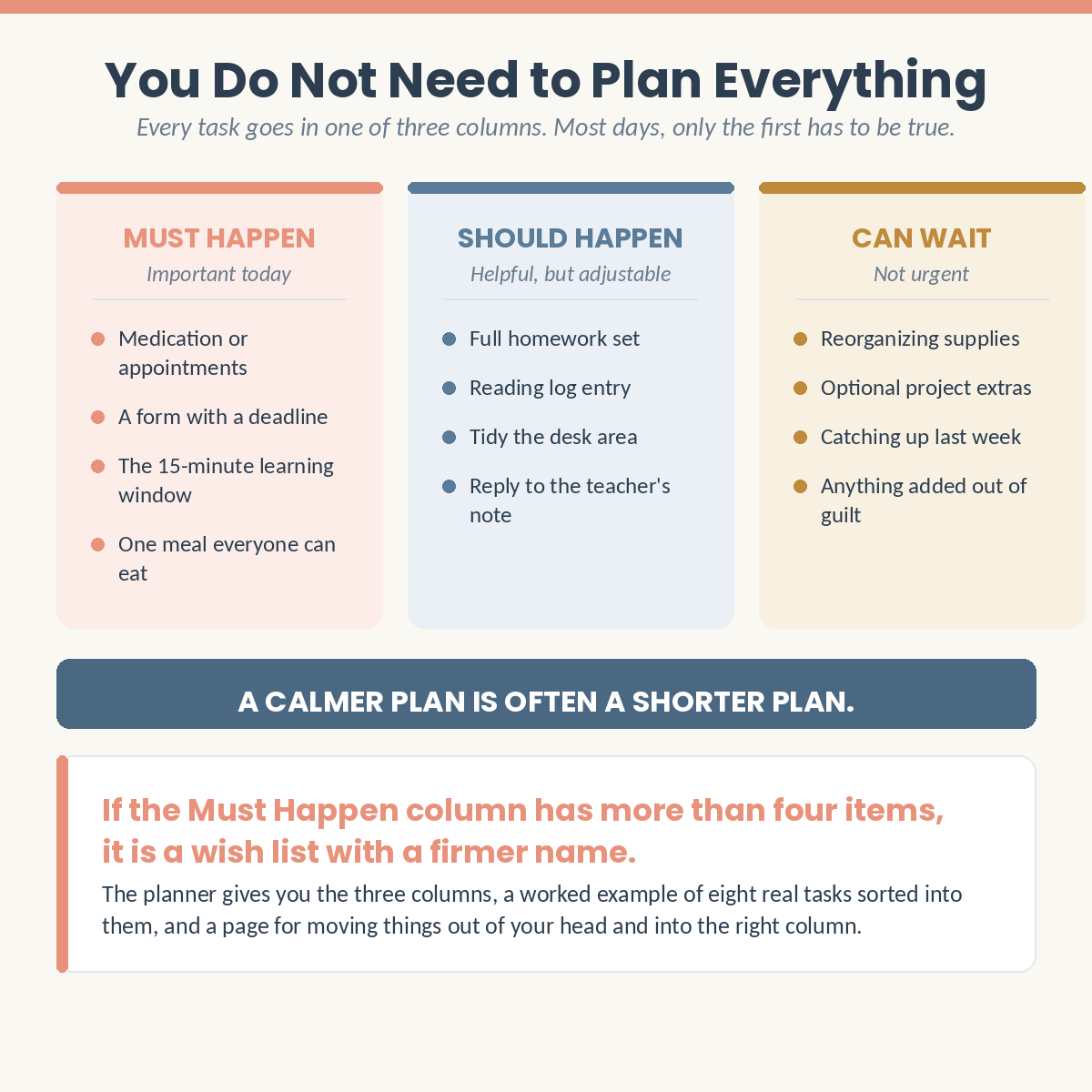
The parent daily planner opens with a rule that sorts every task into one of three columns before you write a single line: Must Happen (important today), Should Happen (helpful, but adjustable), and Can Wait (not urgent). Most days, only the first column has to be true. If Must Happen has more than four items in it, it is not a Must Happen column — it is a wish list with a firmer name.
The Parent Daily Planner in Five Steps
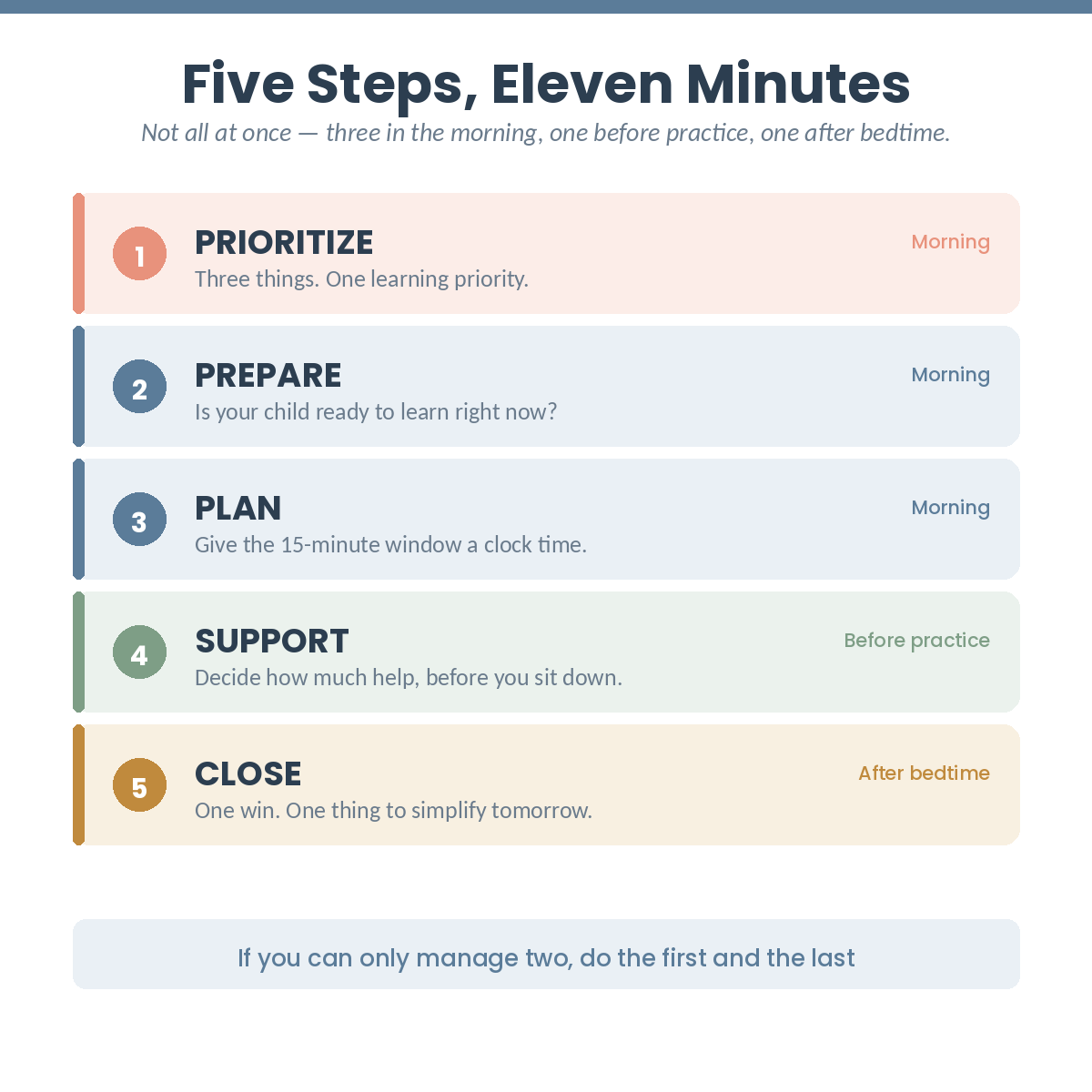
- Prioritize — three things, plus your child’s single learning priority
- Prepare — a two-minute readiness check before practice, not after it goes wrong
- Plan — give the 15-minute learning window an actual clock time
- Support — decide how much help you will give before you sit down
- Close — one win, and one thing to simplify tomorrow
They do not all happen at once. Three are a five-minute morning block, one takes two minutes before practice, and the last is four minutes after your child is in bed. That is roughly eleven minutes a day. If a day only has two of those minutes in it, you do the top three and stop — and the parent daily planner is designed to make that a complete day rather than a failed one.
What You Fill In Each Day
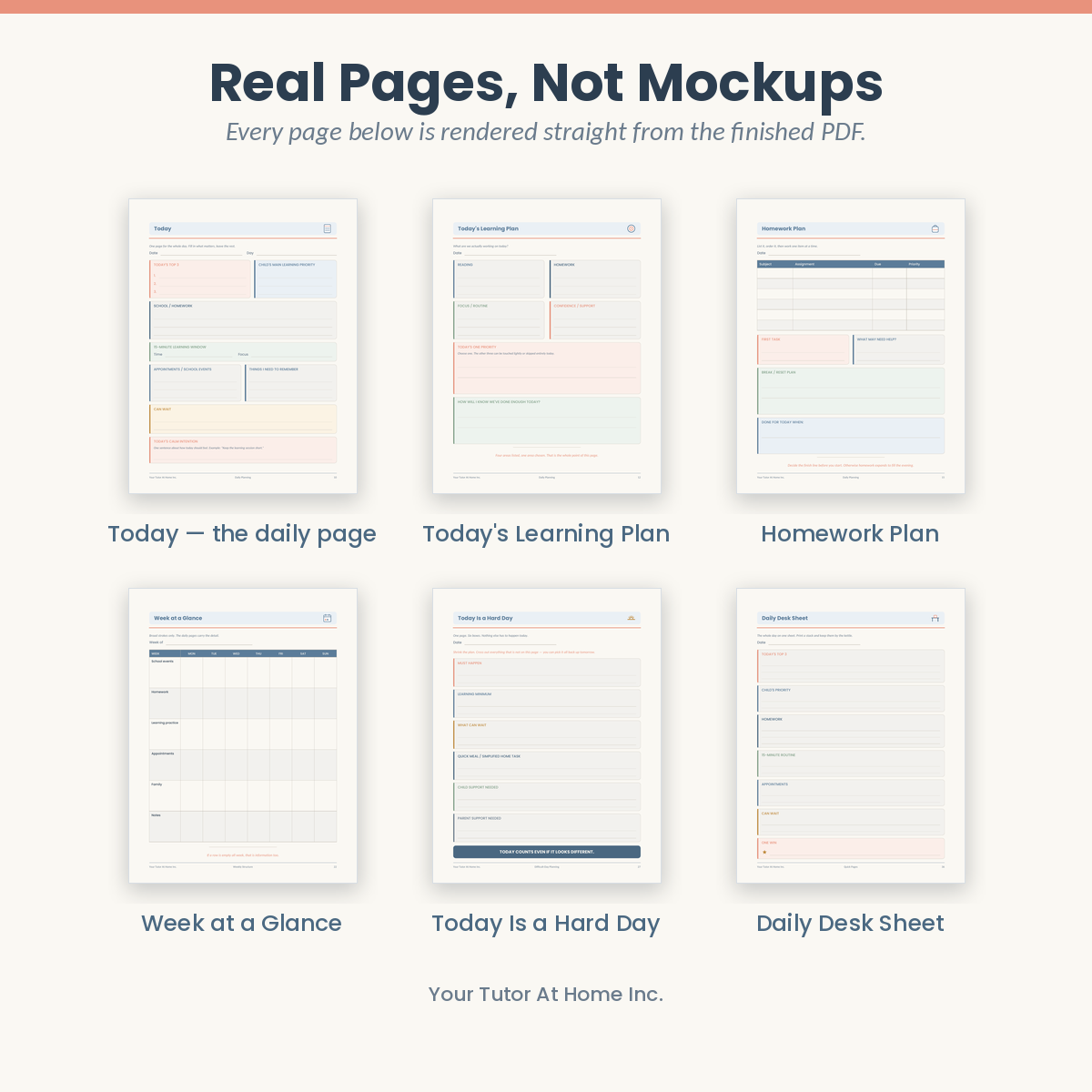
- Today — top three, your child’s learning priority, homework, the 15-minute window, what can wait, and one calm intention
- Today’s Shape — flexible blocks rather than an hour-by-hour timetable
- Child Readiness Check — body, emotions, task and parent, in four quick tick lists
- Homework Plan — list it, order it, and decide the finish line before starting
- School Communication Tracker — so the question you keep meaning to ask gets asked
- End-of-Day Reflection — four minutes that turn a hard week into information
For the Weeks and the Days That Fall Apart
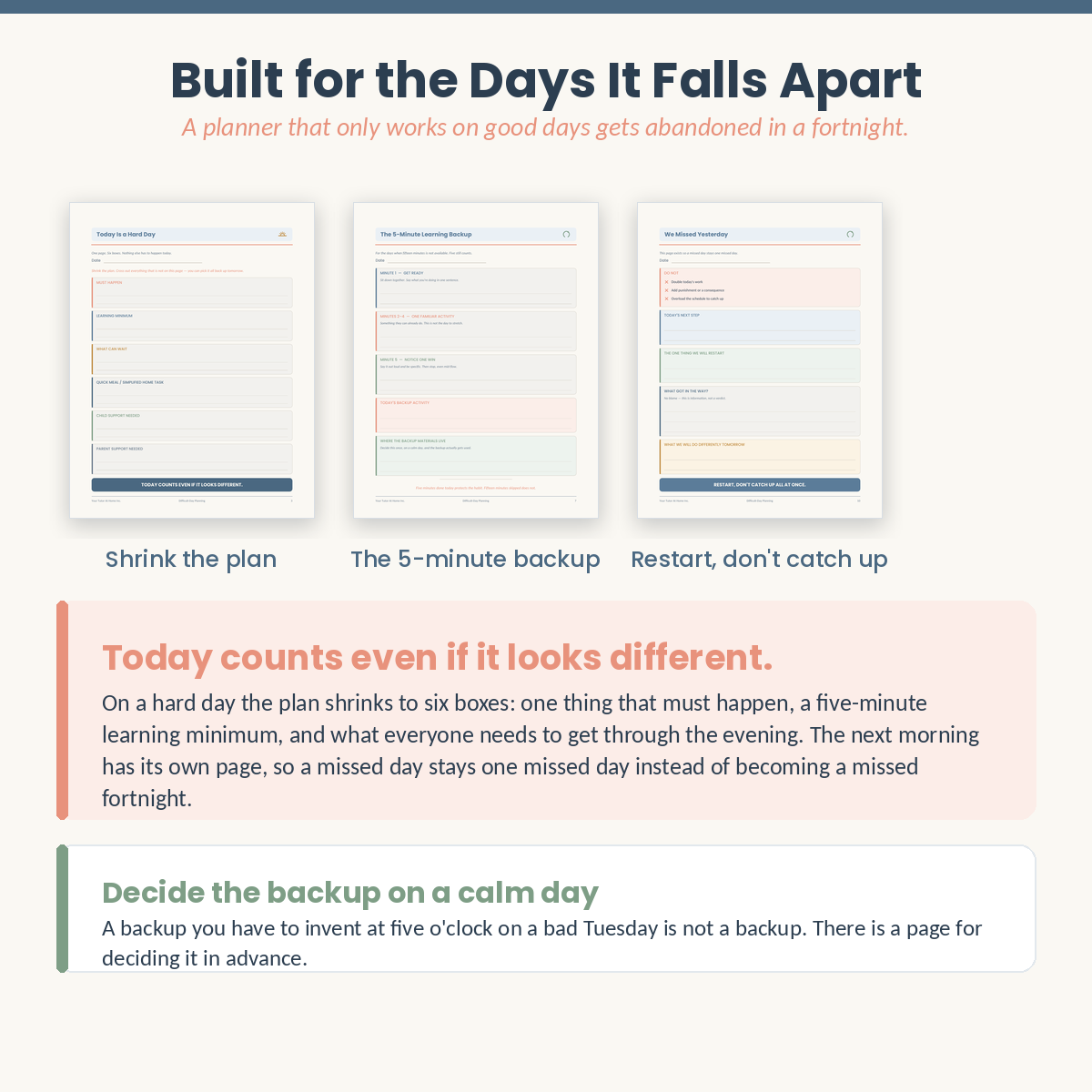
A parent daily planner that only works on good days gets abandoned in a fortnight. This one has a shrink path built into it.
Today Is a Hard Day reduces the whole plan to six boxes: one thing that must happen, a five-minute learning minimum, what can wait, a simplified meal, and what your child and you each need to get through the evening. The 5-Minute Learning Backup is decided in advance, on a calm day, because a backup you have to invent at five o’clock on a bad Tuesday is not a backup. We Missed Yesterday exists so a missed day stays one missed day instead of becoming a missed fortnight.
This parent daily planner also includes parent-facing pages that most planners leave out entirely — a calm check, a script of the day, and a page for the questions you need to ask someone else.
The Parent Daily Planner Weekly Pages
- Week at a Glance — broad strokes only; the daily pages carry the detail
- Weekly 15-Minute Routine Planner — finds the windows your child can actually cope with
- Before the Week Starts — fifteen minutes on a Sunday that saves an hour midweek
- Progress Without Pressure — tracks whether your planning system is holding, not your child’s academic score
There is deliberately no place to record test results. Recording scores at home tends to raise pressure without improving anything, so this parent daily planner measures the thing you actually control.
What’s in the Parent Daily Planner Download
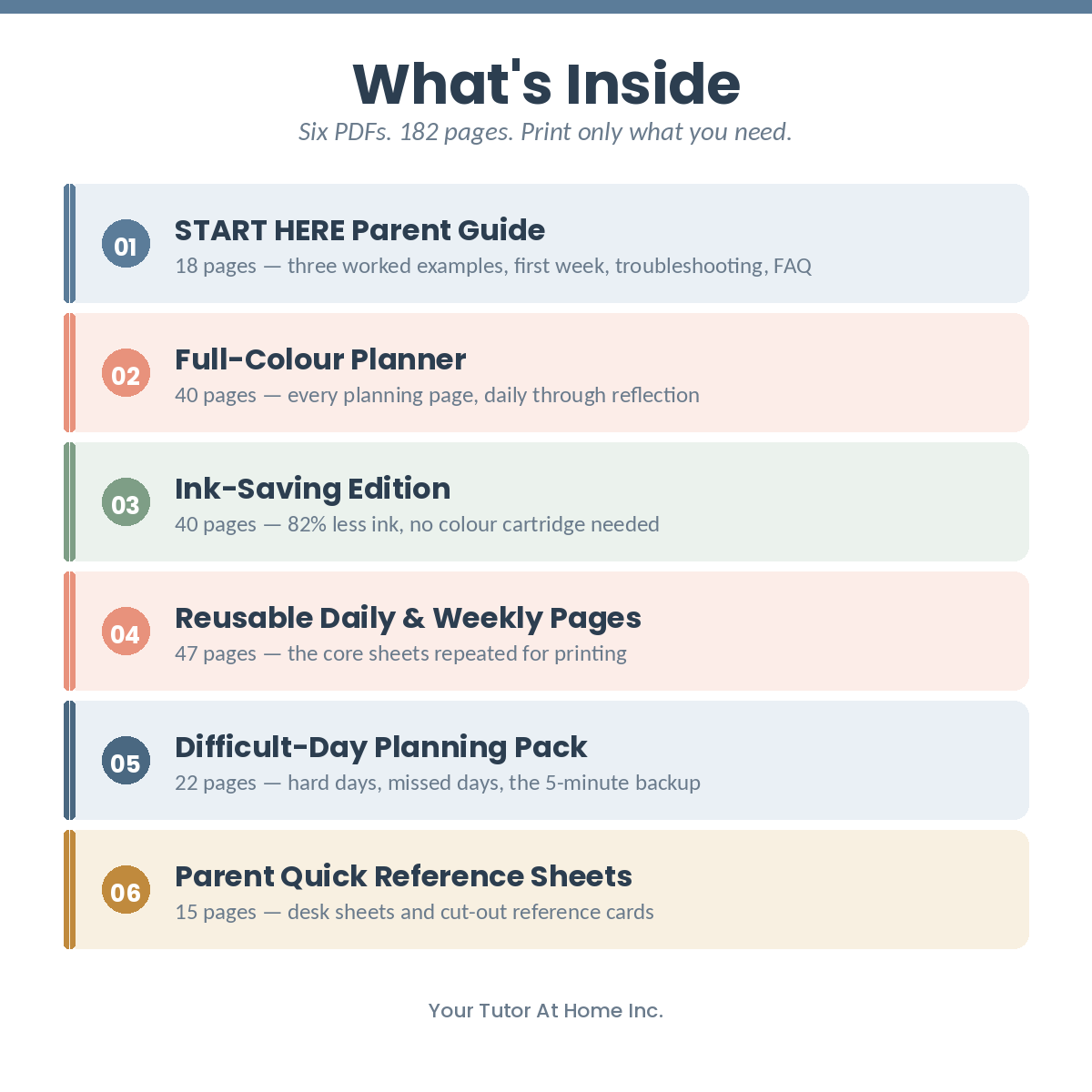
- 01 — START HERE Parent Guide (18 pages) — three worked examples, your first week day by day, eight troubleshooting problems and eight questions
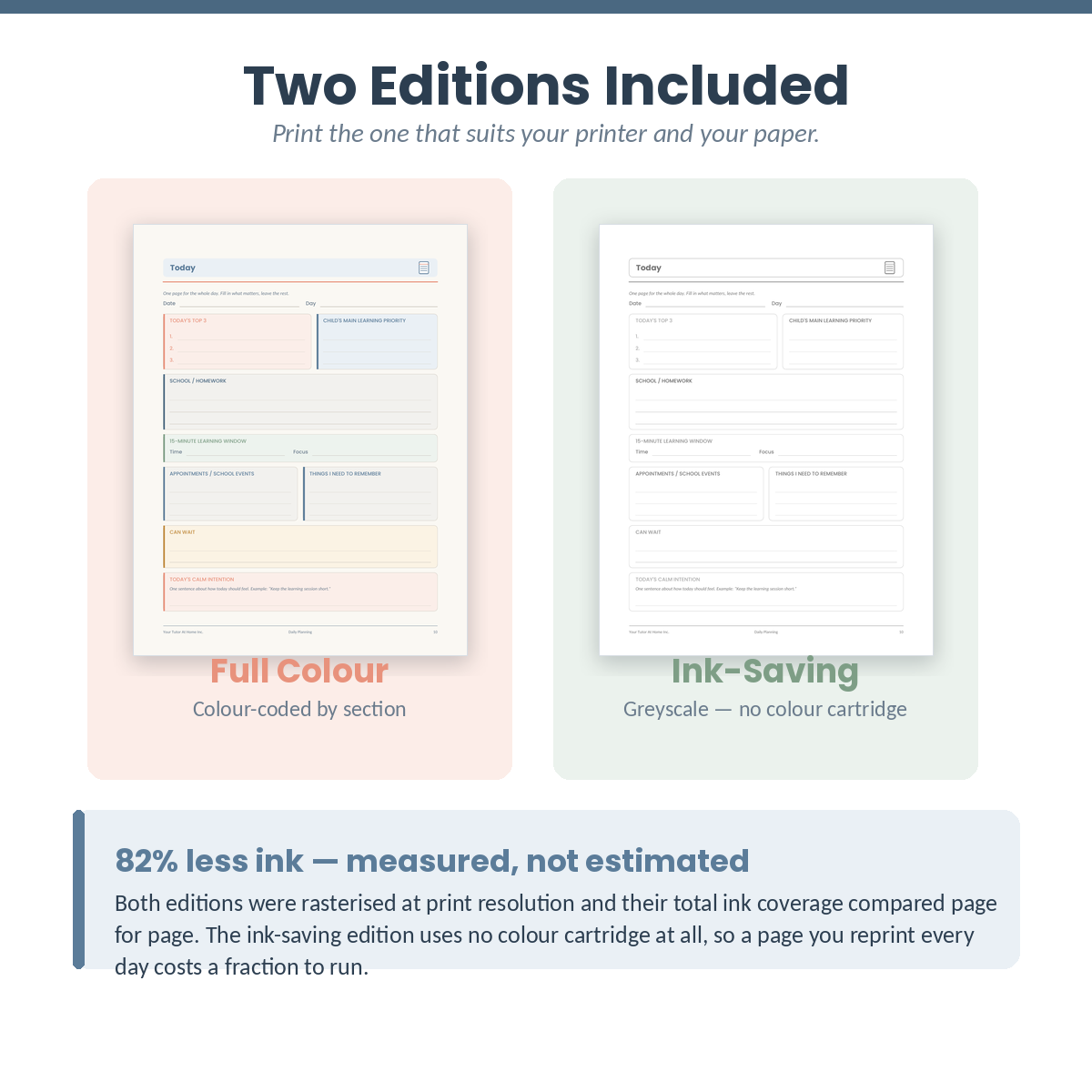
- 02 — Full-Colour Planner (40 pages) — every page, colour-coded by section
- 03 — Ink-Saving Edition (40 pages) — the same content in greyscale
- 04 — Reusable Daily & Weekly Pages (47 pages) — the core sheets repeated so you can print a week at a time
- 05 — Difficult-Day Planning Pack (22 pages) — print once and keep it in a folder
- 06 — Parent Quick Reference Sheets (15 pages) — desk sheets and a cut-out card for the kitchen
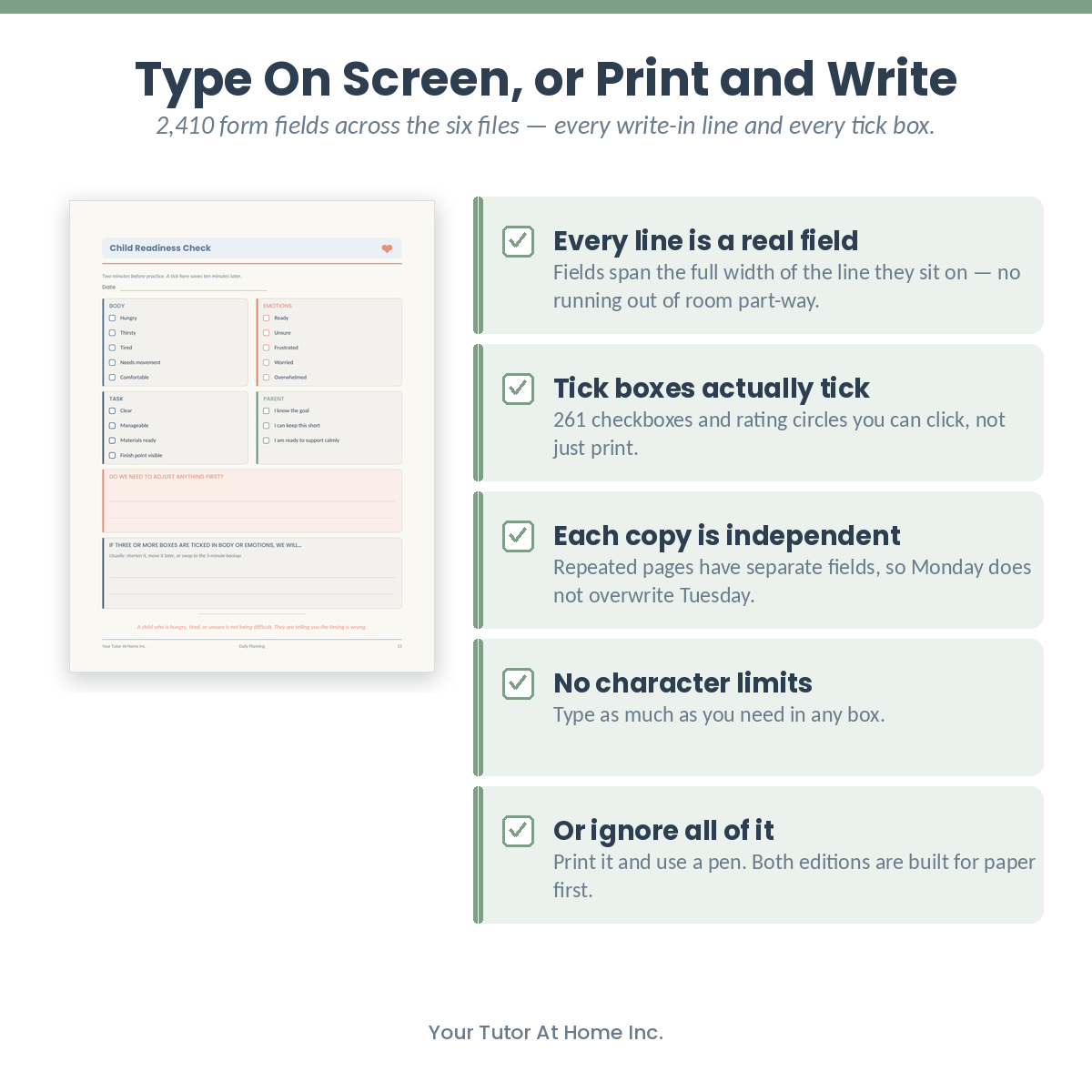
Every write-in line is a real form field, so you can type into this parent daily planner on screen and save it, or print it and use a pen. There are 2,410 fields in total, including 261 tick boxes and rating circles you can actually click. Repeated pages carry independent fields, so filling in Monday does not overwrite Tuesday.
The ink-saving edition was measured at 82% less total ink than the colour pages and uses no colour cartridge at all — rasterised and compared page for page, not estimated.
Start With Two Pages
Do not print the whole parent daily planner at once. Print the Daily Desk Sheet five times and the quick reference card once, fill in three things on Monday, and add one step a day for a week. Most parents who abandon a planner do so because they printed the whole thing in week one.
If you only ever use those two pages, this parent daily planner has still done its job.
Who This Parent Daily Planner Is For
Parents and caregivers of children roughly five to eleven who are finding reading, writing or maths harder than their classmates — with or without a formal diagnosis. It is especially useful if you are already doing a lot at home and getting no clearer picture of whether it is helping.
The parent daily planner is a planning tool, not a diagnosis, an intervention programme, or a behaviour chart. If you have concerns about your child’s learning, attention, vision, hearing or wellbeing, a planner belongs alongside — never instead of — a conversation with their school and a qualified professional. Understood.org and Reading Rockets both maintain excellent free parent libraries, and the CDC publishes plain-language guidance on children’s developmental wellbeing.
Where This Fits
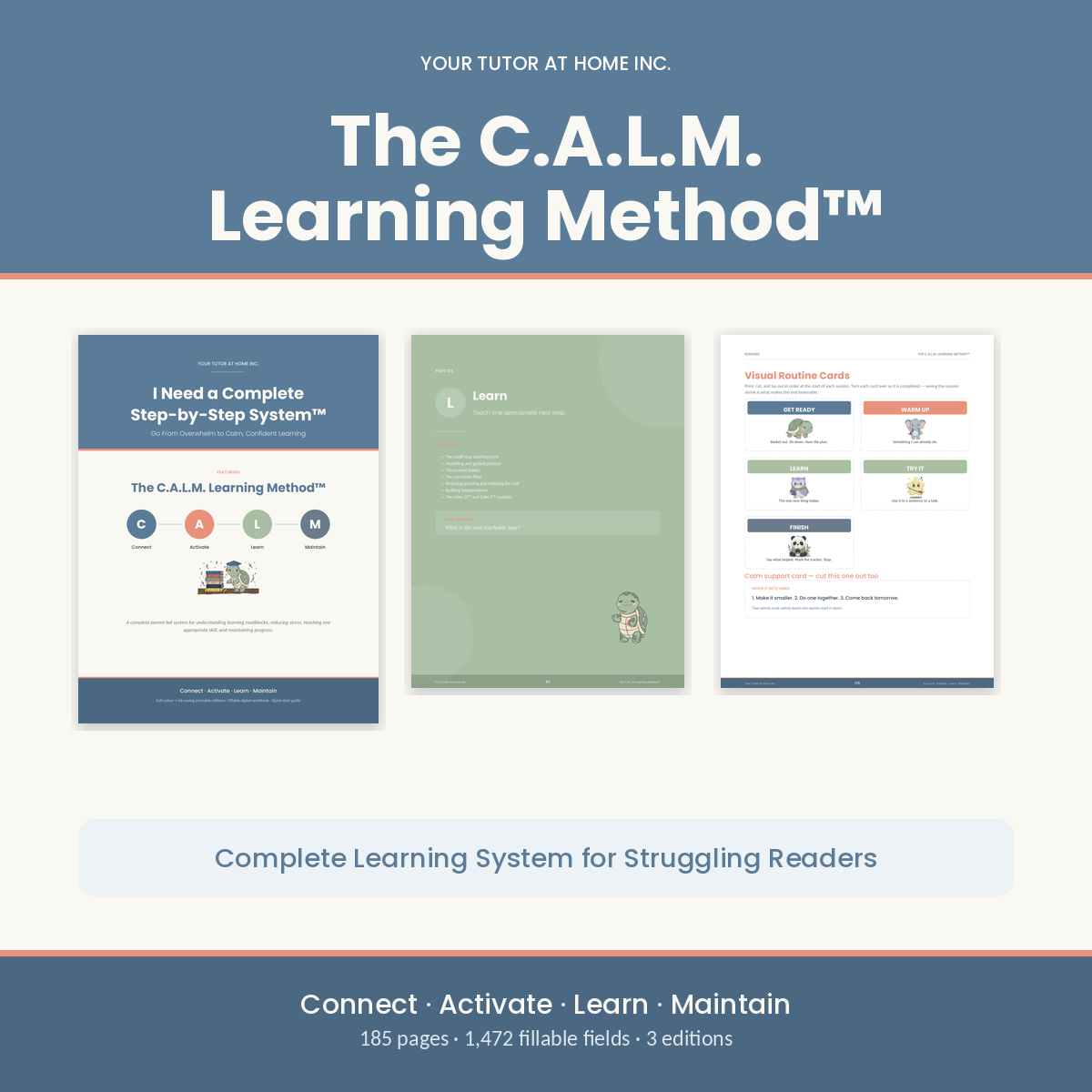
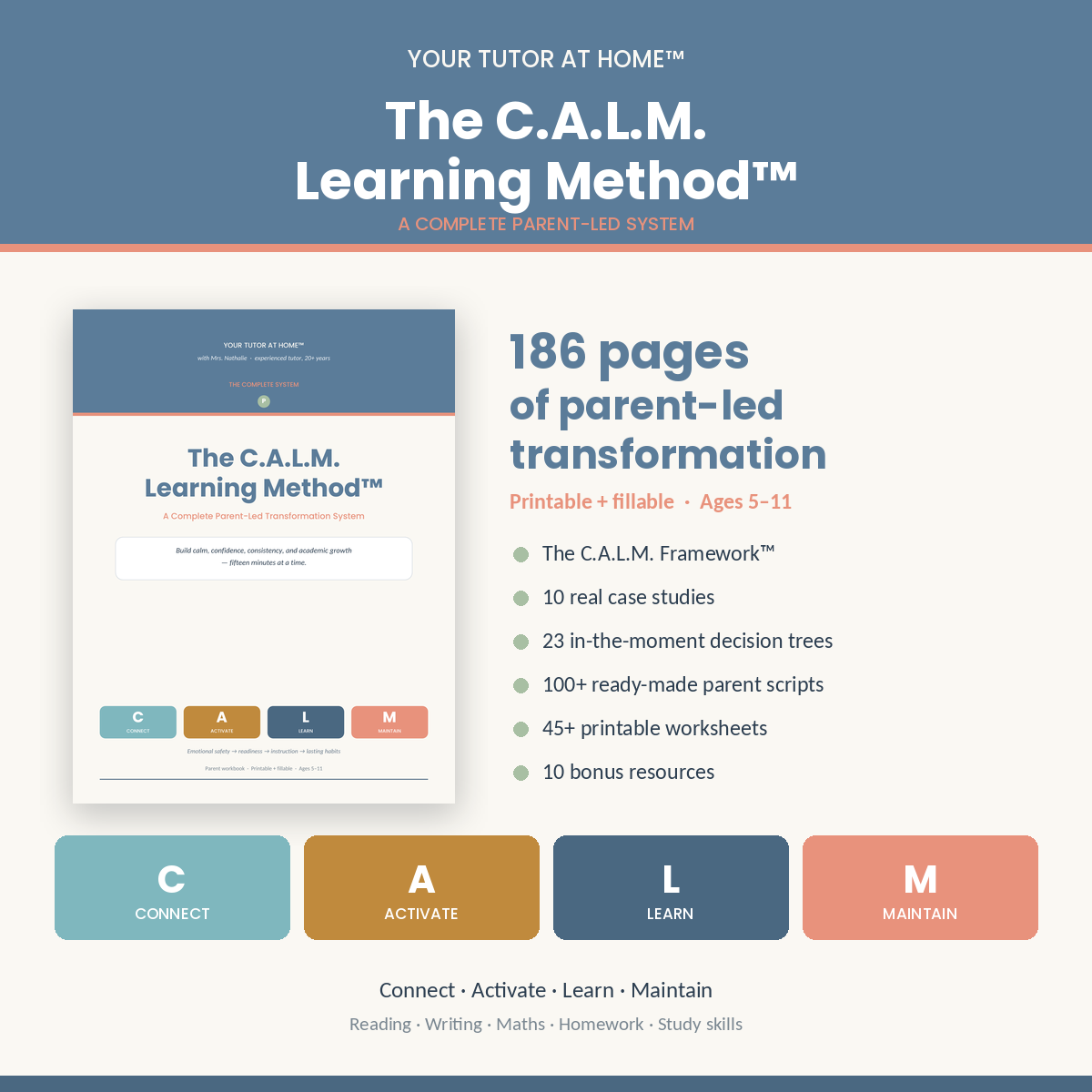
This parent daily planner organises your day around your child’s learning. If you need to organise your child’s homework in detail instead, the Calm Homework Planner™ does that job. If you want a consistent daily learning structure for the child rather than the parent, look at the Calm Learning Routine System™, and the full parent-led system lives in The C.A.L.M. Learning Method™. You can also browse the full range of learning resources.
Download the parent daily planner, print one page, and write down three things. That is a complete first day.
Reviews
There are no reviews yet.