
My Reading Log™
$9.00
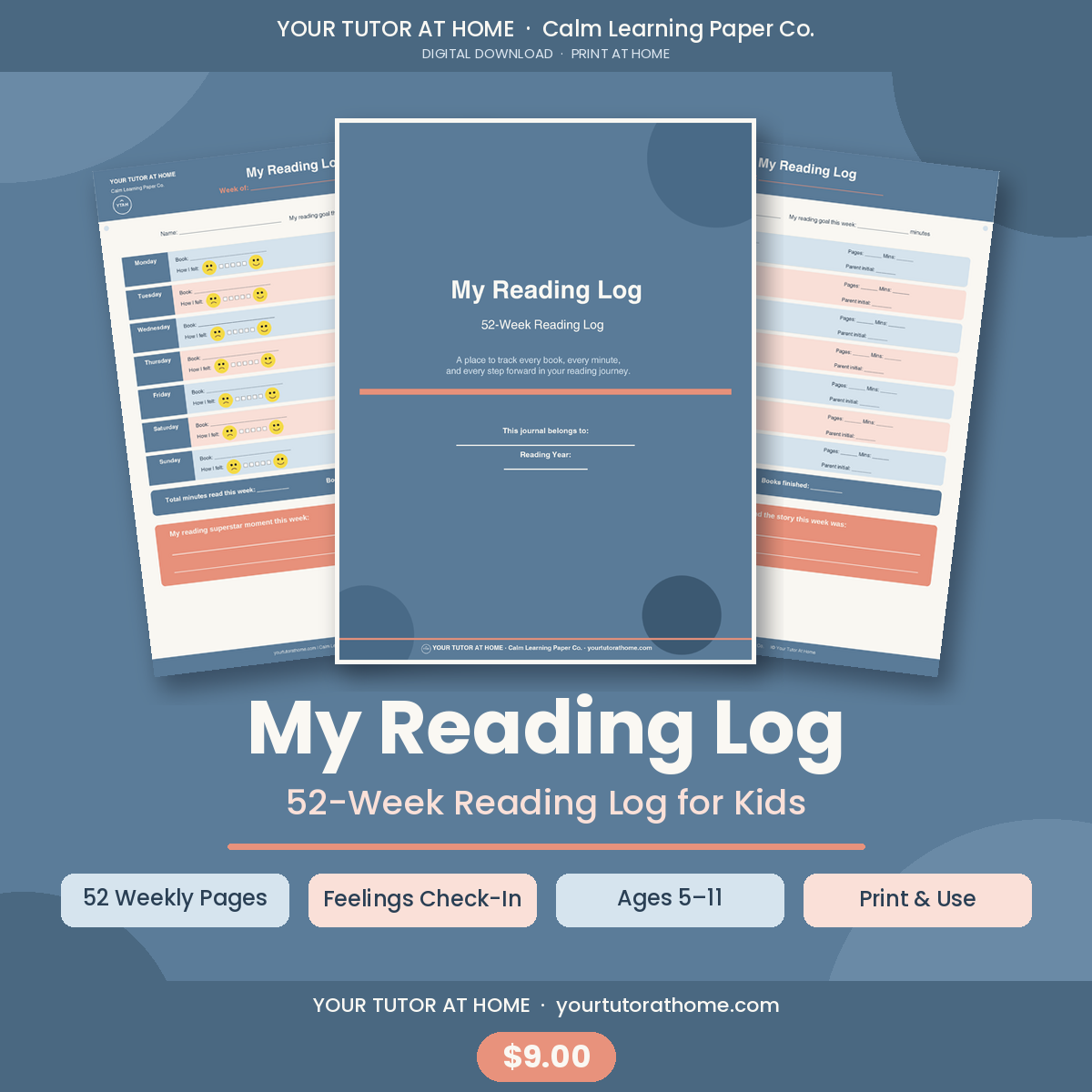
A printable reading log that tracks more than minutes.
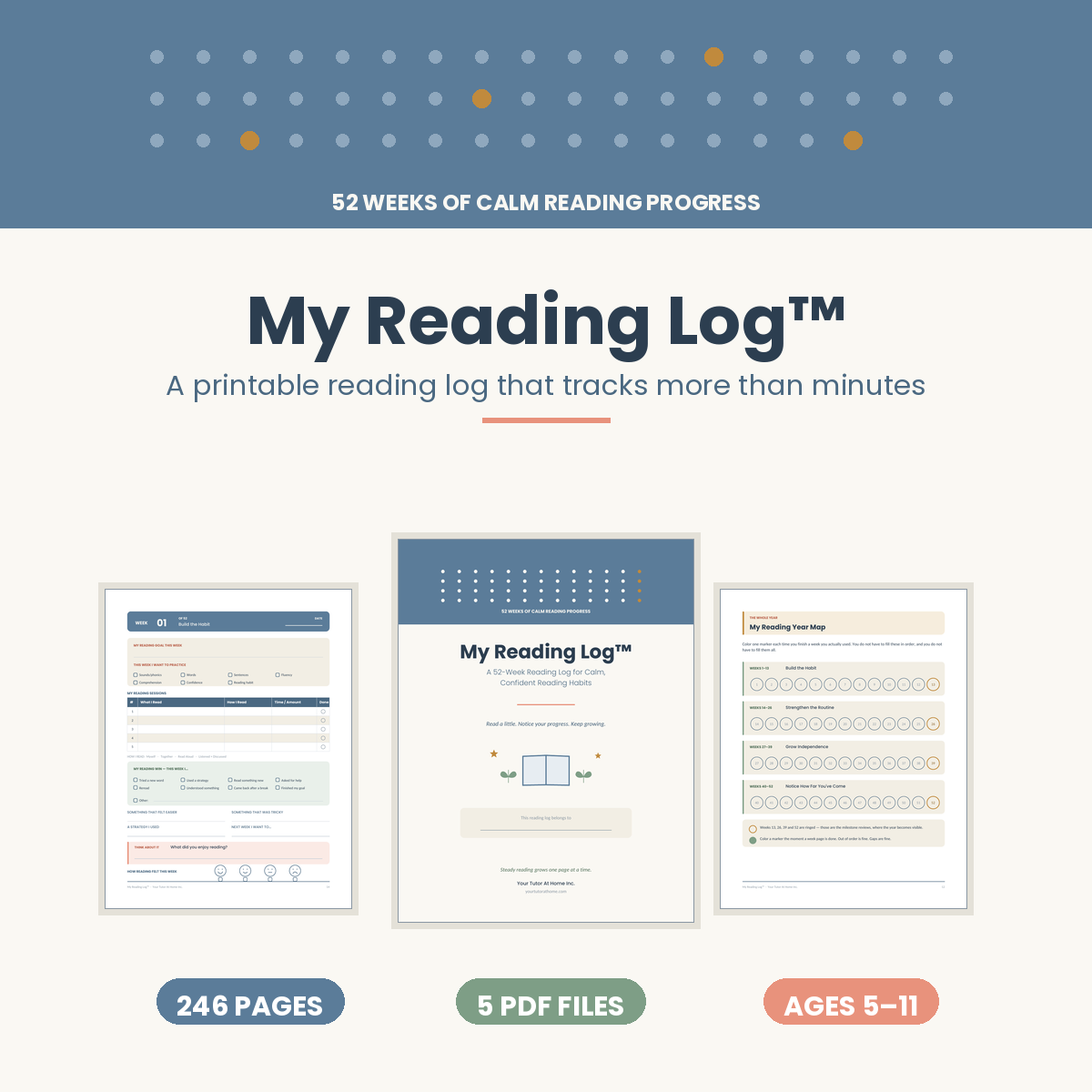
52 undated weekly pages, thirteen four-week check-ins, four milestone
reviews, book and skill trackers, and a year-end celebration — built so
a missed week costs nothing.
- 246 pages across 5 PDFs — full-color and
ink-saving editions included - Start any week of the year — nothing is dated
- Records strategy, understanding and confidence, not just
pages and minutes - Fillable on a tablet or printable at home
- Ages 5–11 · US Letter · instant
download
Product Description
Most reading logs are a grid of dates waiting to be filled in, and most of
them are abandoned by March. Not because the child stopped reading, but
because a blank row started to feel like a failure. My Reading
Log™ is a printable reading log built the other way round: 52
weekly pages, no daily grid, and a system that treats coming back after a gap
as the most important skill of the whole year.
On this page
- Why most reading logs stop being used by March
- What is inside this printable reading log
- Read, notice, record, reflect, grow
- A printable reading log that counts more than finished
books - A printable reading log with no perfect streak
- Milestones that make a year visible
- Who this printable reading log is for
- What you get
- Frequently asked questions
Why most reading logs stop being used by March
The standard format is always the same: date, book, pages, minutes, parent
signature. It quietly teaches three things. That reading is measured in
quantity. That a parent’s signature is the proof it happened. And that a blank
row is a failure. Children learn all three quickly, and a good number of them
respond by getting very good at filling in rows and no better at reading.
A minutes column also cannot answer the questions that actually matter. Was
it hard? What did they do when it got hard — guess, skip, sound it out,
ask? Did anything land? Did they come back after the week they missed?
According to Reading Rockets, comprehension and strategy use develop
through deliberate practice and reflection, not through accumulated time on
the page.
What is inside this printable reading log
Every page in this printable reading log is undated, so you can start in
January, in September, or on a wet Tuesday in the middle of nowhere in
particular.
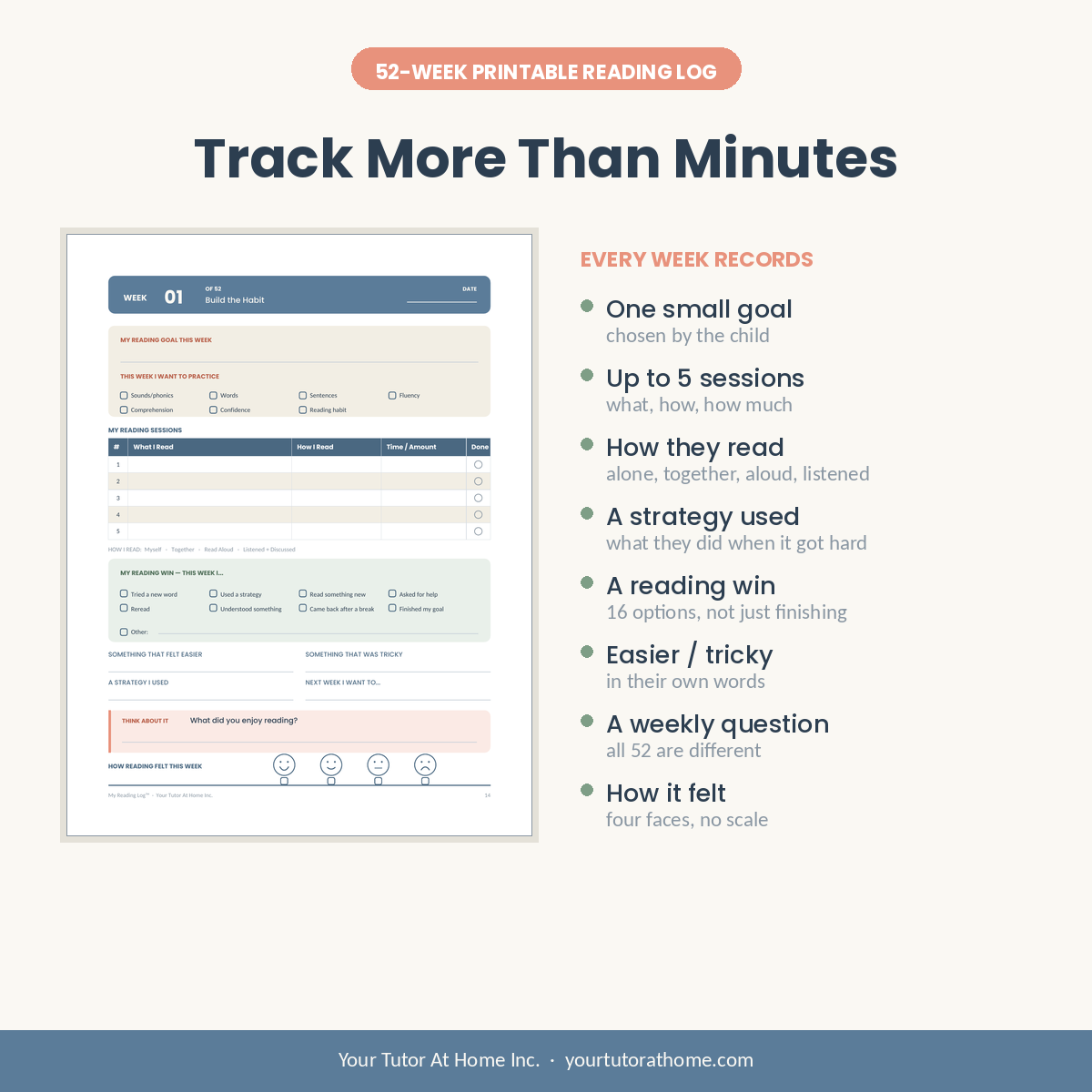
- 52 weekly pages — one goal, up to five reading
sessions, a strategy, a win, a reflection, and a different question every
single week - 52 original weekly questions — from “what did
you enjoy reading?” in week one to “what are you most proud of
from your reading year?” in week 52 - Thirteen four-week check-ins already positioned in the
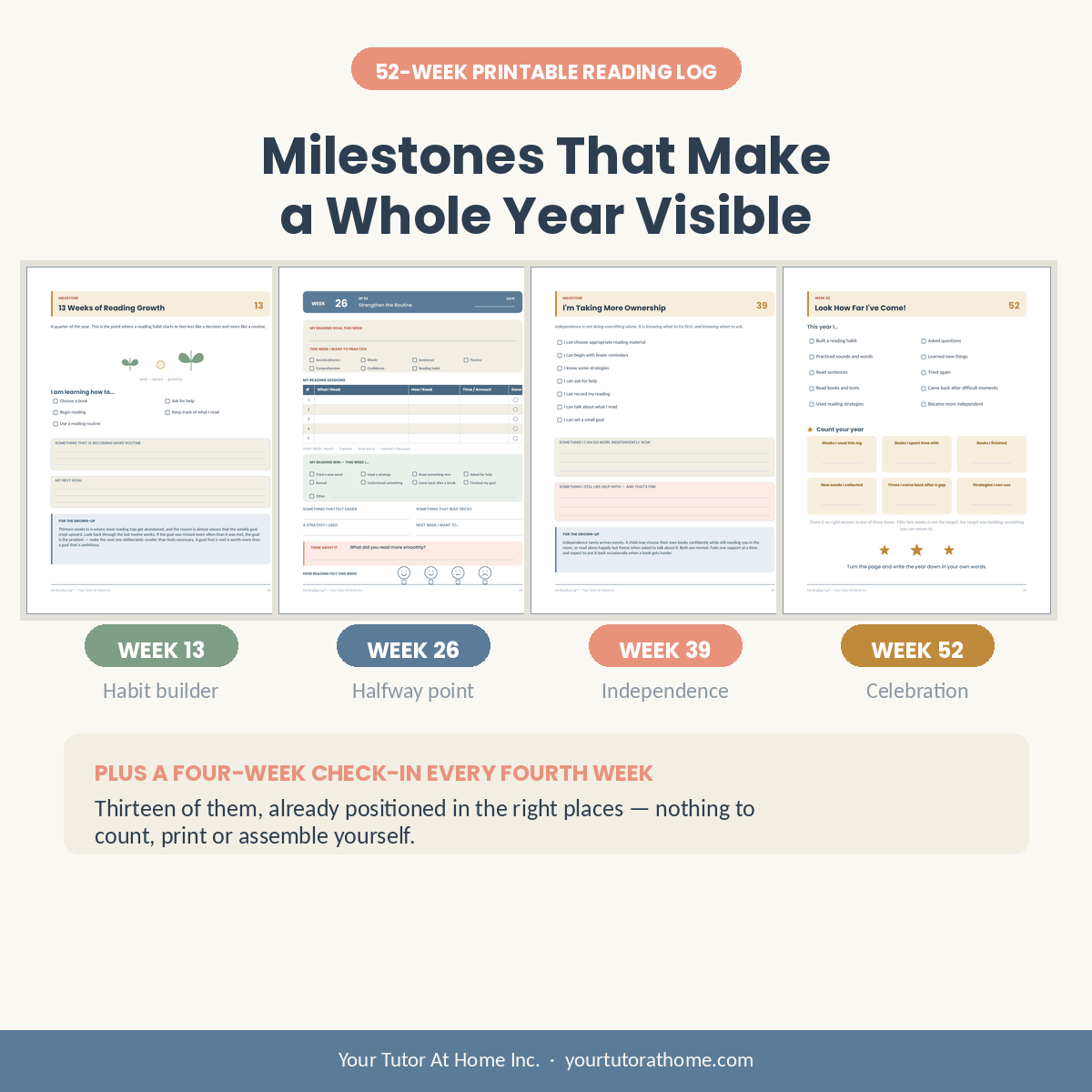
right places - Four milestone reviews at weeks 13, 26, 39 and 52
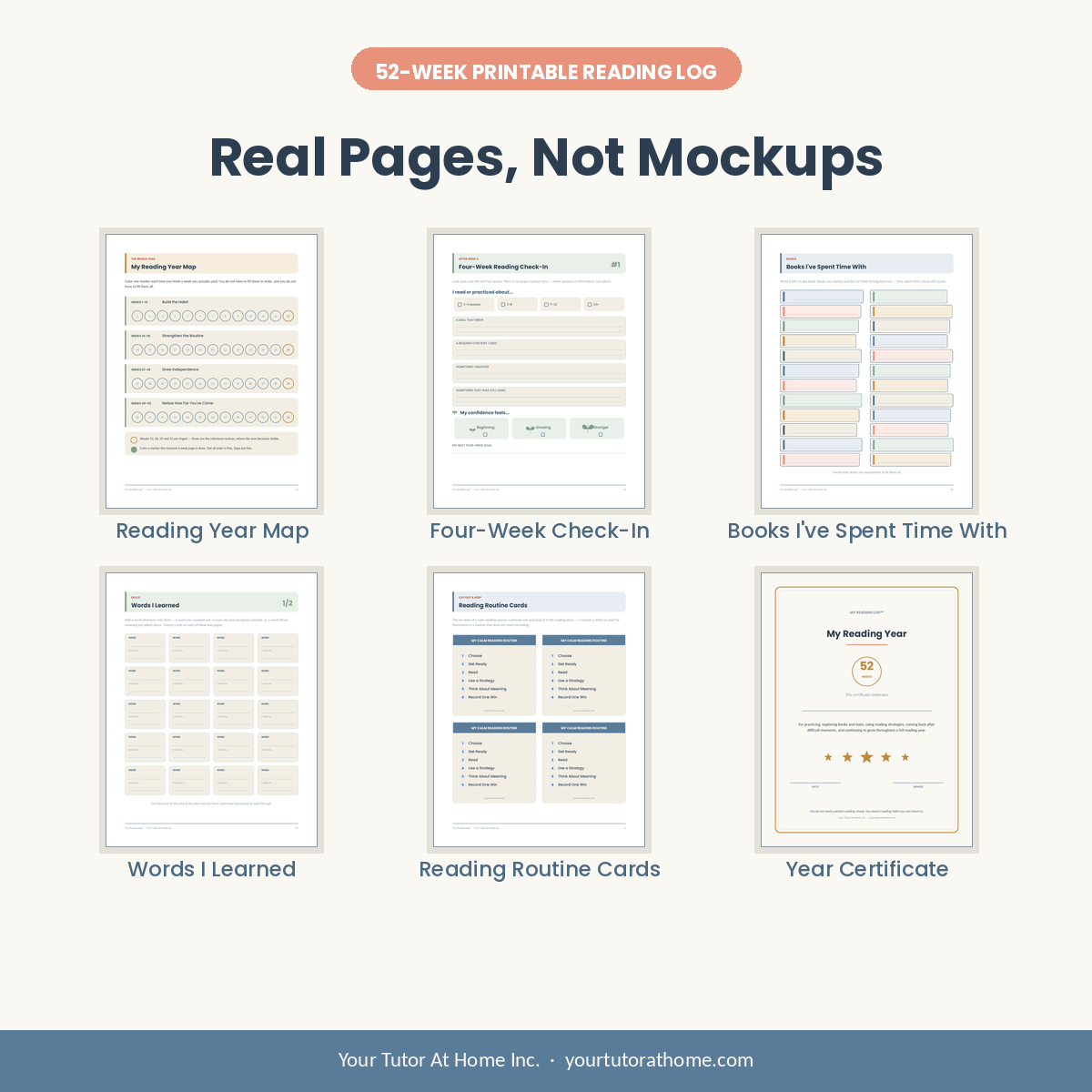
- A Reading Year Map with 52 markers to color in
- Five book trackers — books spent time with, books
finished, books read together, books not finished, and favorites - Six skill trackers — words learned, strategies
known, confidence growth, reading places, and a reading routine page - Two optional challenge boards that nobody has to
complete - A three-page year-end celebration and four
certificates
Read, notice, record, reflect, grow
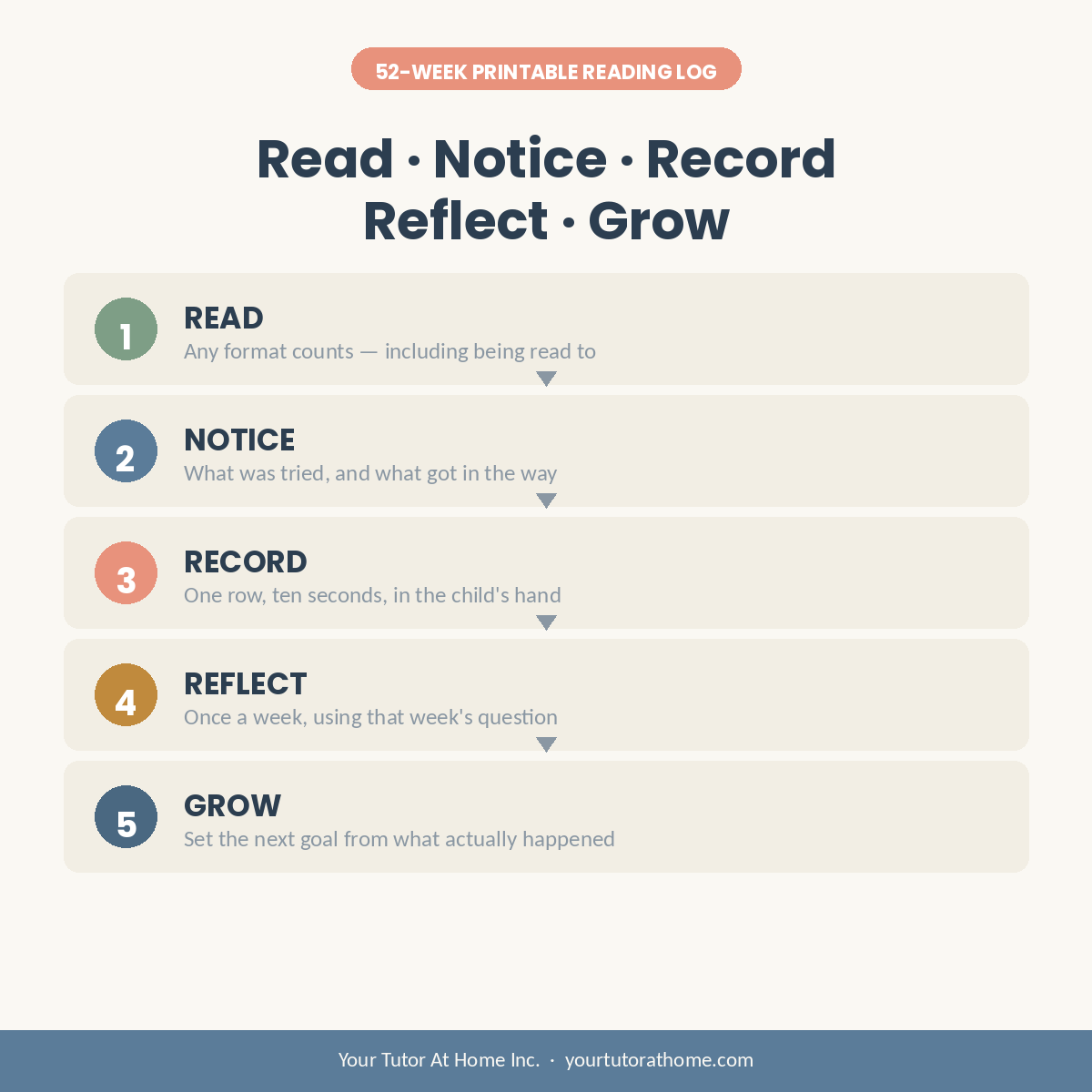
Five steps, in that order, every week. Read anything — the log
recognizes shared reading, reading aloud, being read to and discussing it,
comics, poetry, informational text and appropriate digital reading. Notice
what was tried and what got in the way. Record it in one row, in ten seconds,
in the child’s own handwriting. Reflect once a week using that week’s
question. Then set the next goal from what actually happened rather than from
what you hoped would.
The included parent guide covers the part most families get wrong: goal
size. A weekly goal that is met builds a reader. A goal missed three weeks
running builds a child who quietly decides they are bad at reading. The guide
includes a goal-matching table, a goal-shrinking ladder, and three fully
worked examples from real weeks.
A printable reading log that counts more than finished
books
Sixteen things count as a reading win in this system, and finishing a book
is only one of them. Starting. Sounding something out. Rereading. Asking about
a word. Retelling part of a story. Returning after a break. Choosing a book
without being asked. For a child who finds reading hard, those are the wins
that are actually available this week — and noticing them out loud is
what makes next week possible.
This matters most for children who are behind their peers.
Understood.org
notes that children with learning differences often work considerably harder
for smaller visible gains, which makes a record that only celebrates
completion actively discouraging.
A printable reading log with no perfect streak
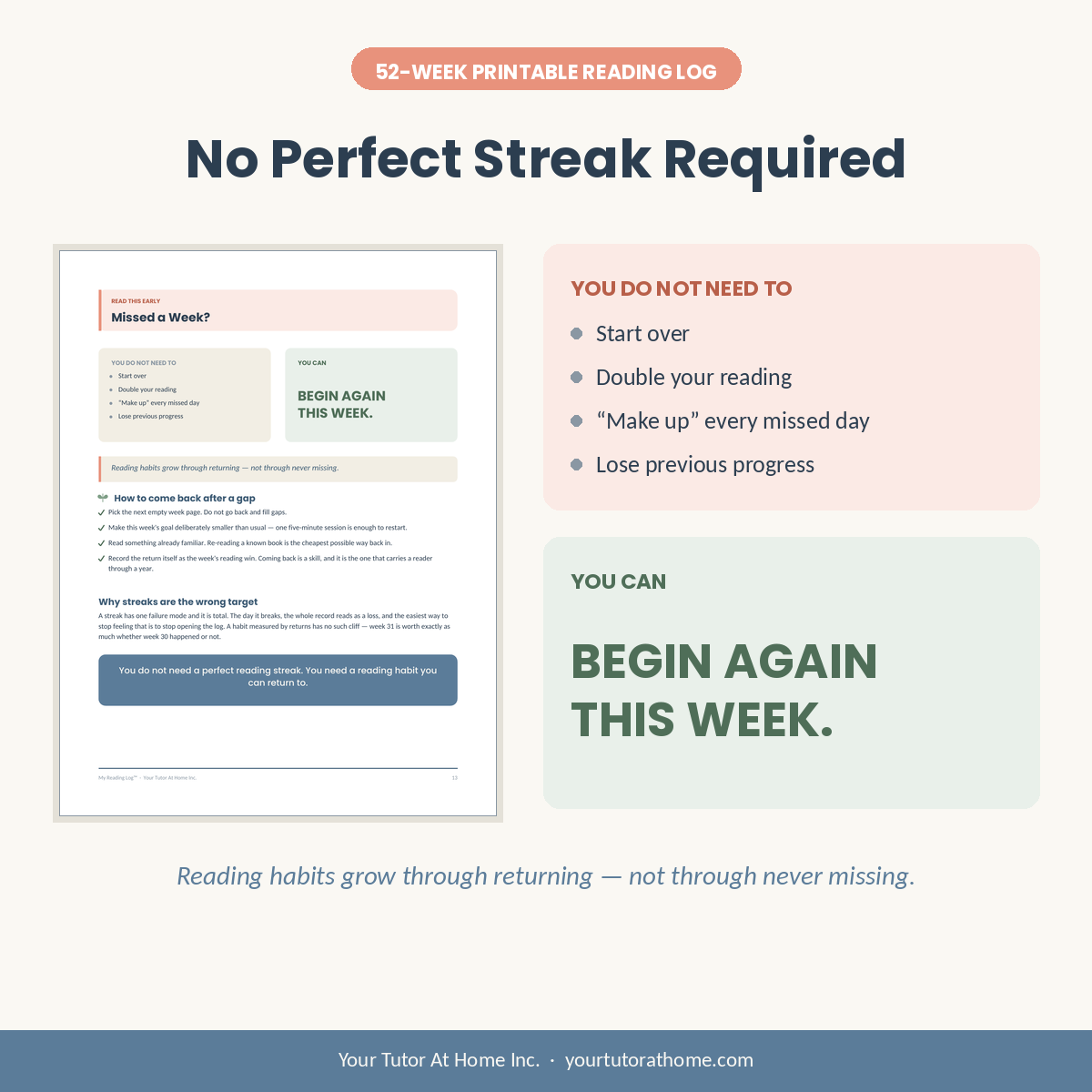
There is a page in this printable reading log that says, in large letters,
that a missed week does not need to be made up, doubled, or started over. Pick
the next empty week page, make the goal deliberately smaller, and record the
return itself as the week’s win. One of the three worked examples in the guide
is a seven-year-old who missed six consecutive weeks and finished the year
having used 41 of the 52 pages — and rated the week she came back as the
one she was proudest of.
Milestones that make a year visible
This printable reading log breaks the year into intervals a child can
actually feel. At week 13 the child notices what has become routine. At week 26 there is a
halfway reflection. At week 39 an independence check-in. At week 52 a
three-page celebration, a then-and-now comparison against the answers written
in week one, and a certificate. In between, a four-week check-in every fourth
week asks what grew, what was enjoyed, what was still hard, and what the next
goal should be.
Who this printable reading log is for
- Parents of children roughly five to eleven, at any
reading level - Children who read fine but resist — and children who want to read
but find it hard - Homeschooling families who need a full-year record without a curriculum
attached - Anyone whose child has been handed a minutes-based log at school and has
quietly stopped filling it in - Families who want a printable reading log the child owns, rather than one
the parent polices
It is a tracking and reflection tool, not an assessment. It does not
measure reading level and it does not diagnose anything. If you have concerns,
speak to your child’s school or a reading specialist — the
CDC has guidance on when to seek an
evaluation.
What you get
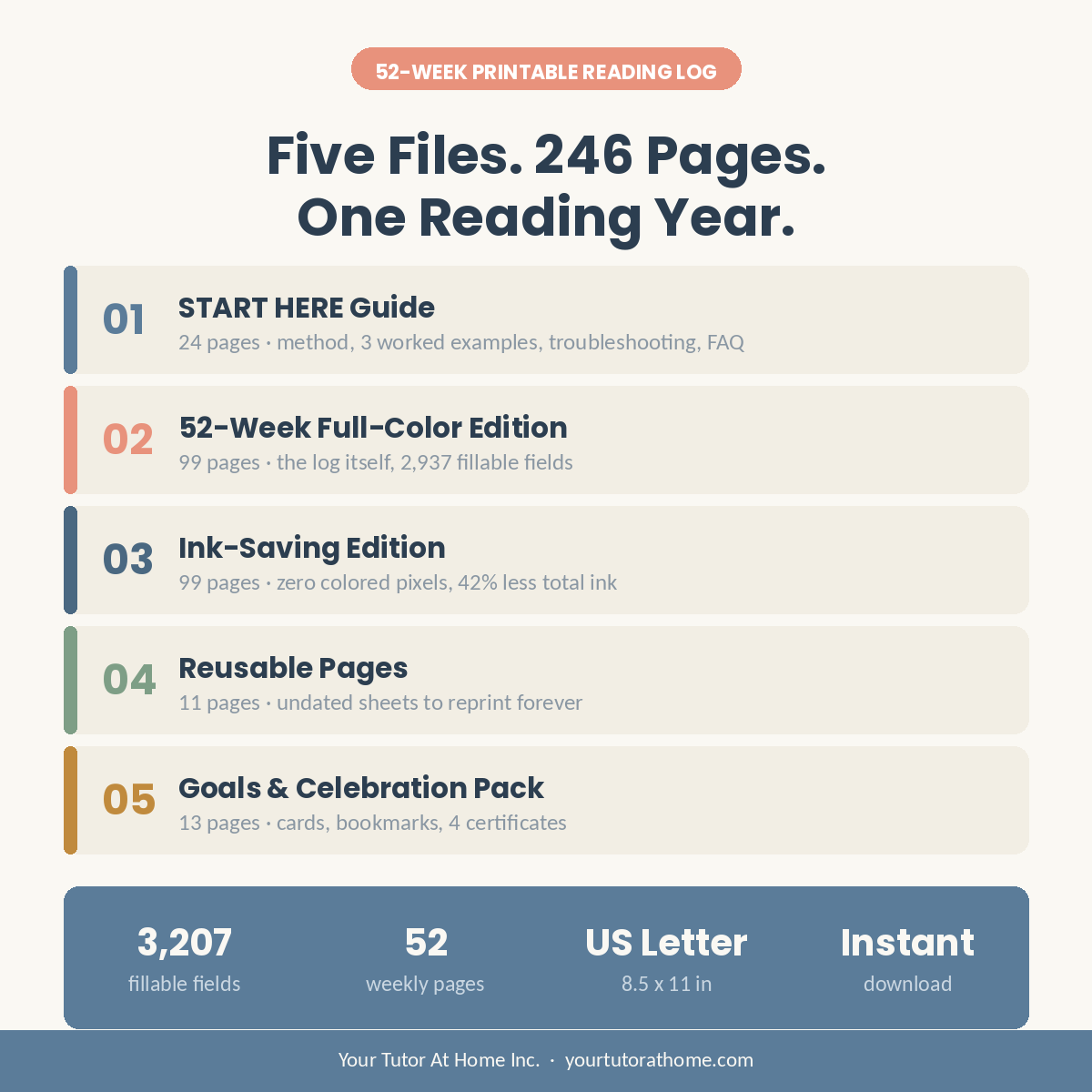
- 01 — START HERE Guide (24 pages) — the
method, three worked examples, goal setting, troubleshooting, a ten-question
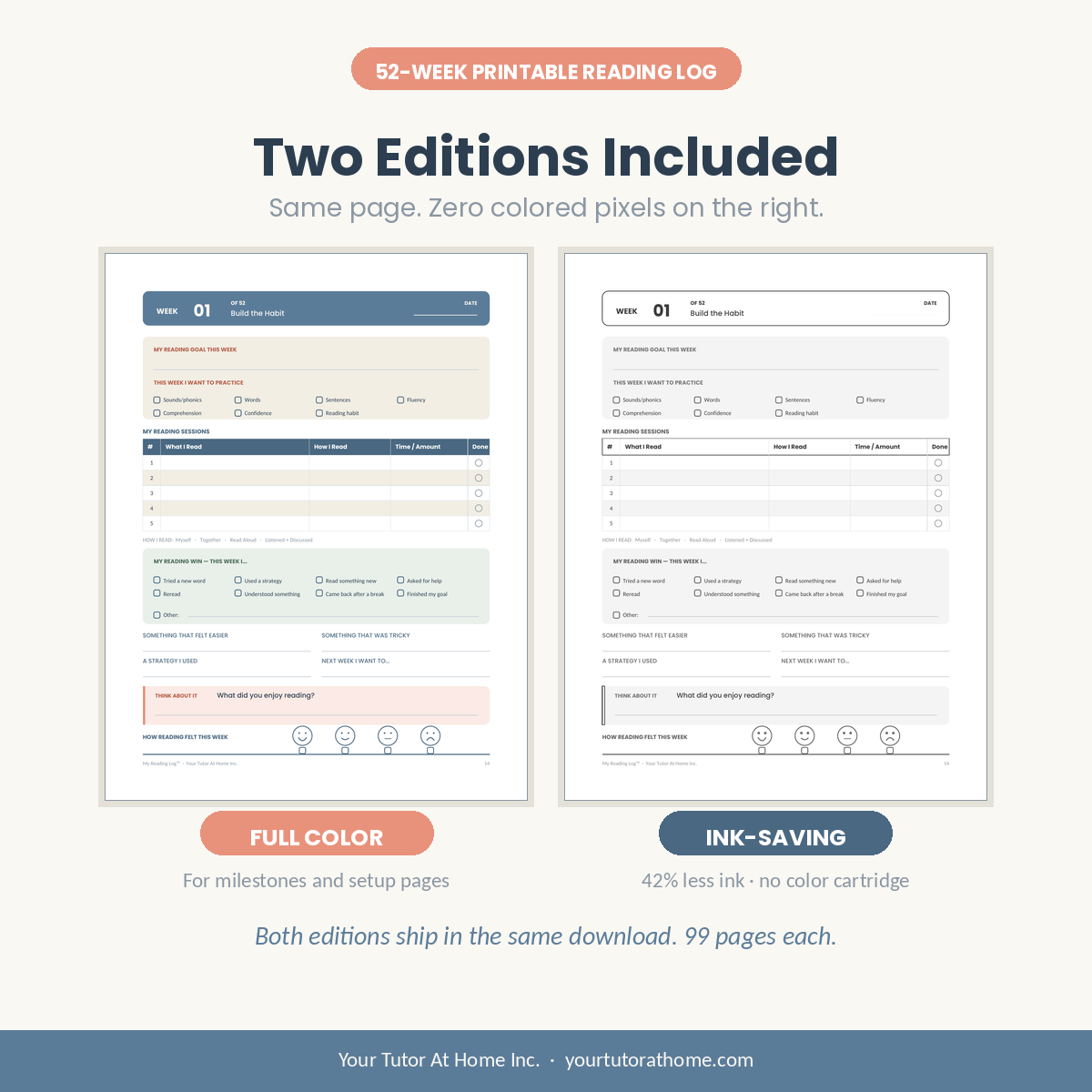
FAQ, book choosing, and printing - 02 — 52-Week Full-Color Edition (99 pages) —
the log itself, fully fillable - 03 — Ink-Saving Edition (99 pages) — the same
99 pages with zero colored pixels, measured at 42% less total ink - 04 — Reusable Pages (11 pages) — undated
weekly, reflection and check-in sheets to reprint forever - 05 — Goals & Celebration Pack (13 pages) —
goal menu, reading reset and routine cards, bookmarks, four certificates
246 pages. 3,207 fillable fields. US Letter. Instant
download. Licensed for every child in your own household — one
printable reading log purchase covers the whole family.
Frequently asked questions
Do we have to start in January? No. Nothing in this
printable reading log is dated. Week one is whichever week you print it in.
Can I use it for two children? Yes, within your household.
Print a second copy — do not share one log between two children, because
the comparison is unavoidable.
Does being read to count? Yes, if you talk about it
afterwards. Listening comprehension runs years ahead of decoding, and cutting
it off removes most of a young child’s vocabulary growth.
My child cannot write much yet. Every weekly page can be
completed with ticks alone. There is a full page in the guide on drawing
instead of writing, dictating, and filling it on screen.
Can we type into it? Yes. This printable reading log is
also a fillable PDF — files 02, 04 and 05 carry over three thousand
fields, including every checkbox.
Is there a daily version? Deliberately not. A daily grid
creates 365 opportunities to fail. Weekly is the smallest unit that survives
an ordinary week.
Where this fits
If you only want individual tracking sheets rather than a full printable
reading log year, start with Reading Tracker Sheets™
($7). If your child needs actual decoding and comprehension practice, the
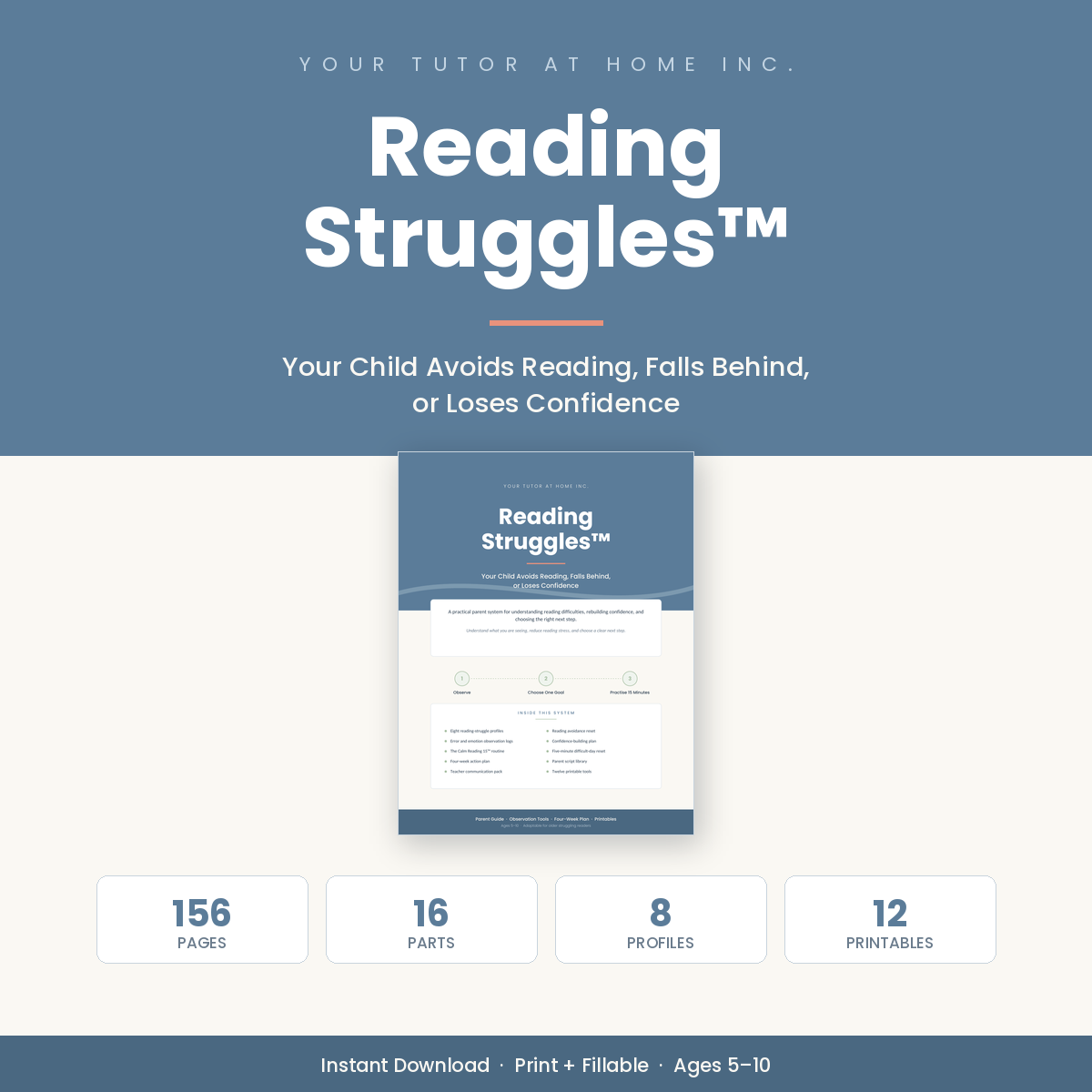
Reading Confidence
Workbook™ ($27) is the child-facing practice book, and the
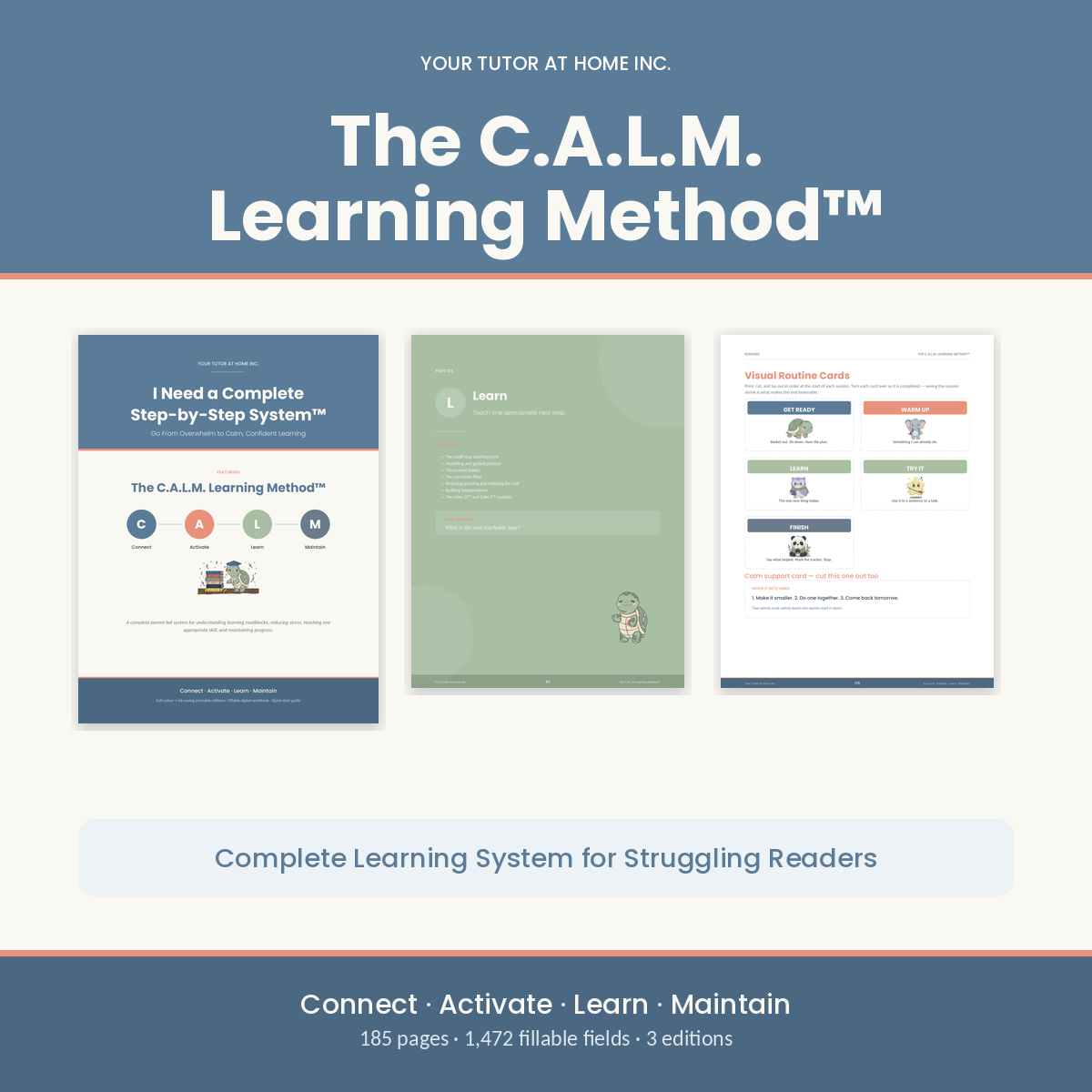
Calm Reading Confidence
Builder™ ($37) is the parent-led framework for when reading
struggles have started affecting confidence. Pairs well with
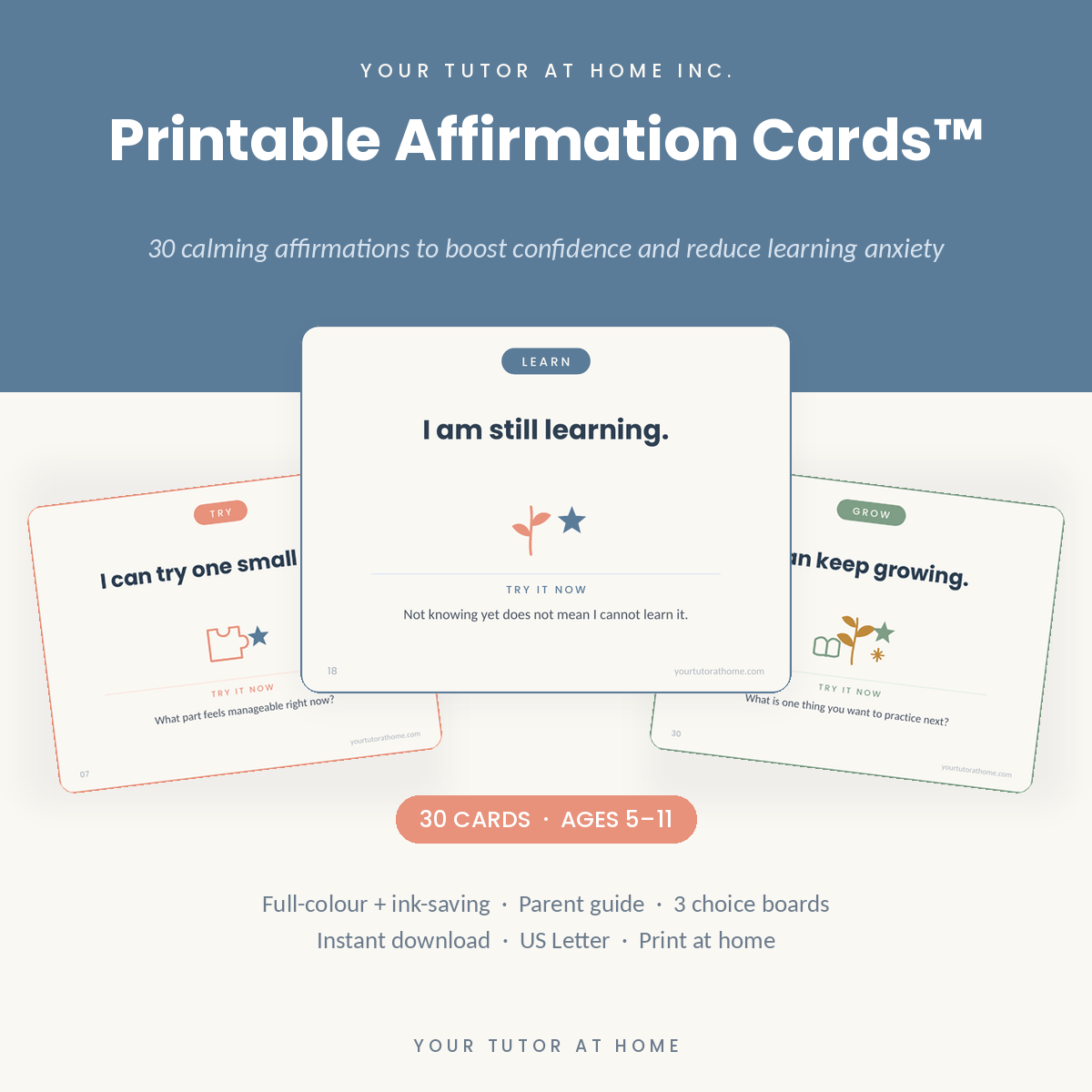
Printable Affirmation
Cards™ ($7). Not sure where to start? Take the
free reading quiz.
You do not need a perfect reading streak. You need a reading habit you
can return to.

Reviews
There are no reviews yet.