
The C.A.L.M. Learning Method™ Complete System
$67.00
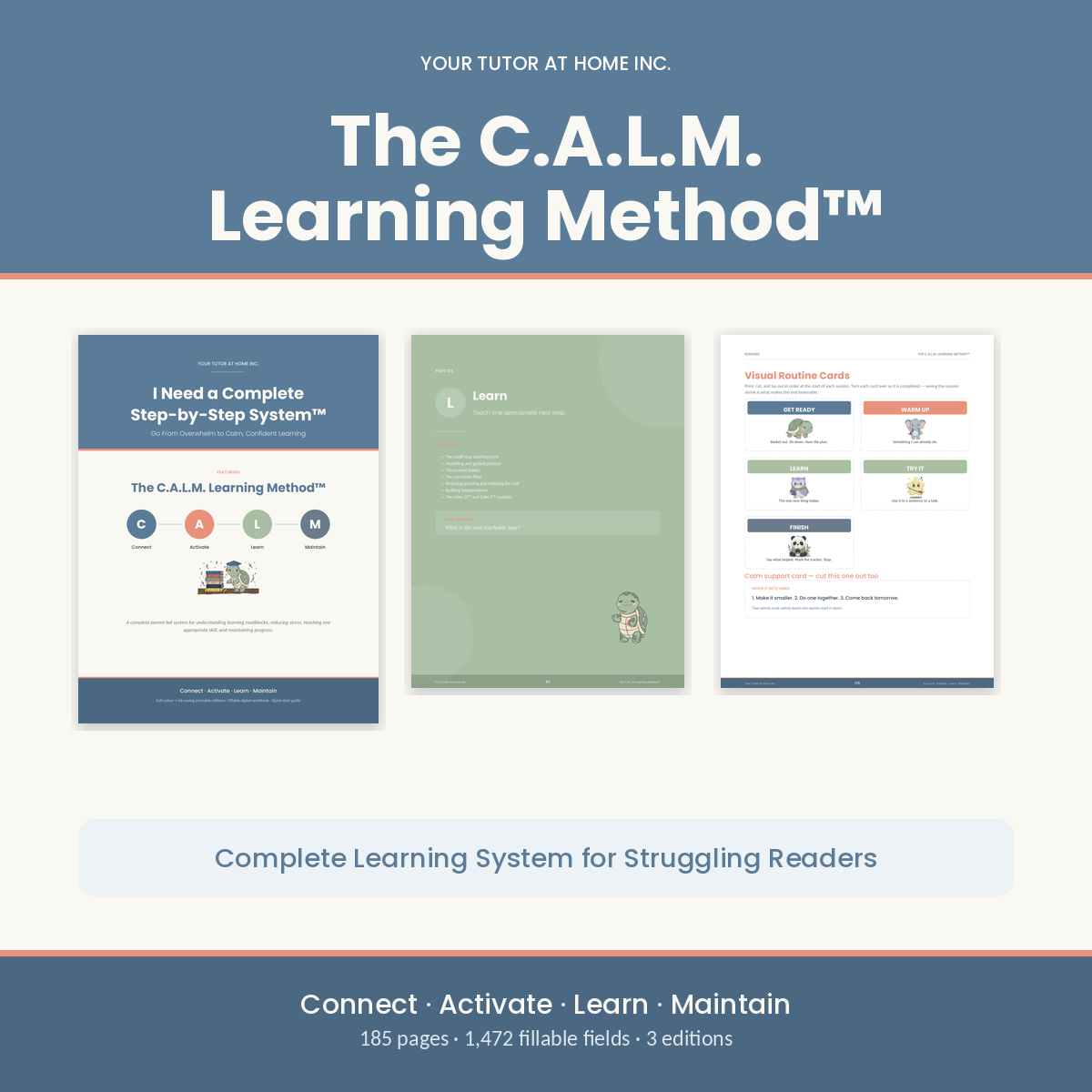
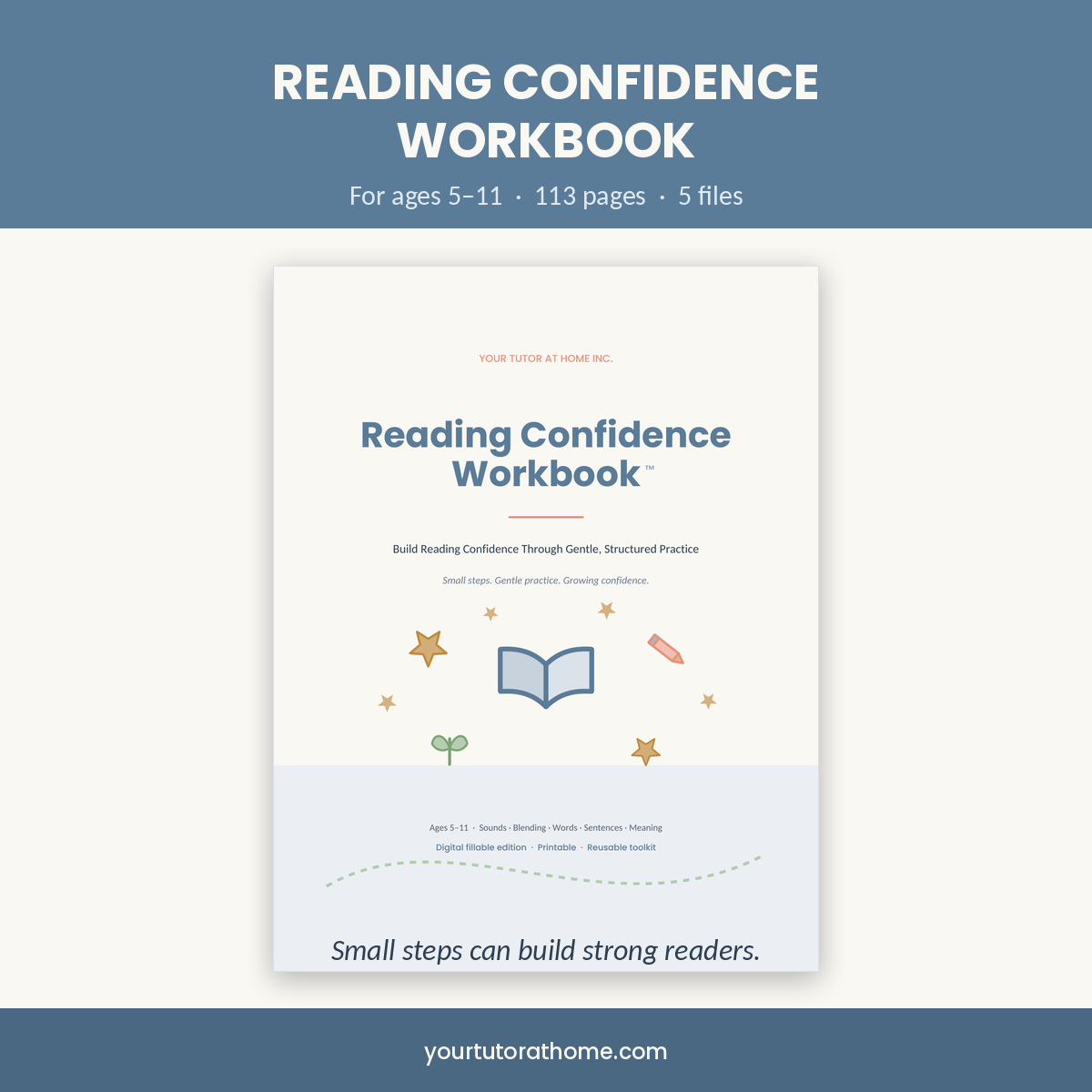
Stop piecing together random worksheets. The C.A.L.M. Learning Method™ gives you a complete learning system for struggling readers — 185 pages that show you how to find the real roadblock, prepare your child to learn, teach one skill at a time, and keep progress going without the nightly battle. Includes a fillable digital workbook with 1,472 typable fields, plus full-color and ink-saving printable editions. Ages 5–11. Instant PDF download.
Product Description
You don’t need another worksheet. You need a complete learning system.
If you’re reading this, you’ve probably already bought the workbooks. There’s a phonics app on the tablet that lasted nine days. There’s a reading programme you abandoned in week three. And every evening still ends the same way — with a child who shuts down, and a parent who doesn’t know whether to push or stop.
Here’s what almost nobody tells you: the problem usually isn’t the resource. It’s that nobody has worked out what’s actually in the way — and until you know that, every worksheet you buy is a guess.
The C.A.L.M. Learning Method™ is the complete learning system that replaces the guessing with a process.
What a complete learning system actually looks like
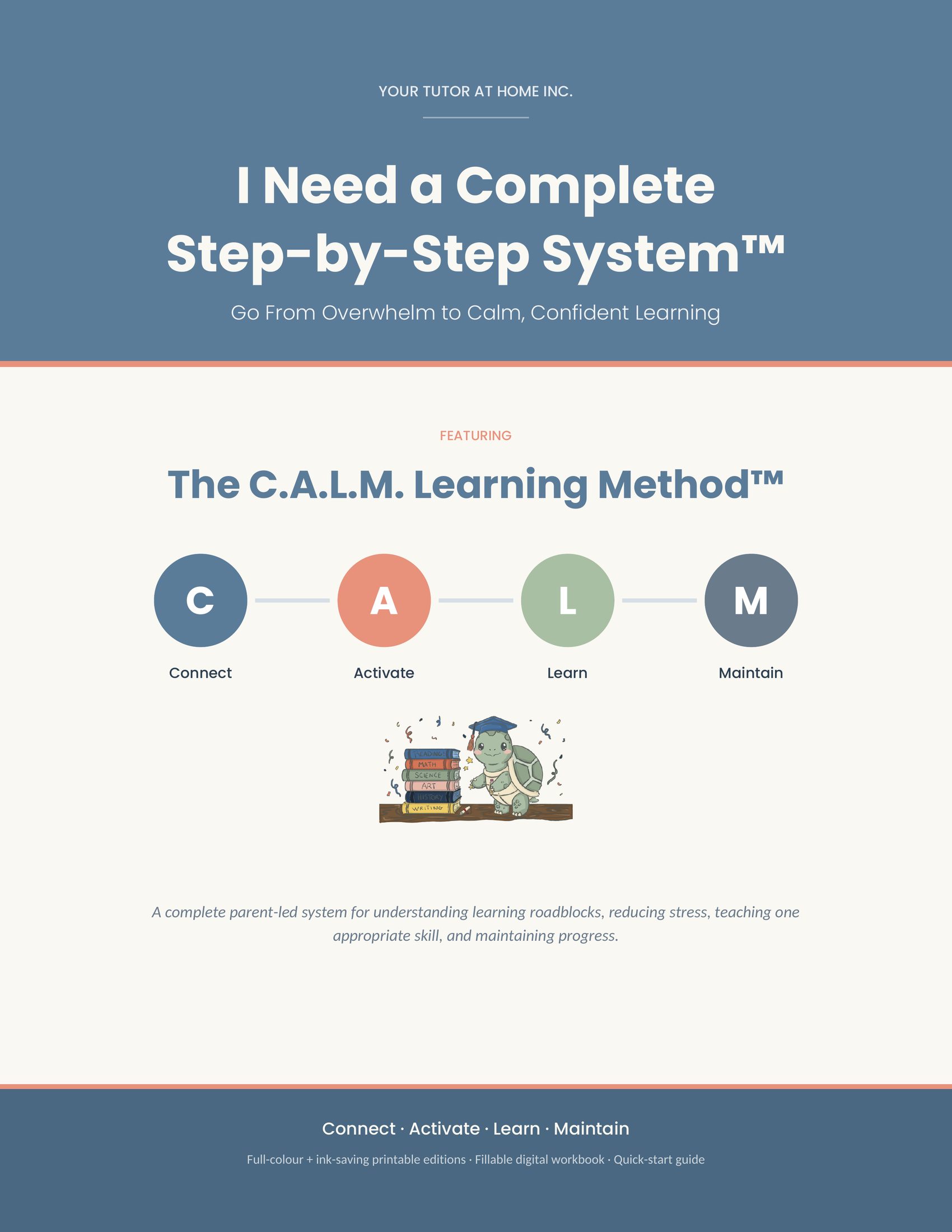
C — Connect · Understand before you correct
Every complete learning system has to start here. Before you teach anything, you find out what your child is actually experiencing. Their strengths, their stress signals, their learning history, and — crucially — what they say helps. Most struggling readers have never been asked directly.
A — Activate · Prepare before you expect performance
A task that’s perfectly matched at 4:15 p.m. can be genuinely impossible at 6:30 p.m. This stage covers readiness, timing, environment, transitions and materials. Many families find the conflict stops here, before any teaching method has been touched.
L — Learn · Teach one appropriate next step
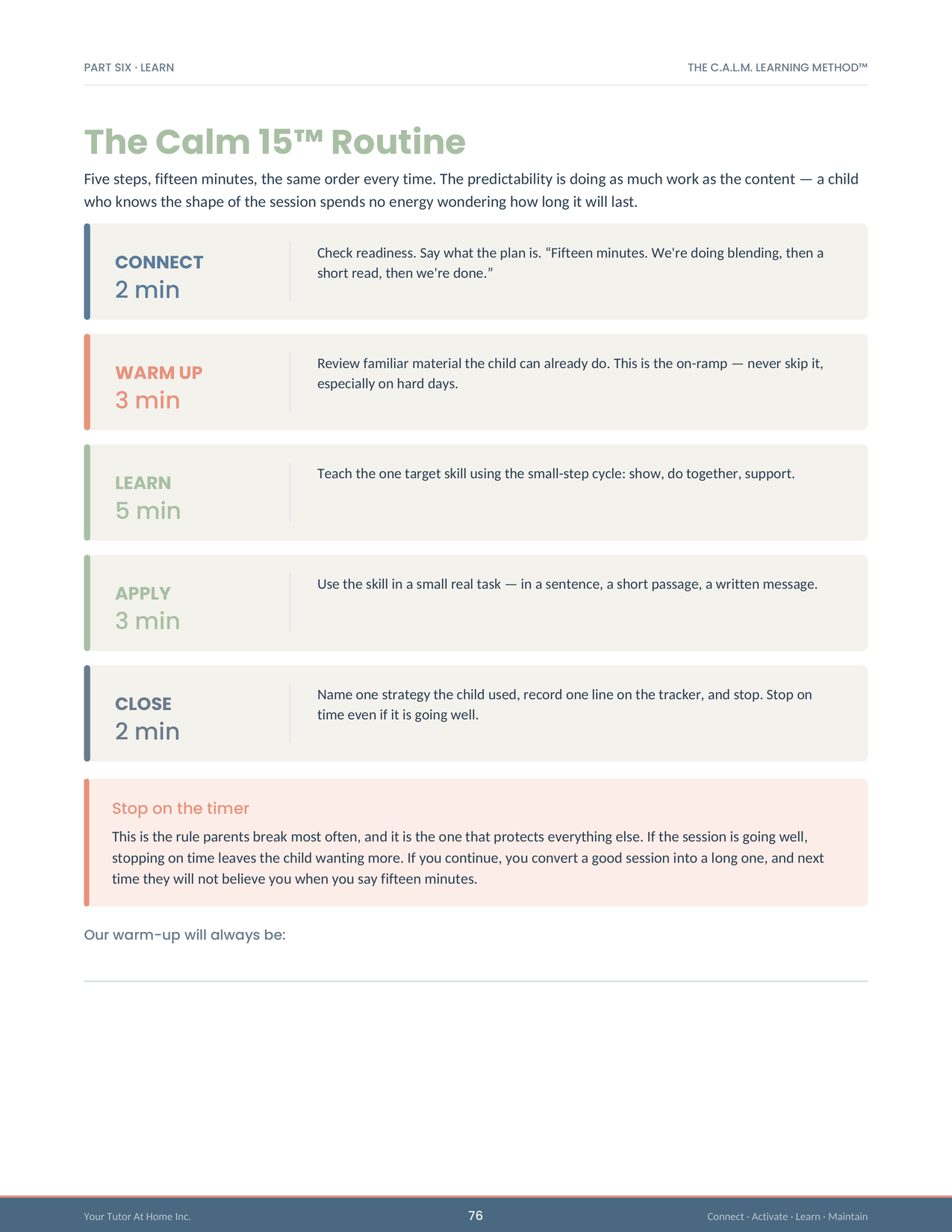
One skill. Fifteen minutes. A five-step teaching cycle, a prompt ladder, and a correction filter that stops you correcting things that aren’t today’s goal.
M — Maintain · Track, adjust, and protect progress
A support-level scale that shows movement weeks before accuracy does, a ten-minute weekly review, and a clear decision rule: continue, adjust, step back, or move forward.
Why this complete learning system works when worksheets haven’t
It finds the roadblock first. A complete learning system has to tell you where to start, not just what to do. A Reading Development Pathway walks you from oral language up to comprehension so you can mark exactly where your child is secure, developing, or stuck — and teach the right level instead of the visible symptom.
The Read-Aloud Test. Four minutes. It tells you definitively whether your child has a comprehension problem or a decoding problem in disguise. This one page redirects more families than anything else in the book — because most children handed comprehension worksheets don’t have a comprehension problem at all.
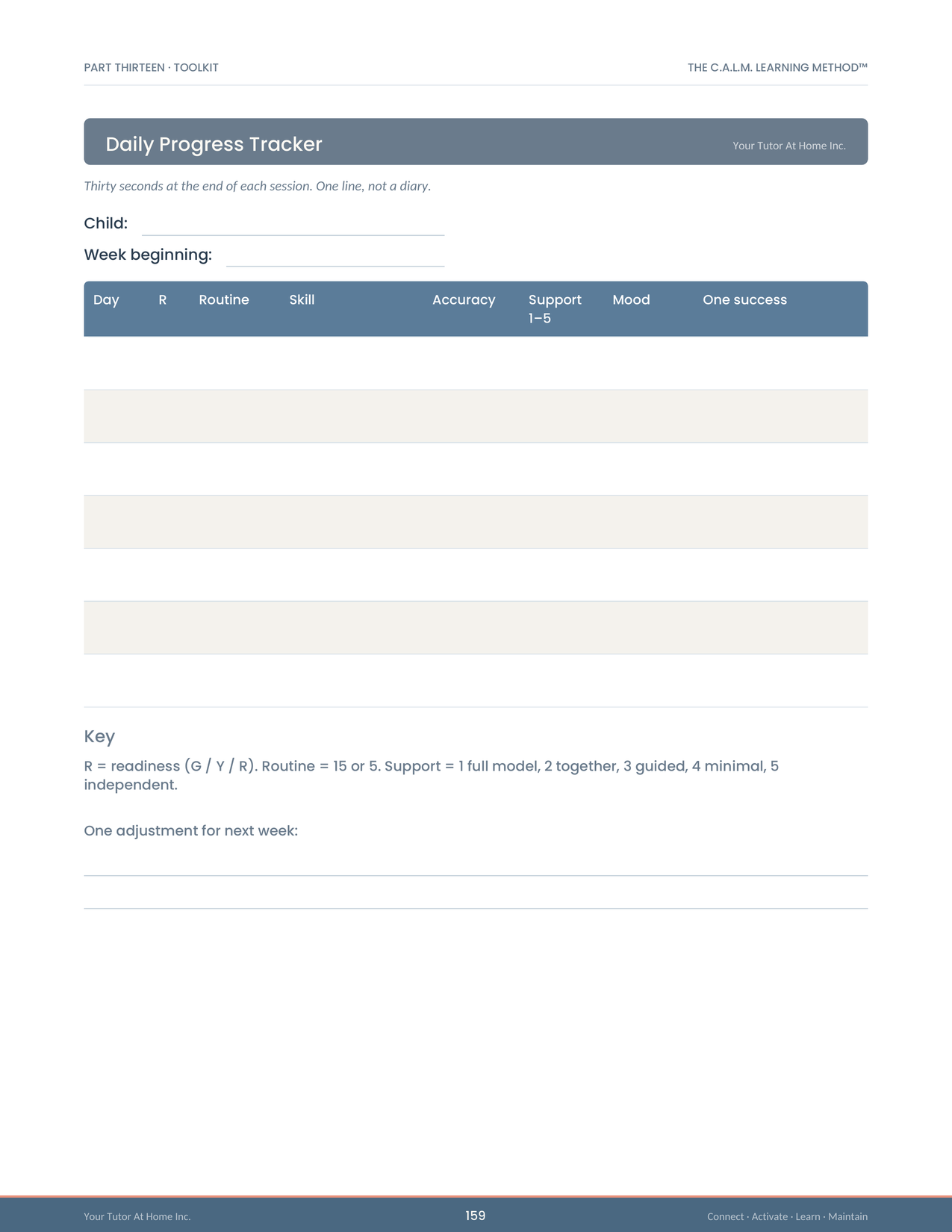
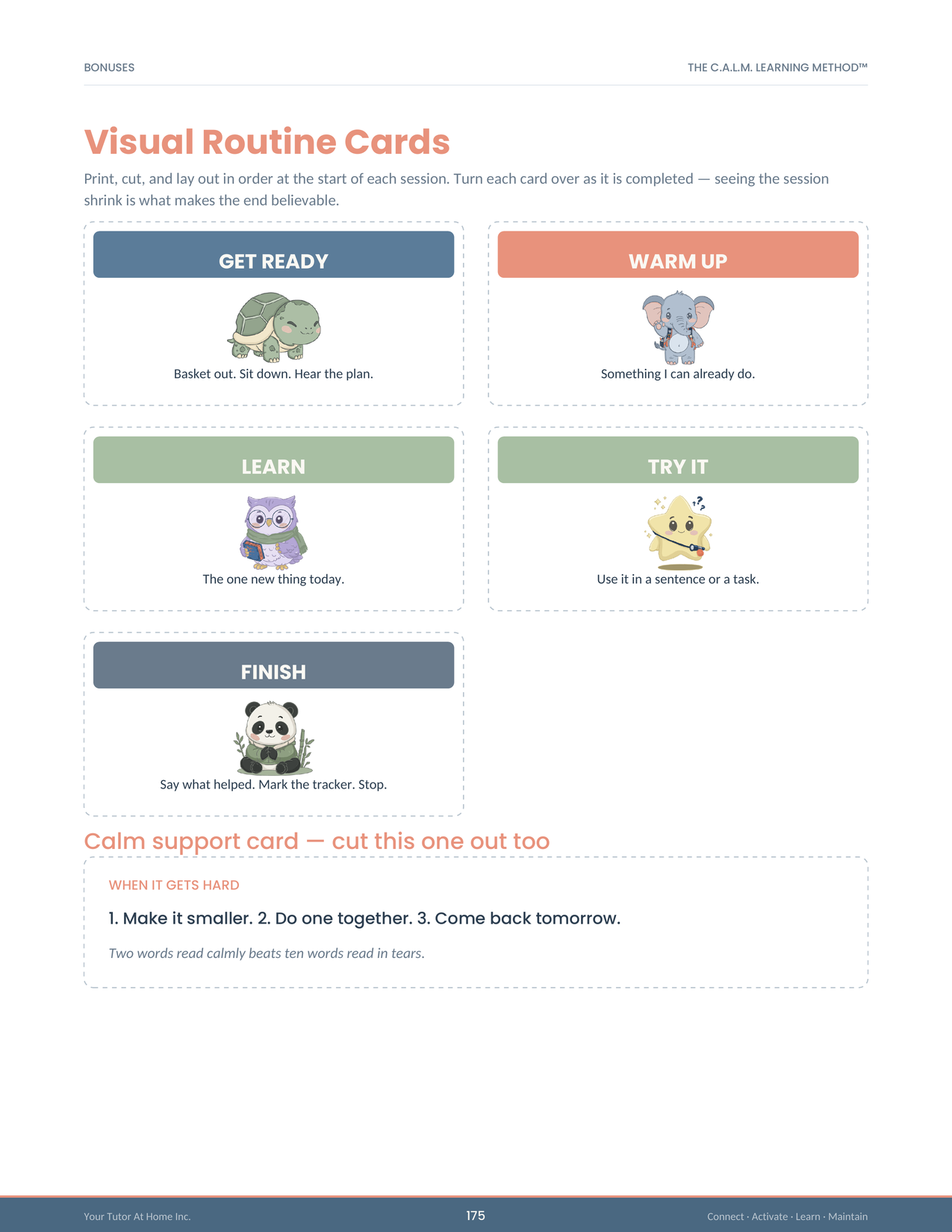
The Calm 15™ routine. Five steps, fifteen minutes, the same order every time: Connect, Warm Up, Learn, Apply, Close. Short enough that you’ll actually run it on an ordinary Tuesday.
The Calm 5™ difficult-day routine. Four minutes for the evenings when the full routine was never going to happen. This is what protects consistency — because the threat to a routine isn’t the good weeks, it’s the night when the only options seem to be everything or nothing.
It tells you what progress looks like before the marks move. School reports are a lagging indicator. This system shows you the seven stages improvement actually arrives in — emotional temperature first, support level second, marks last. Most families quit at week five, four weeks before the evidence would have arrived.
What’s inside the complete learning system — 185 pages
- Thirteen parts, from understanding the overwhelm through to school communication
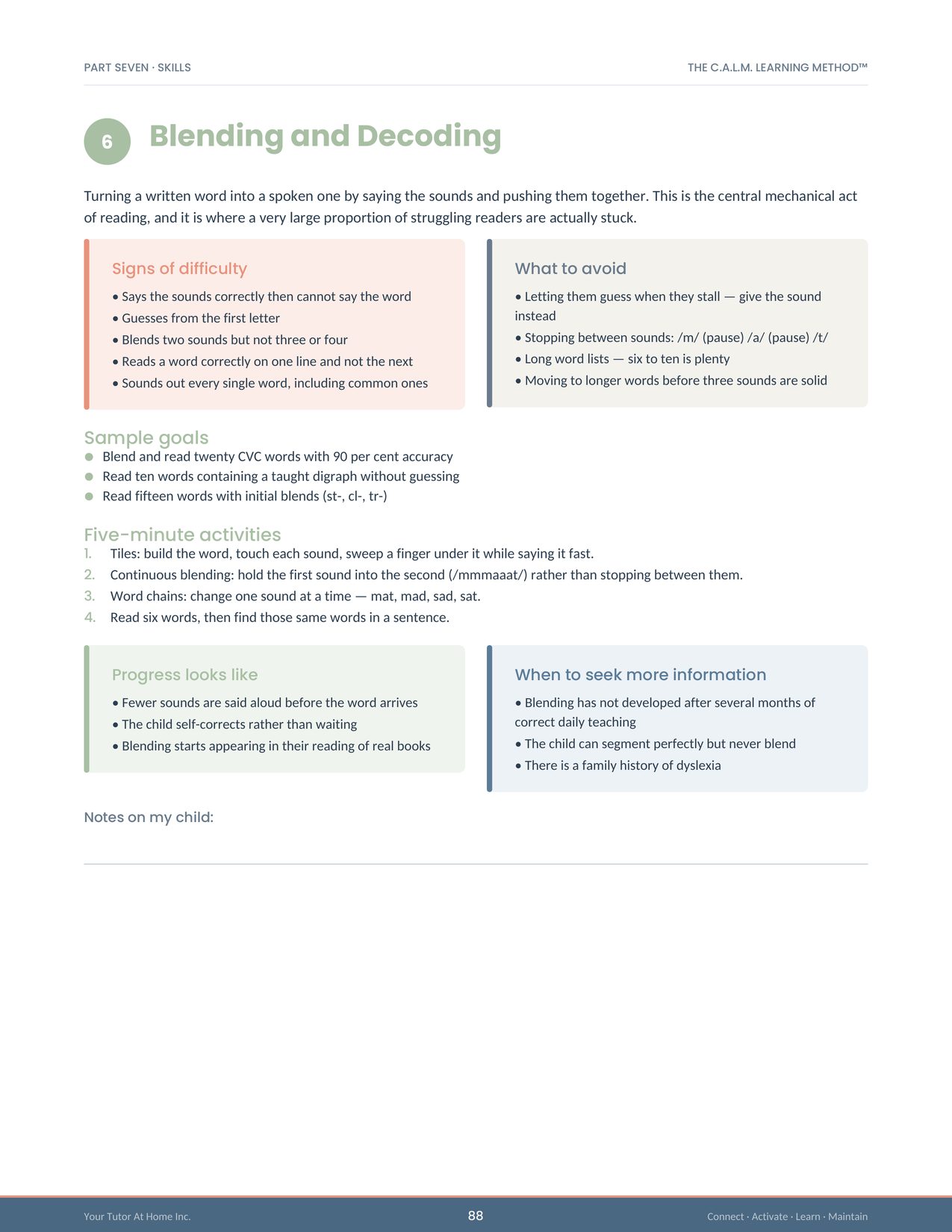
- Twelve reading skill modules — oral language, rhyming and syllables, phonemic awareness, letter recognition, letter sounds, blending and decoding, word recognition, fluency, vocabulary, comprehension, written response, focus and participation
- Twenty-nine printable toolkit pages — learning profile, roadblock map, goal builder, Calm 15™ and Calm 5™ planners, daily tracker, support-level tracker, weekly review, reading log, word ring record, monthly session calendar, routine reset, teacher forms
- A parent script library — what to say when starting, modelling, prompting, correcting, reducing, handling tears, ending, and restarting after a break
- Eleven troubleshooting chapters — refusal, tears, guessing, focus, forgetting, slow reading, weak comprehension, homework battles, parent exhaustion, constant programme switching, and “fine at school, falls apart at home”
- Three real family case studies showing the whole system running end to end
- Your first session, word for word, plus a day-by-day plan for weeks one and two
- A teacher communication toolkit — observation summaries, meeting planners, homework logs, and what to do if the school disagrees with you
- Eight bonuses — quick-start guide, script library, visual routine cards, difficult-day toolkit, what-to-teach-next guide, thirty five-minute activities, reflection prompts, and an FAQ
- A glossary of every term you’ll meet in a school report
Three editions of the complete learning system
| Edition | What it’s for |
|---|---|
| Digital fillable workbook | 1,472 typable fields and 175 tappable contents links. Fill it in on a tablet or laptop — nothing to print. |
| Full-colour printable | Print any page, any time, as many times as you need. |
| Ink-saving printable | The same 185 pages using roughly 70% less ink. For the trackers you’ll print weekly. |
Who this is for
Parents of children roughly ages 5–11 who are struggling with reading, homework, focus, or confidence — including neurodivergent learners and children who have never had a formal diagnosis. It works alongside school support and tutoring rather than replacing them.
This is for you if:
- Your child struggles in more than one area and you don’t know what to address first
- Learning time is stressful, inconsistent, or ends in tears
- You’ve tried several resources without a clear plan
- You need guidance for the good days and the difficult ones
- You want a complete learning system instead of another one-off worksheet
An honest note about what this is not
This complete learning system does not diagnose dyslexia, ADHD, autism, or any other condition, and it is not a substitute for assessment or specialist teaching. It won’t guarantee a particular reading level by a particular date, and it won’t remove every difficult day.
What it will do is give you a complete learning system with a repeatable process for deciding what to work on, a way to tell whether it’s working, and a plan for the days that go badly. If you’d like to pursue assessment as well, Part Twelve is written to help you prepare for exactly that conversation.
Your child is not behind. They are becoming.
Instant download. The complete learning system in three PDF editions, yours to keep and reprint for your household, for as long as you need them.
New to this? Start with the free reading quiz to find your child’s roadblock, or read I Need to Understand Why Reading Is Hard™ first. For the daily routine on its own, see The 15-Minute Calm Learning Routine™ Workbook, and meet the characters at the Mascot Companion Universe™.
For further reading on learning differences, see Understood.org, Reading Rockets, and the CDC’s child development pages.



Reviews
There are no reviews yet.