
Focus Break Cards™
$12.00
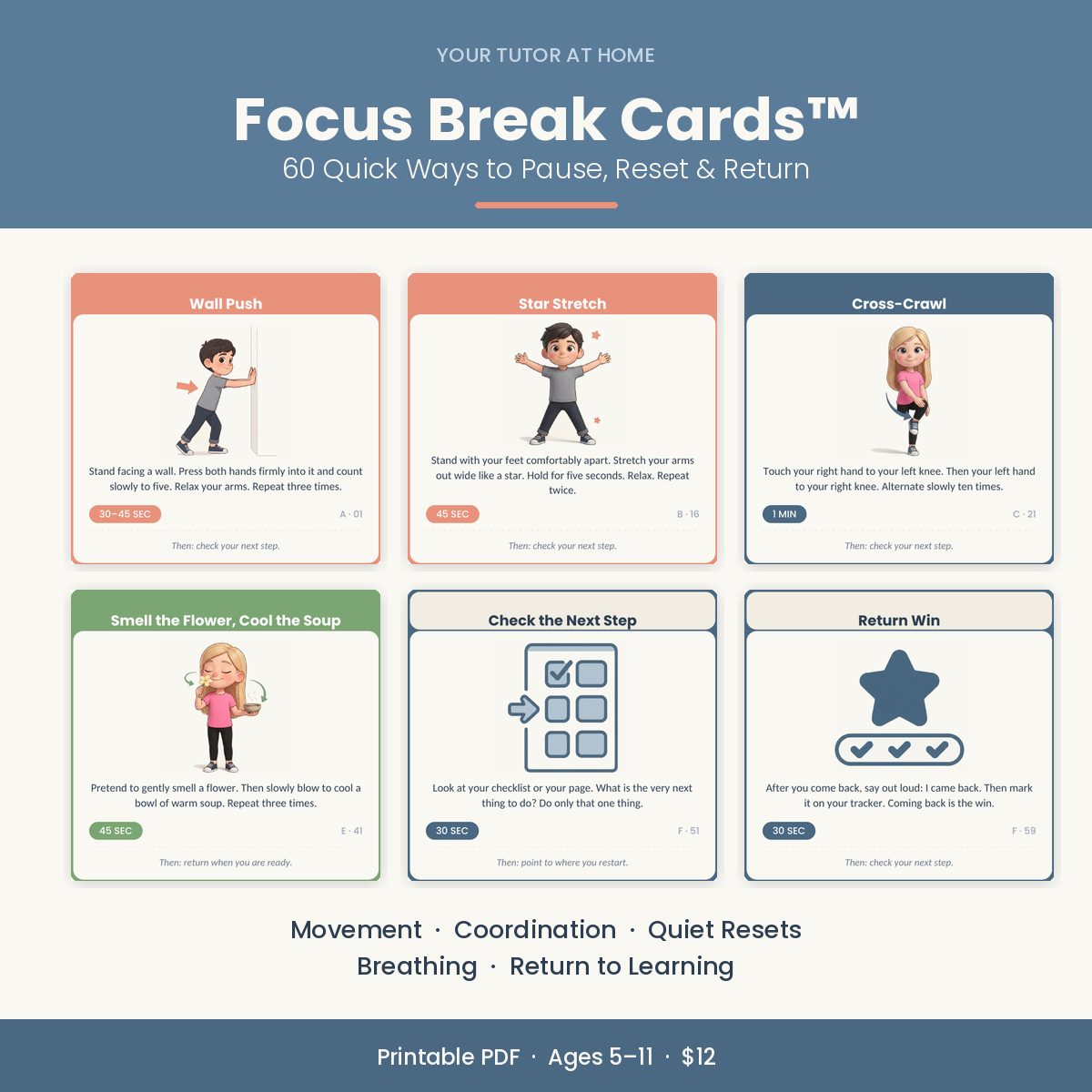
Sixty printable focus break cards for children aged 5–11 — movement, coordination, quiet resets, breathing, and the step most break tools forget: coming back.
When attention drifts, telling a child to “focus” does not show them what to do. Each card names one small action, gives it a time, and ends by telling them what happens next.
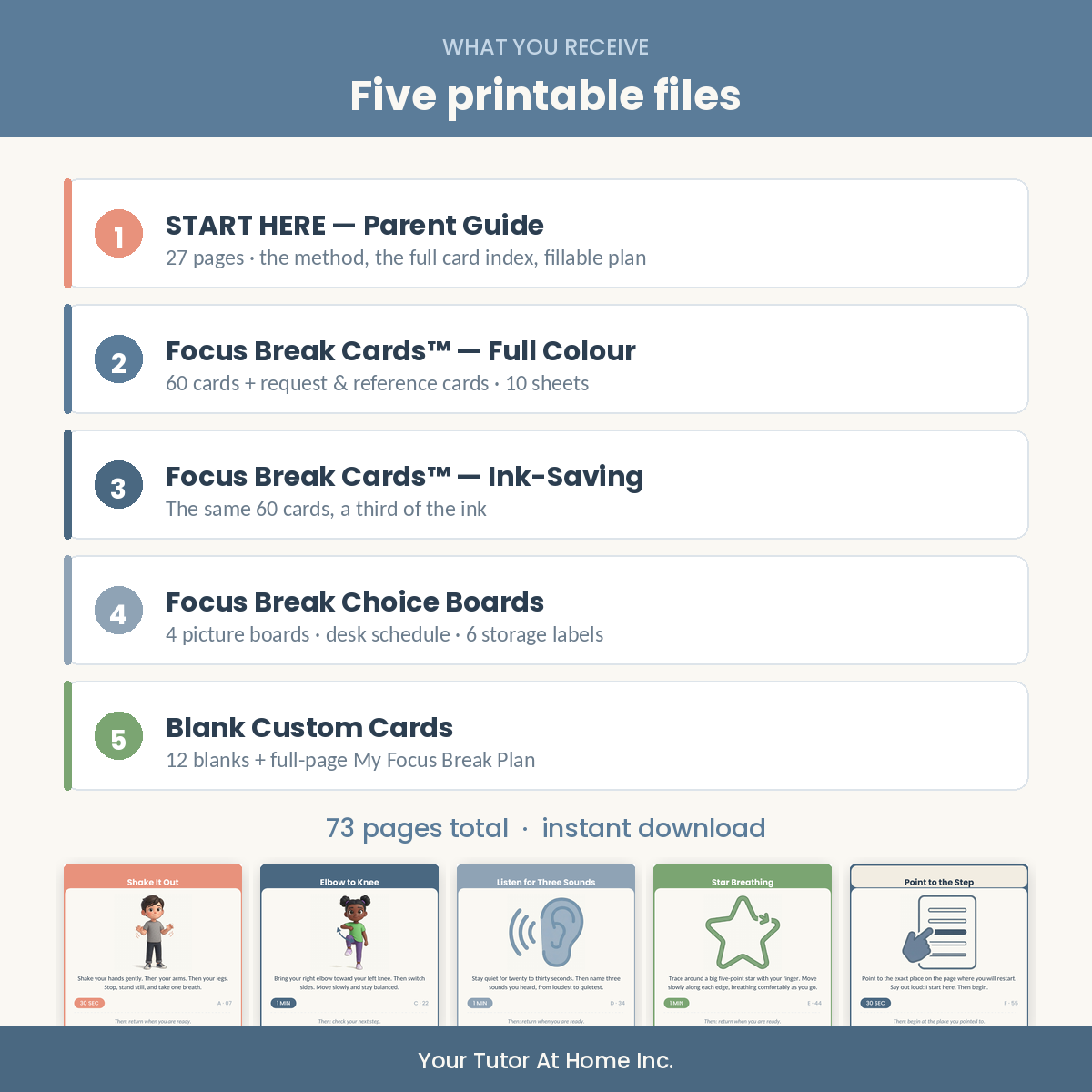
Instant download · 5 files · 73 pages · Full-colour and ink-saving editions · Choice boards · Blank custom cards
Product Description
- What focus break cards are actually for
- Why most brain break cards fail at the same point
- Sixty focus break cards, six categories
- What you receive
- Request cards, for children who cannot say it out loud
- How families actually use these focus break cards
- Breaks are not rewards, and never punishments
- Who this is for
- What this is not
- Where this fits
- Questions parents ask
What focus break cards are actually for
There is a moment every parent recognises. Your child has stopped working. The pencil is being tapped, the same line has been read four times, and the wriggling has started. You say “focus” — and nothing changes, because “focus” is not an instruction a child can follow. It does not describe an action.
That gap is what focus break cards are for. Each card names one small, specific thing a child can do right now, gives it a time, and then tells them what happens next.
Focus Break Cards™ is a printable deck of sixty focus break cards, built for children aged 5–11, to be used inside reading practice, homework, and everyday learning routines at home.
Why most brain break cards fail at the same point
Ask a parent what goes wrong with breaks and you will usually hear the same story. The break happens. The child feels better. And then twenty minutes later they are building something out of cushions in the next room, and the session is over.
The break did not fail. The return failed.
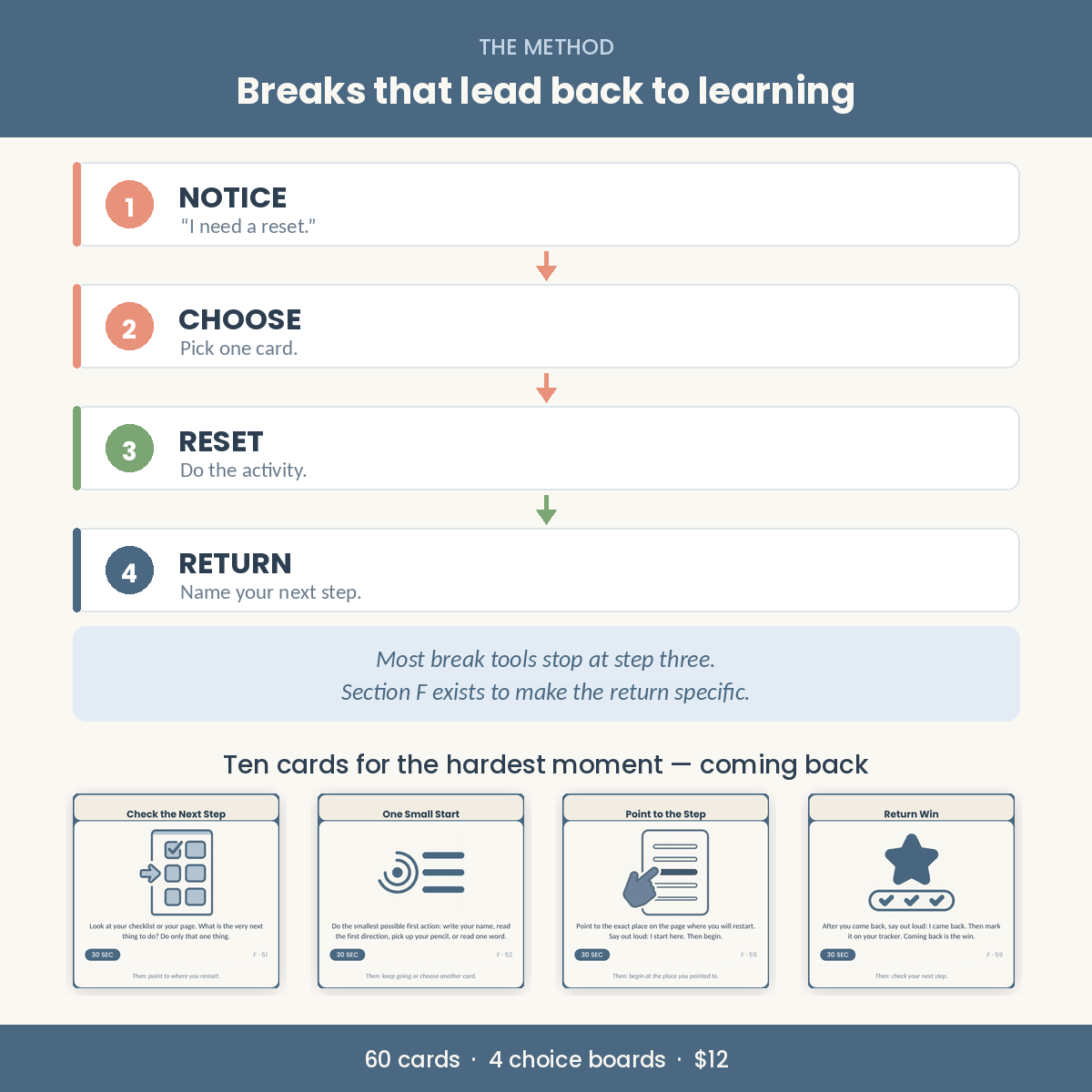
A break with no ending built into it is not a break — it is a stop. That is why this deck treats every break as a four-step shape:
Notice → Choose → Reset → Return
Most brain break cards on the market do the first three steps and finish there. This deck gives the fourth step ten cards of its own, because the hardest twenty seconds of the whole cycle is not the movement. It is the moment afterwards, when a child has to find their place, remember the instruction, and start again.
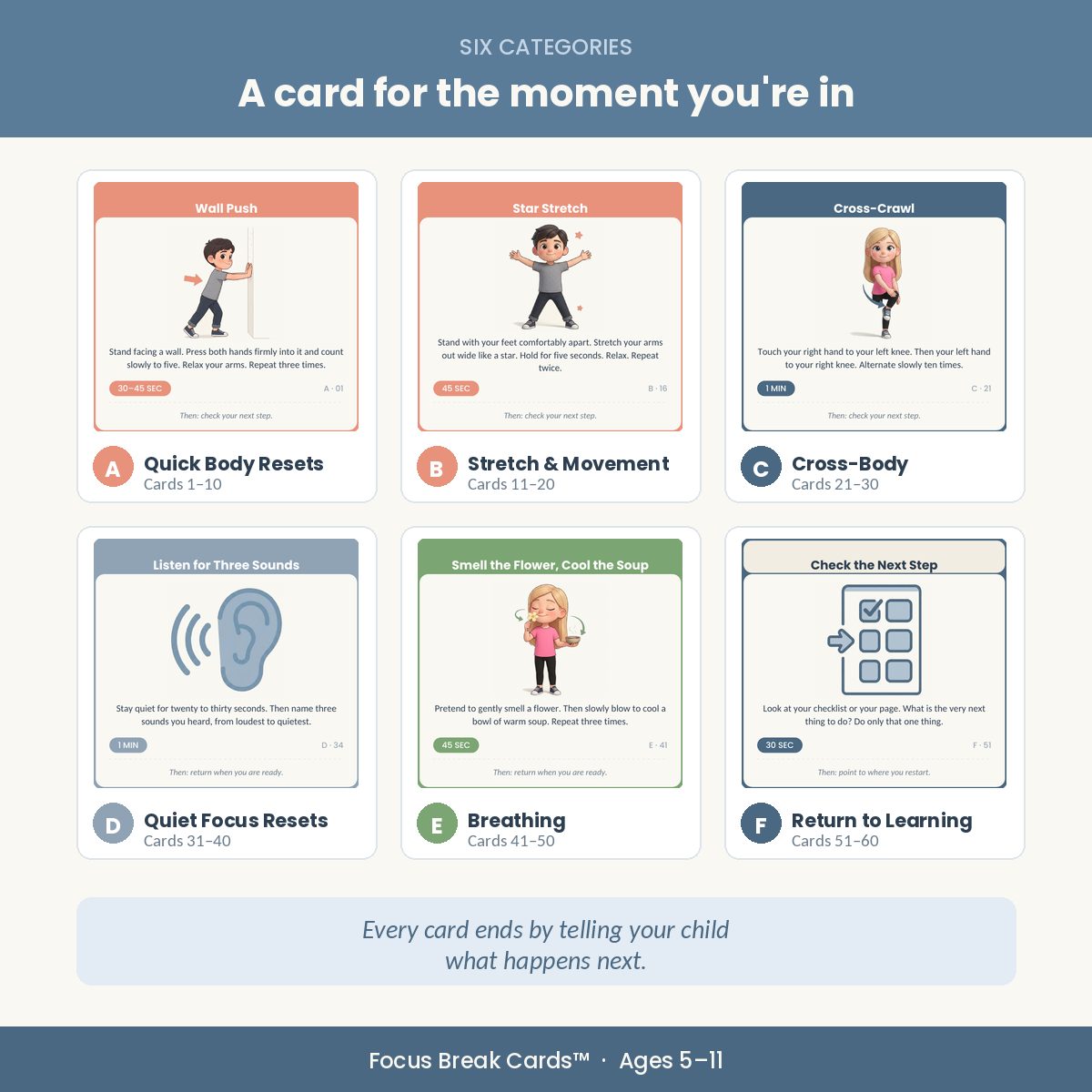
Sixty focus break cards, six categories
The categories are not interchangeable. Handing a wound-up child a breathing card rarely works, and handing a frustrated child a marching card often makes things bigger. Reach for the category that matches what you are actually seeing.
A · Quick Body Resets (cards 1–10)
Short, contained resets that work beside the desk. Wall Push, Hand Press, Shoulder Roll, Shake It Out. Good when the space is small or the room is shared.
B · Stretch & Movement (cards 11–20)
For when a child genuinely needs to leave the chair first. March in Place, Star Stretch, Side Steps, Walk to the Door & Back.
C · Cross-Body & Coordination (cards 21–30)
Both sides of the body working together with a pattern to follow. Cross-Crawl, Elbow to Knee, Pattern Clap, Mirror Me.
D · Quiet Focus Resets (cards 31–40)
A change of pace with no extra movement or noise. Find Five, Listen for Three Sounds, Pattern Hunt, One-Minute Doodle. These are the cards for shared rooms, late evenings, and children who are already over-stimulated.
E · Breathing & Slow-Down (cards 41–50)
Comfortable, unforced breathing. No breath-holding, no fixed counts. Smell the Flower Cool the Soup, Finger Breathing, Shoulder Drop, Pause for Three Breaths.
F · Return to Learning (cards 51–60)
The step that turns a break back into work. Check the Next Step, One Small Start, Two-Minute Restart, Point to the Step, Return Win.
What you receive
Five printable PDF files, 73 pages, delivered instantly. Two of them are the brain break cards themselves; the other three are the guide, the choice boards, and the blanks.
1 · START HERE — Parent Guide (27 pages). The whole method in ten minutes of reading: when to offer a break, which card to reach for, how a break ends, and what to do on the evenings it goes wrong. Includes an index of all sixty cards with a note on when each one earns its place, plus a fillable My Focus Break Plan.
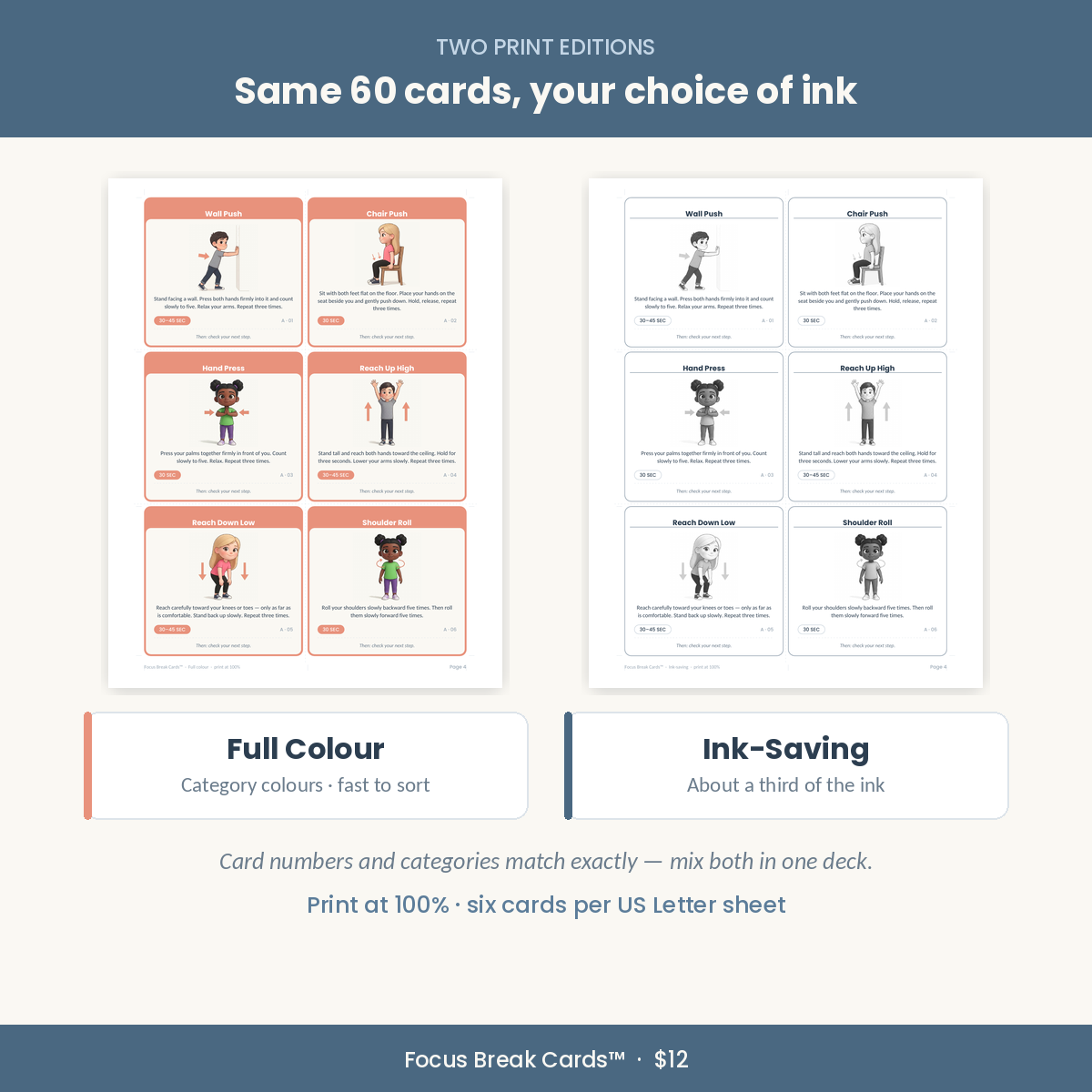
2 · Focus Break Cards™ — Full Colour. All sixty brain break cards, six per US Letter sheet, plus four request cards and two reference cards. Finished card size approximately 3.4 × 3.2 inches.
3 · Focus Break Cards™ — Ink-Saving Edition. The same sixty brain break cards with the colour blocks removed, using roughly a third of the ink. Card numbers and categories match exactly, so you can mix both editions in one deck.
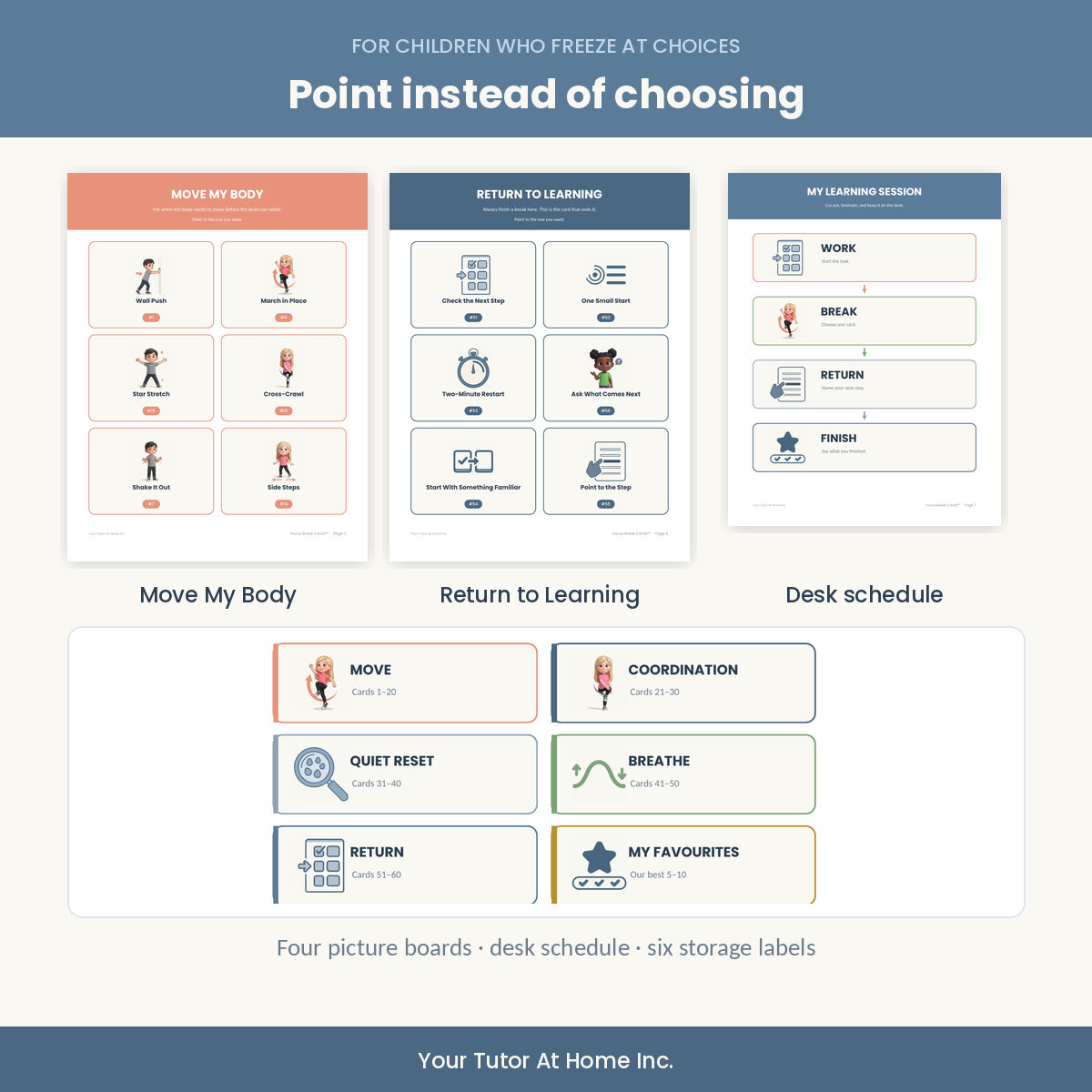
4 · Focus Break Choice Boards. Four point-and-choose picture boards, a WORK → BREAK → RETURN → FINISH desk schedule, and six printable storage labels.
5 · Blank Custom Cards. Twelve blanks in the same format, so strategies your child’s teacher or occupational therapist already recommended can live in the same deck, plus a full-page fillable plan.
Request cards, for children who cannot say it out loud
Four extra cards let a child hand you something instead of finding the words: I Need a Break · I Need to Move · I Need Help · I’m Ready to Return.
These are not behaviour cards, and they should never be withheld or earned.
How families actually use these focus break cards
Do not print all sixty and hand them over. Sixty focus break cards is a library, not a deck.
Choose five to ten with your child at a calm moment, put them on a binder ring, and keep them where the work happens. The parent guide includes a ten-minute method for making that choice, and for rotating cards when the novelty wears off. Keep at least two return cards in the working set — those are the ones that end the break.
Breaks are not rewards, and never punishments
The moment a break becomes something a child earns or loses, it stops being a tool they can reach for. Children learn that distinction fast, and once a break is a reward, asking for one starts to feel like admitting failure.
Instead of “If you finish this page nicely, you can have a break,” the deck is built around “Let’s do this page, and use a card whenever you need one.” Your child is learning to notice their own state and choose a response — which is a real skill, not a concession.
Who this is for
These focus break cards are for children aged 5–11 who fidget, drift, rush, or stall during homework and reading. Children who find transitions hard. Children who ask for breaks that then never end. Neurodivergent learners and children with no diagnosis at all — the deck makes no assumptions either way.
It is also for the parent who has run out of things to say other than “concentrate.”
What this is not
These focus break cards are a general educational tool, not a clinical one. They are not ADHD treatment, not occupational therapy, not a sensory-processing assessment, and not a substitute for advice from your child’s doctor or therapist. If a professional has given your child specific strategies, those come first — and the blank cards exist so you can write them into the same system.
All activities are general movement and reset ideas. Adapt or skip any movement that is uncomfortable, medically inappropriate, or inconsistent with guidance from your child’s qualified healthcare professionals.
If you would like to read more about attention and self-regulation in children generally, Understood.org and Reading Rockets both publish free, evidence-based parent guidance, and the CDC maintains general information on children’s developmental milestones.
Where this fits
These focus break cards are the quick-tool tier of the focus range. If you want daily focus-building practice, the Calm Focus & Attention Builder™ is the next step at $17. If you need to understand why attention is breaking down in the first place, Focus & Attention™ is the full parent guide at $27. Many families also pair the deck with the 15-Minute Calm Learning Routine™ Workbook.
Questions parents ask
Do I need a printer at home? Yes, or access to one. Everything is print-at-home on US Letter. Cardstock helps but ordinary paper works.
How long does each card take? Most focus break cards in this deck run thirty seconds to three minutes. A few return cards take two.
My child refuses breathing exercises. Then skip section E entirely and use section D. The quiet focus cards do the same job by a different route, and the guide explains when to reach for each.
Will this work for a five-year-old and a ten-year-old? Yes, though you will choose different focus break cards for each. The card text is written to be read aloud to a younger child and read independently by an older one.
Is there a physical product? No. These are printable focus break cards you download and print yourself, which is why sixty of them cost $12.
Focus break cards work best when they are planned into the session rather than reached for after it has already gone wrong. Print the deck once, choose your child’s best five to ten, and put them where the work happens.
Reviews
There are no reviews yet.