
Homework Calm Checklist™
$8.00
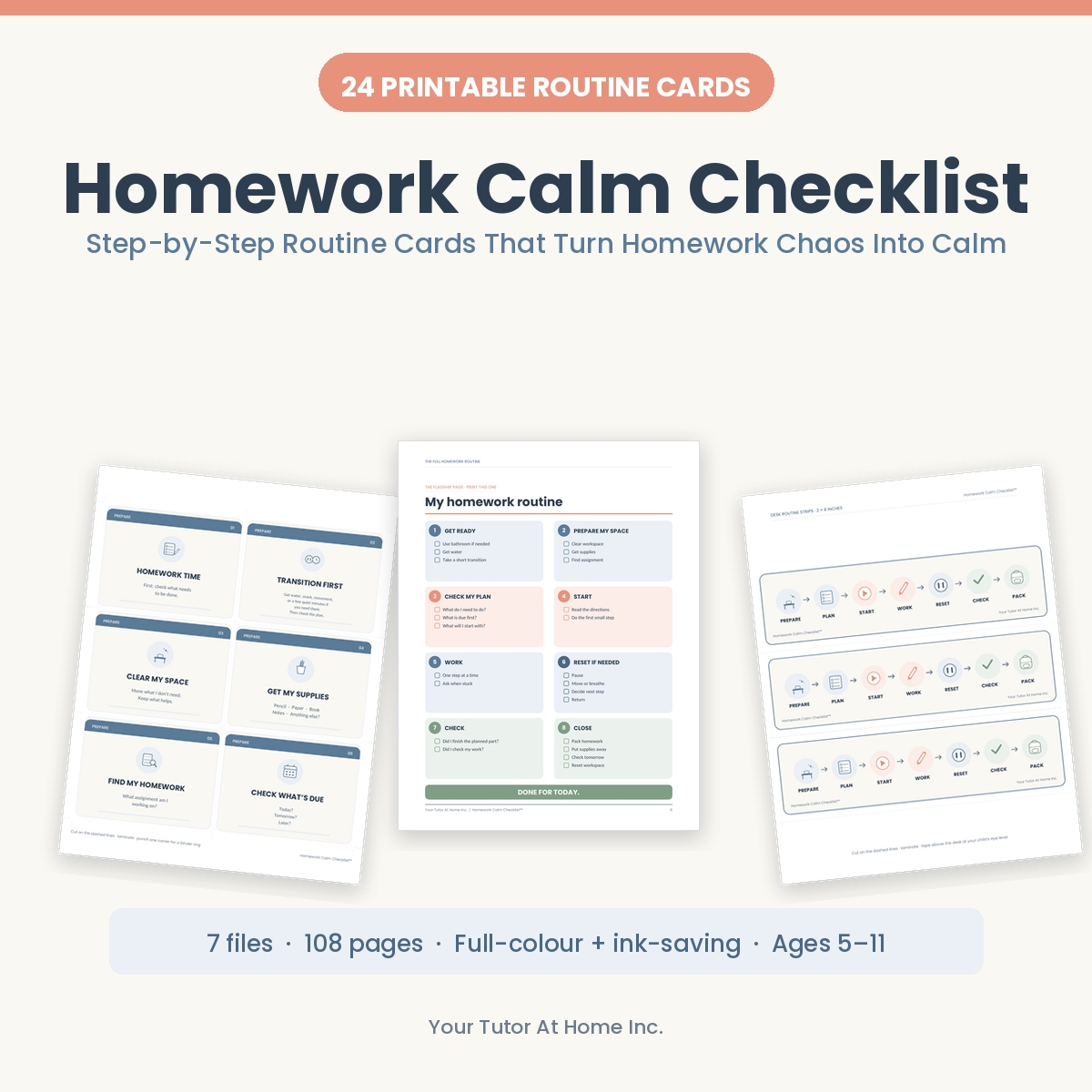
A printable homework checklist and 24 step-by-step routine cards that show your child what to do before, during and after homework — prepare, start, work, reset, check, close. Includes a 27-page parent guide, choice boards, desk strips and an ink-saving edition. Ages 5–11.
Product Description
A Printable Homework Checklist That Makes the Next Step Visible
Most homework afternoons do not fall apart because the work is too hard. They fall apart in the gaps — the twenty minutes before anyone sits down, the moment a child stares at the page without knowing where to begin, the break that quietly becomes the end of the session.
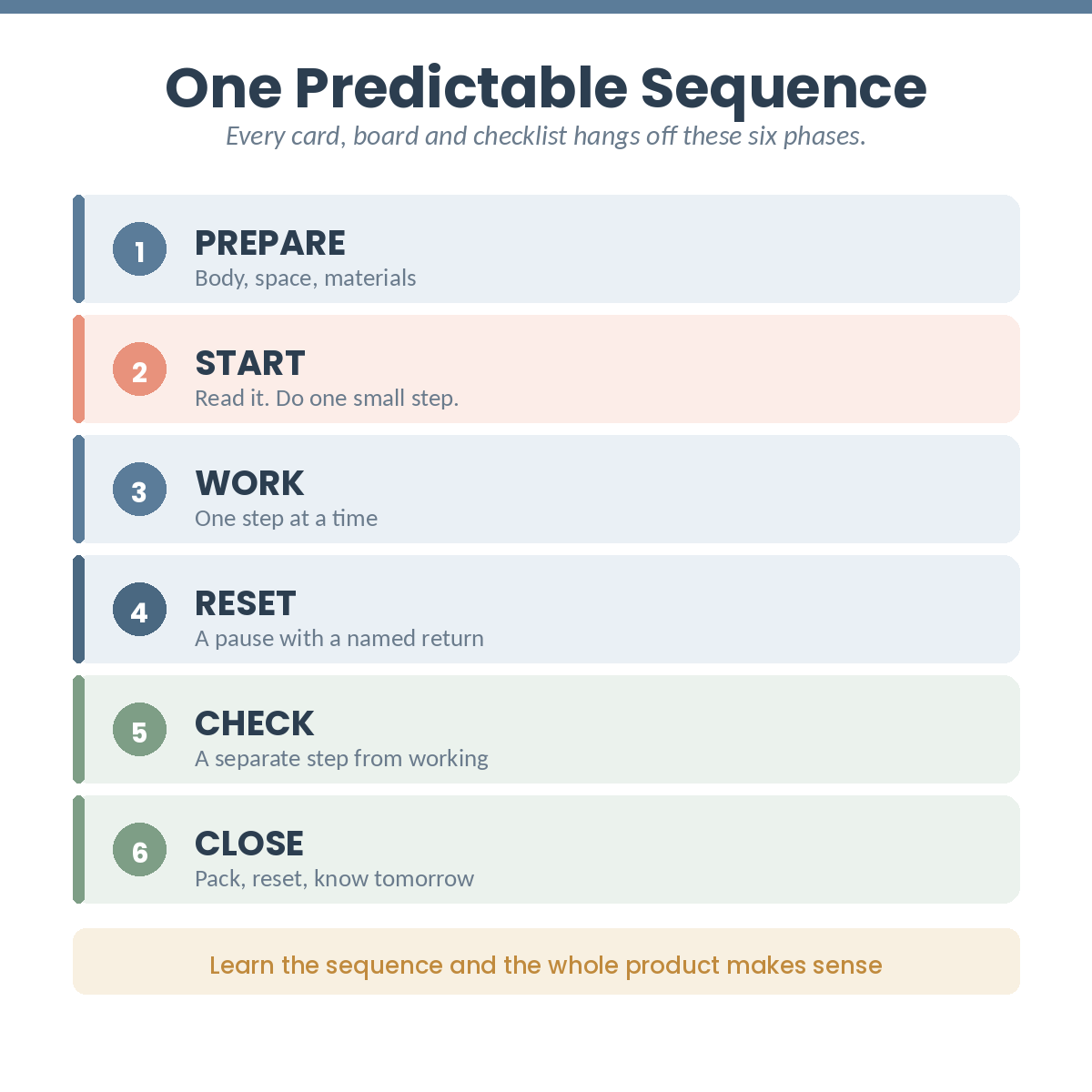
This printable homework checklist gives your family one repeatable sequence to follow instead: prepare, start, work, reset, check, close. Your child stops asking what comes next, and you stop having to answer.
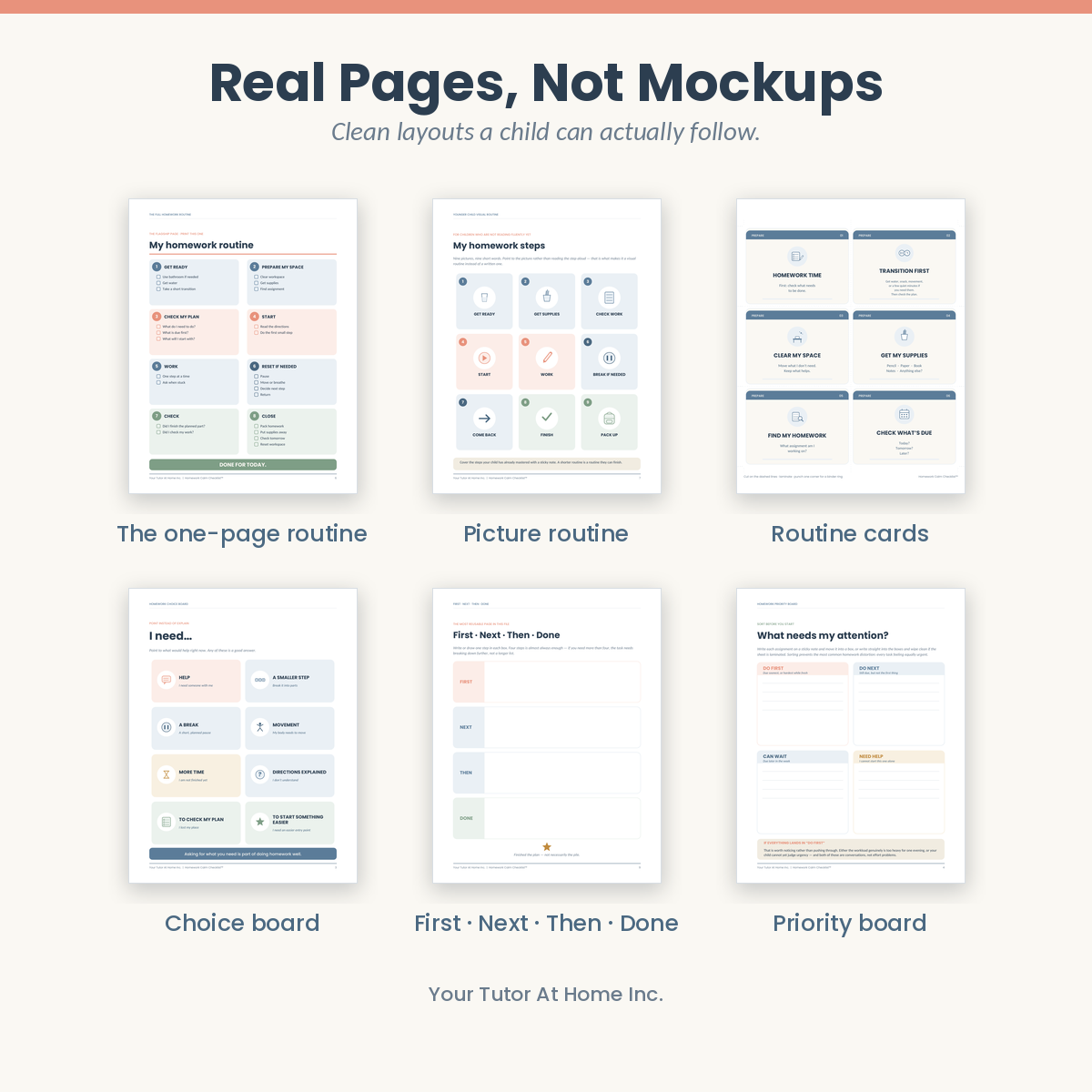
Built by Mrs. Nathalie, an experienced tutor with more than twenty years supporting struggling readers and children with learning differences, the pack includes the one-page routine, twenty-four printable routine cards, a reset deck for the hard days, choice boards, desk strips, and a parent guide that explains exactly how to use them.
Why a Visible Homework Checklist Works
Homework asks a child to do two demanding things at once. The first is the actual academic work. The second is running the session — remembering the steps, noticing what comes next, monitoring progress, deciding when to stop, and starting again after interruptions.
Adults do that second job so automatically it is easy to forget it is a job at all. For a child between five and eleven it is a skill still under construction. A homework checklist takes that second job out of your child’s head and puts it on the desk, which frees up the mental room they need for the work itself.
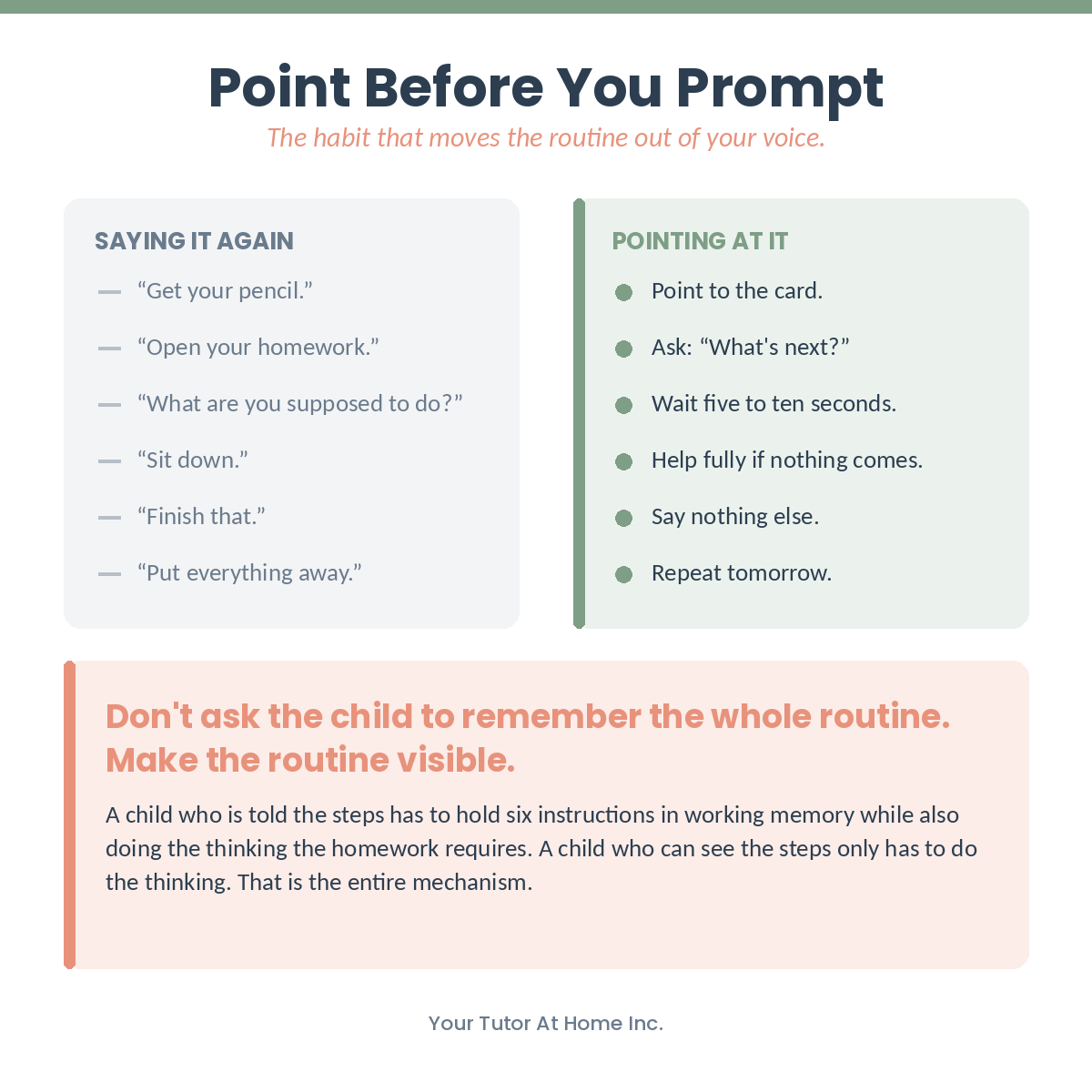
The whole product rests on one sentence, printed on page three:
- Don’t ask the child to remember the whole routine. Make the routine visible.
The Six-Phase Homework Checklist Sequence
- Prepare — transition, water or snack, clear desk, supplies out, assignment located
- Start — read the directions, choose one small first action, do that one action
- Work — one step at a time, with a named place to ask for help
- Reset — a planned pause with a named return point
- Check — a separate step from working, not an accusation
- Close — pack, put supplies away, reset the space, know what tomorrow holds
Every card, board and page in this homework checklist hangs off those six phases, so once you know the sequence the whole pack makes sense.
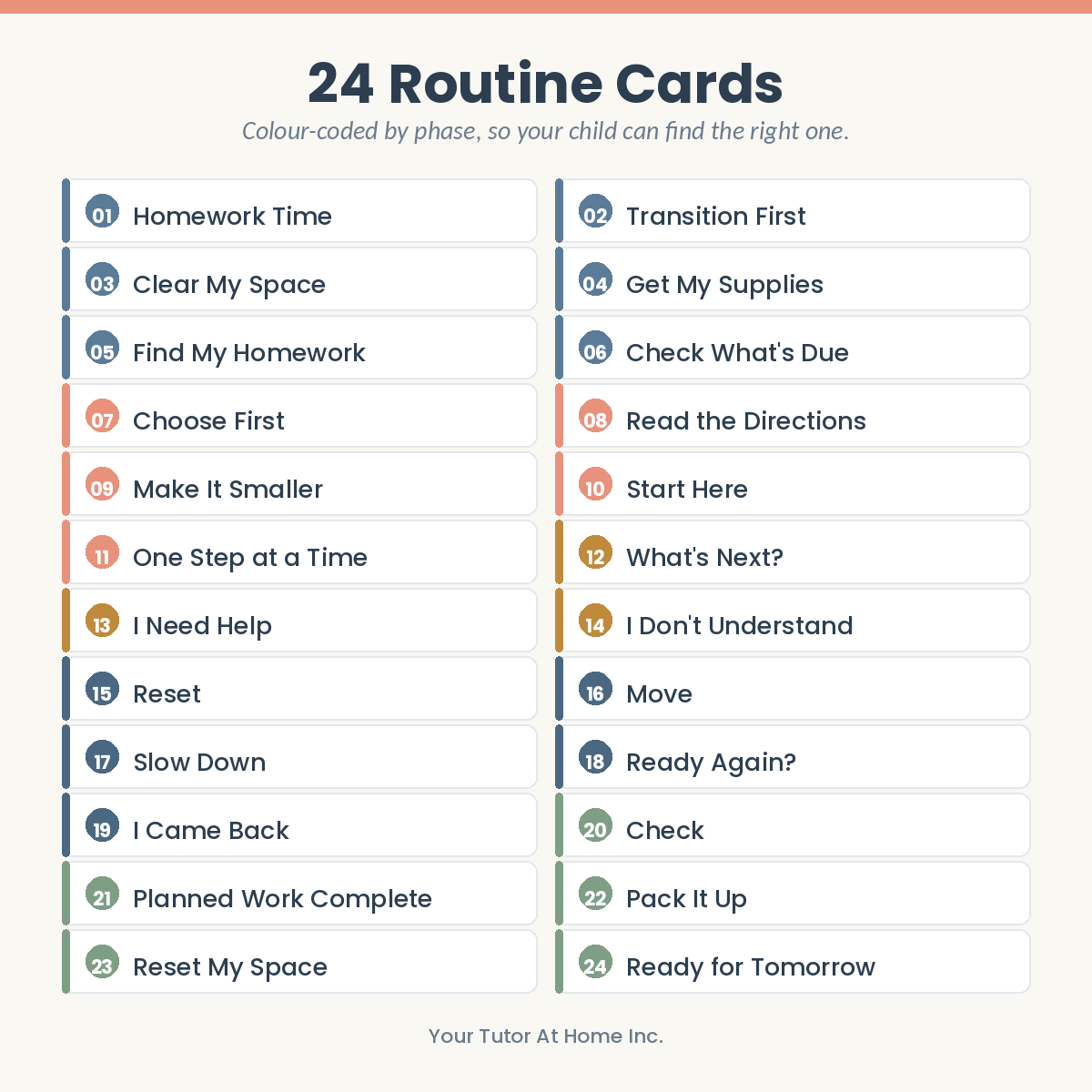
Twenty-Four Printable Routine Cards
The homework checklist cards are 4 × 3 inches, six per sheet, and colour-coded by phase so a child can find the right one without reading the whole deck. Print, cut, laminate, and put them on a binder ring.
- Prepare (cards 1–6) — Homework Time, Transition First, Clear My Space, Get My Supplies, Find My Homework, Check What’s Due
- Plan and start (cards 7–11) — Choose First, Read the Directions, Make It Smaller, Start Here, One Step at a Time
- Ask (cards 12–14) — What’s Next?, I Need Help, I Don’t Understand
- Reset and return (cards 15–19) — Reset, Move, Slow Down, Ready Again?, I Came Back
- Finish (cards 20–24) — Check, Planned Work Complete, Pack It Up, Reset My Space, Ready for Tomorrow
You are not meant to print all twenty-four. Four cards used every afternoon will change your homework routine far more than the full deck admired once and forgotten.
For the Afternoons That Go Sideways
A separate reset deck extends the homework checklist to the harder days: six reset cards for naming what is difficult, shrinking the task, asking for help, taking a planned break, finding the return point, and trying the next step. Alongside them sit four troubleshooting cards — including one for the night the work is genuinely too much, and one for restarting after a week when the homework checklist got abandoned entirely.
There are also two parent script cards. Instead of “Just finish it,” try “What’s making this part difficult?” Instead of “Focus!”, try “Check your next step.” The wording matters more than most of us expect.
Homework Checklist Boards and Desk Strips
- Choice board — eight things a child might need, so they can point instead of explain
- Priority board — sorts tonight’s work into do first, do next, can wait, need help
- Work block board — gives one long assignment a beginning, a stopping point and a next step
- Desk routine strips — the whole sequence in one line, sized to tape above a desk
- Daily mini checklist — a consumable half-sheet homework checklist, two per page
- Backpack and finish checklists — because work that never leaves the house undoes the session
The 27-Page Parent Guide
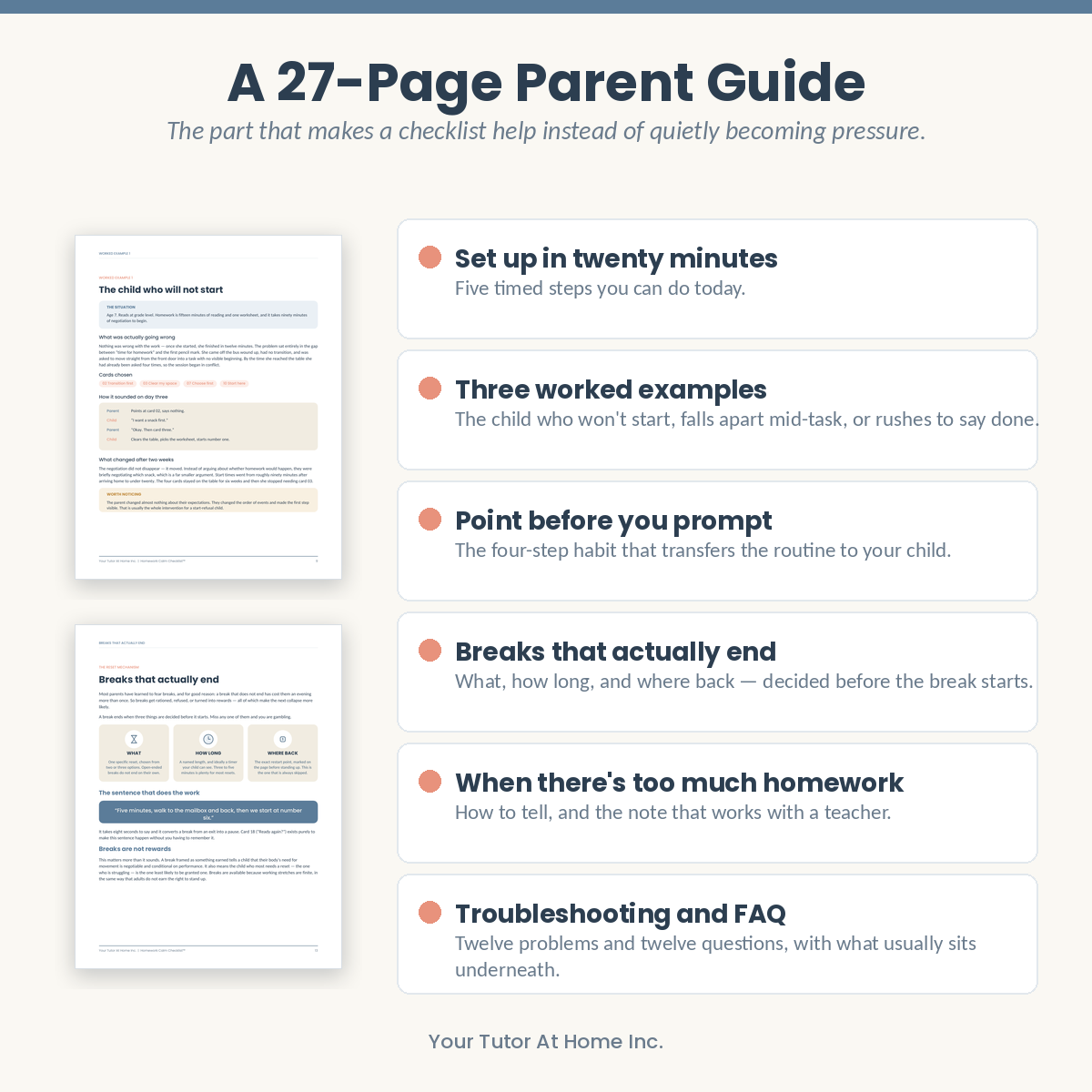
The guide is the part that makes a homework checklist help rather than quietly become pressure. It covers setting up in twenty minutes, three fully worked examples, the four-step “point before you prompt” habit, how to run breaks that actually end, what to do when there is genuinely too much homework, twelve troubleshooting problems, twelve parent questions, and a note on every card explaining why it exists.
It is also honest about limits. This is a visual implementation tool, not a behaviour chart, not a punishment system, and not a diagnosis. Breaks are available because bodies need them, never because behaviour earned them, and asking for help is treated as a correct move every single time.
What You Download
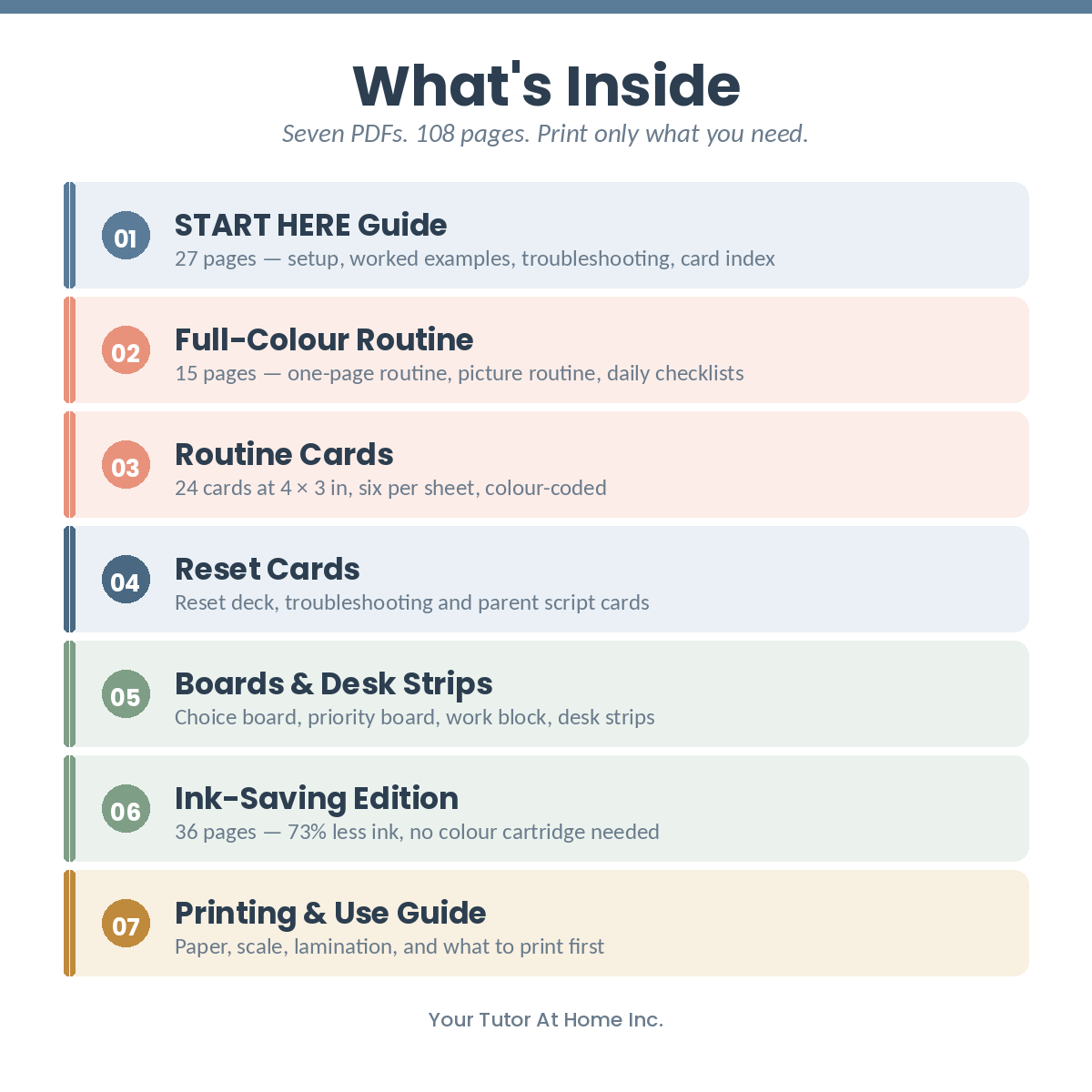
- 01 — START HERE Parent Guide (27 pages)
- 02 — Full-colour routine pages (15 pages, US Letter)
- 03 — Homework routine cards (24 cards across 9 pages)
- 04 — Homework reset cards (7 pages)
- 05 — Choice boards and desk strips (8 pages)
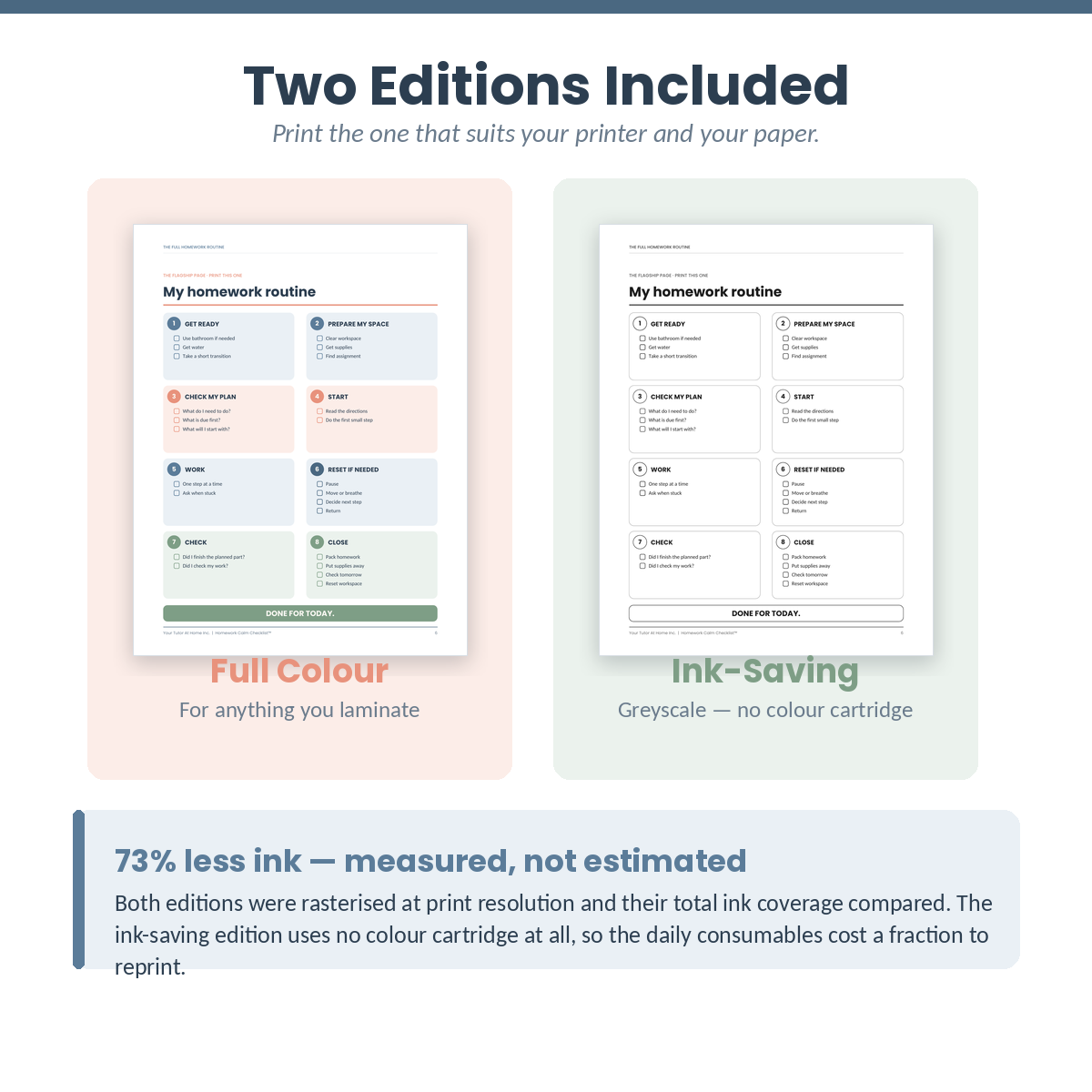
- 06 — Ink-saving edition (36 pages, greyscale)
- 07 — Printing and use guide (6 pages)
That is 108 pages of homework checklist material in total, with 117 fillable fields you can type into on screen. The ink-saving edition was measured at 73% less total ink than the colour pages and uses no colour cartridge at all.
Who This Homework Checklist Is For
Children roughly aged five to eleven, and adaptable either side of that. It is especially useful for the child who will not start, the child who falls apart fifteen minutes in, and the child who rushes to say “done” without checking anything. A picture-only routine page is included for children who are not reading fluently yet.
If homework difficulty is persistent, severe, or causing real distress, a routine belongs alongside — never instead of — a conversation with your child’s school or a qualified professional. For background reading, Understood.org and Reading Rockets both maintain excellent free parent libraries, and the CDC publishes plain-language guidance on children’s developmental wellbeing.
Where This Fits
This is the quick visual tool. If you need to organise assignments, projects and the week ahead, the Calm Homework Planner™ does that job. If homework has become a recurring emotional battle needing a full parent strategy, the Calm Homework Reset System™ goes considerably further. If breaks are your sticking point, Focus Break Cards™ pair naturally with the reset deck. You can also browse the full range of learning resources.
Download the homework checklist, print the one-page routine and one desk strip, choose four cards, and tell your child exactly where to look when they are not sure what comes next.
Reviews
There are no reviews yet.