
Reading Support: Phonics Worksheets™
$17.00
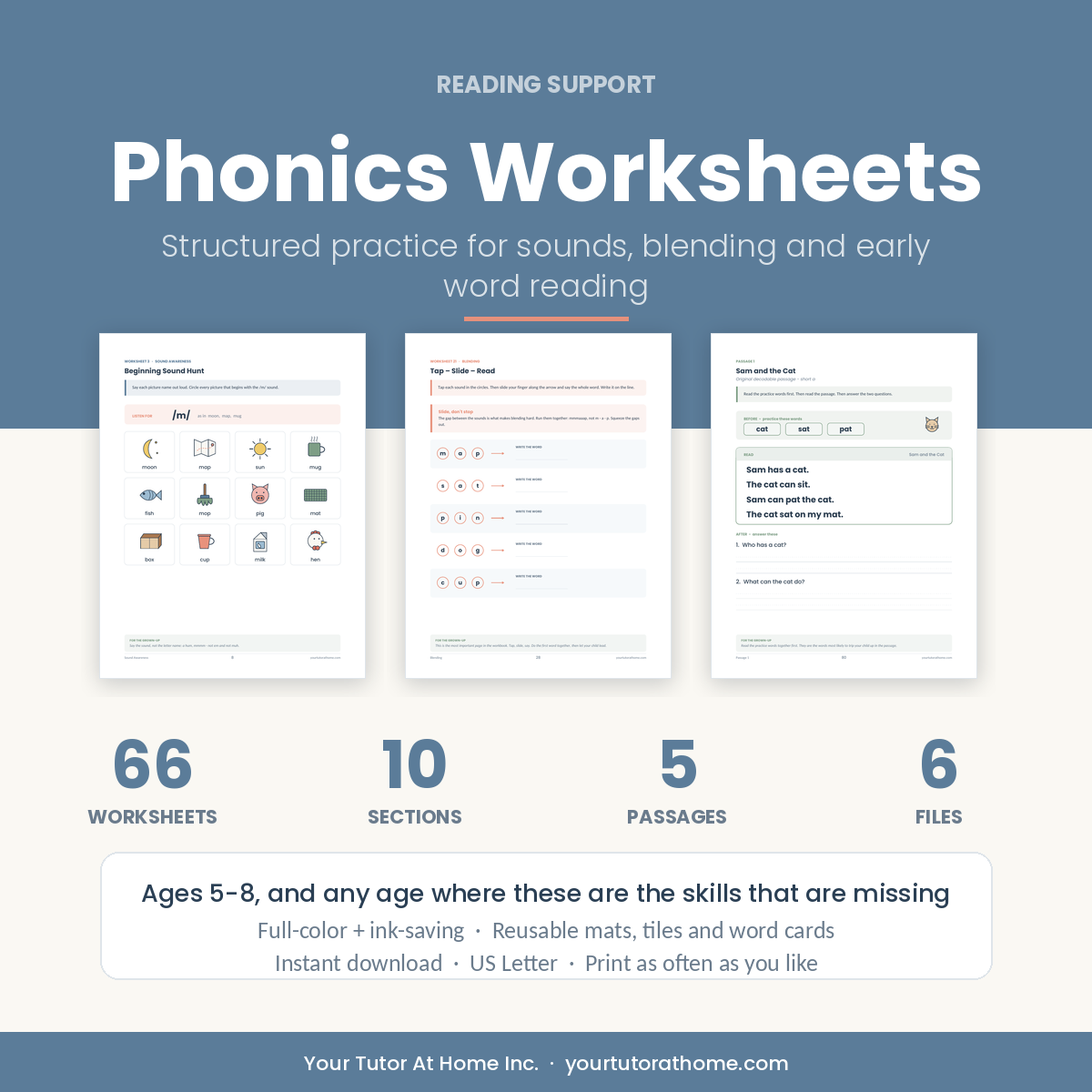
Structured phonics worksheets that build in order
— from hearing sounds, to blending, to reading real sentences.
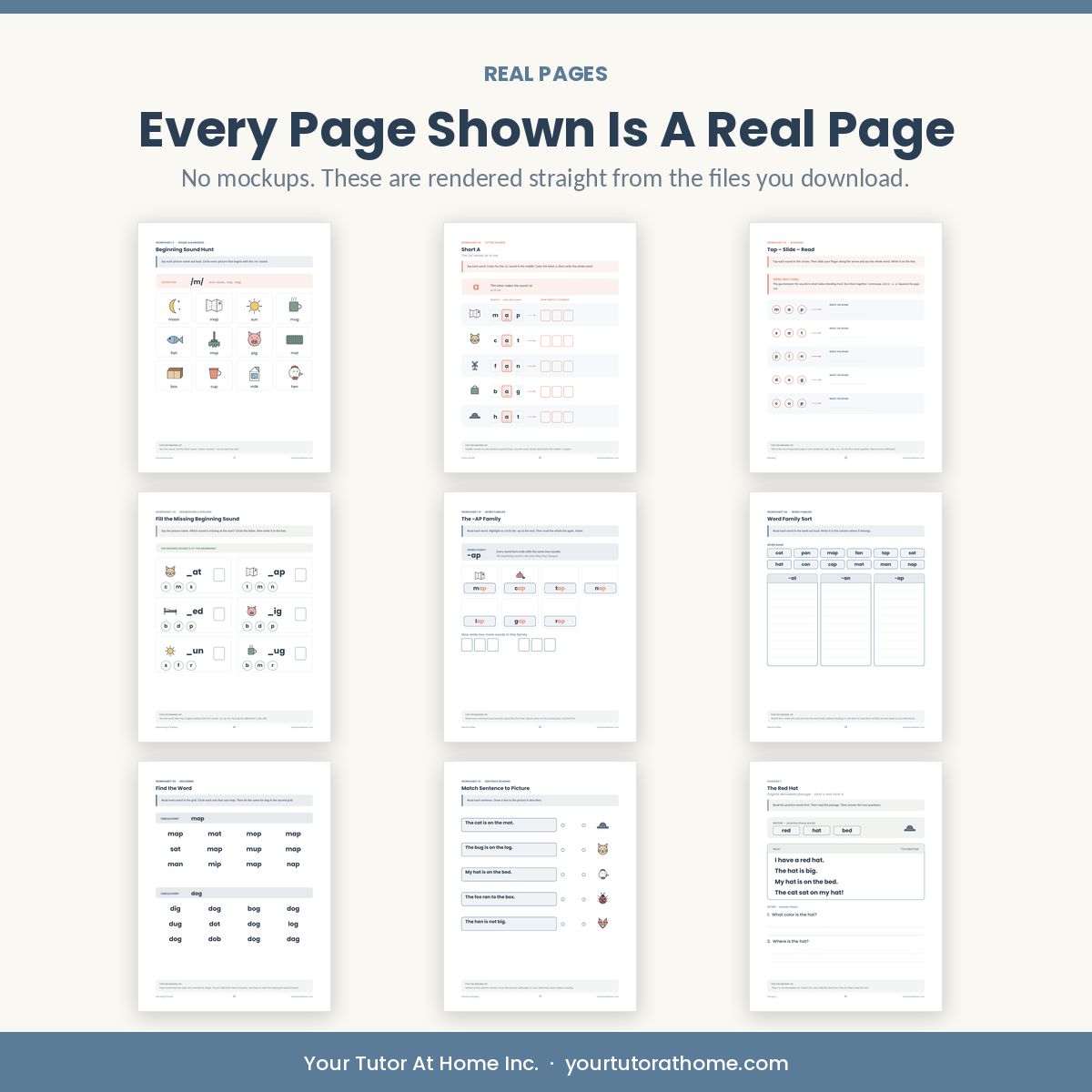
66 worksheets across 10 sections, plus 5 original decodable passages,
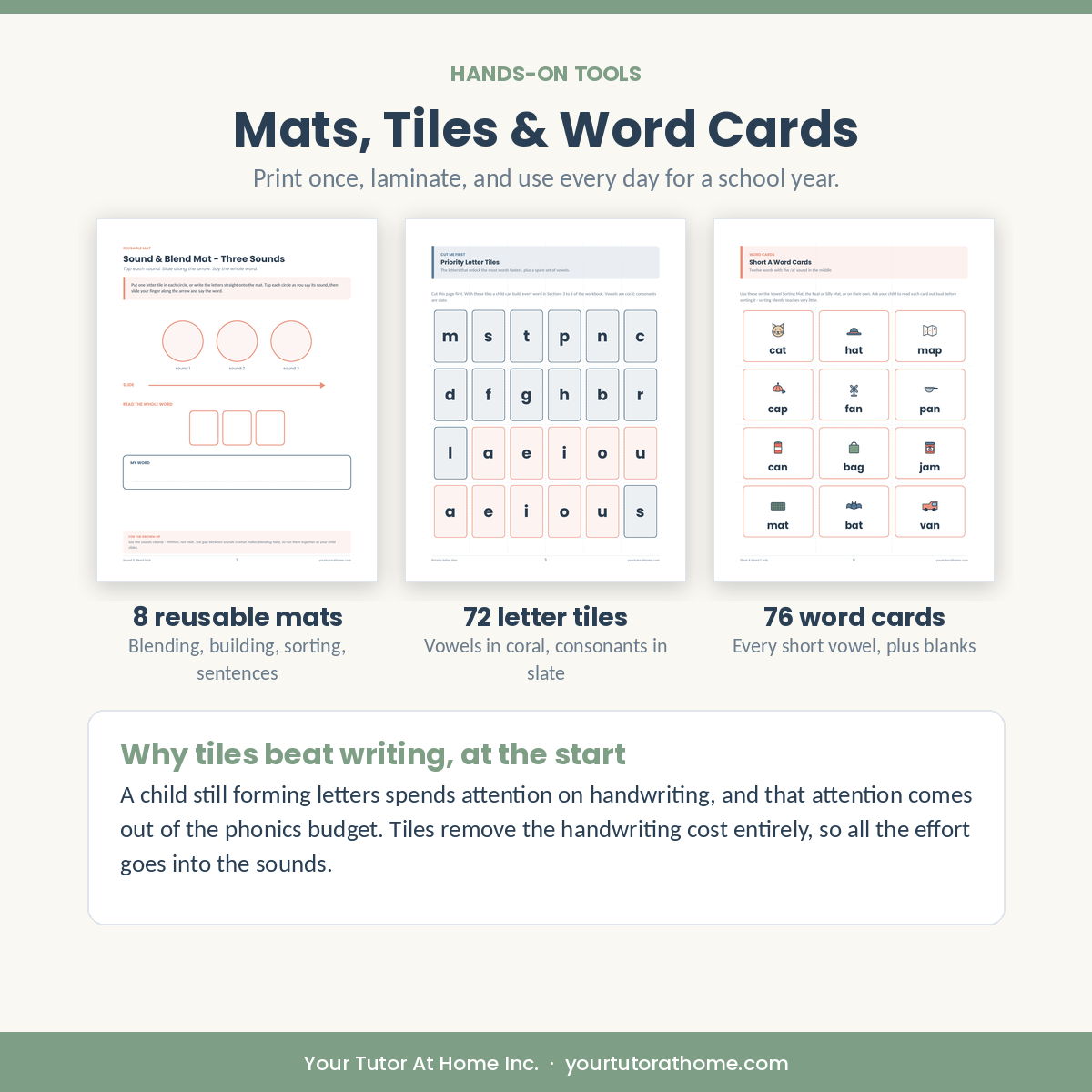
reusable blending mats, letter tiles and word cards. Blending is taught
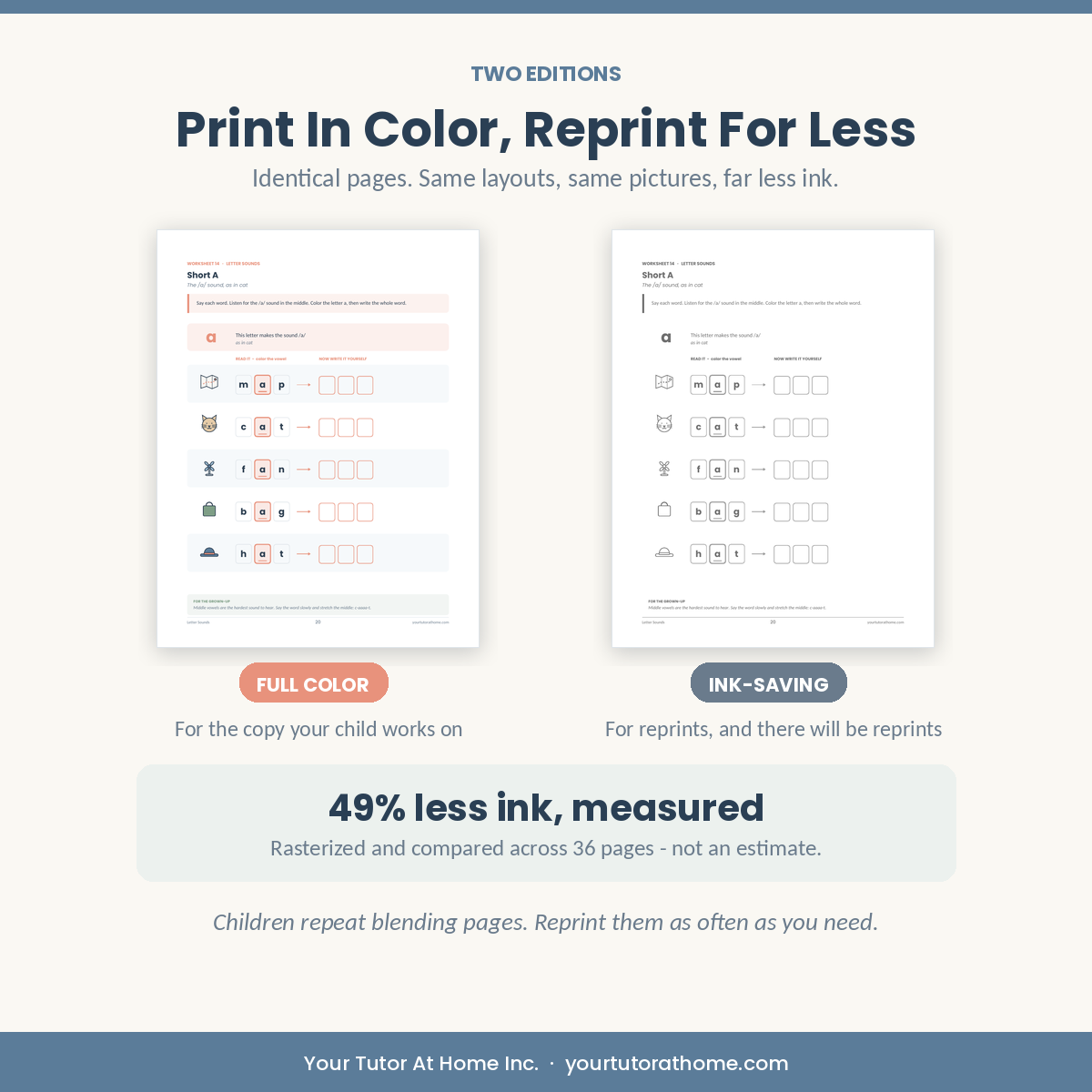
explicitly, not assumed. Full-color and ink-saving editions of every page.
Ages 5–8, and any age where these are the skills that are missing.
- 244 pages across 6 files · 1,592 fillable fields
- Sound awareness → letter sounds → blending → spelling
→ word families → sentences → passages - 25-page parent guide with scripts for the moments that go wrong
- Instant download · US Letter · print as often as you like
Product Description
Phonics worksheets that build in order, not in a pile
If your child has been bringing home phonics worksheets for months and reading
still is not moving, the problem is very rarely effort. It is far more often
order.
Most phonics worksheets arrive as a pile. Eighty pages, alphabetically
arranged, each one a self-contained task. A child can finish every page in a
pile and still not be able to read, because nothing in the pile ever taught
them the one move reading actually depends on: sliding separate sounds
together into a word.
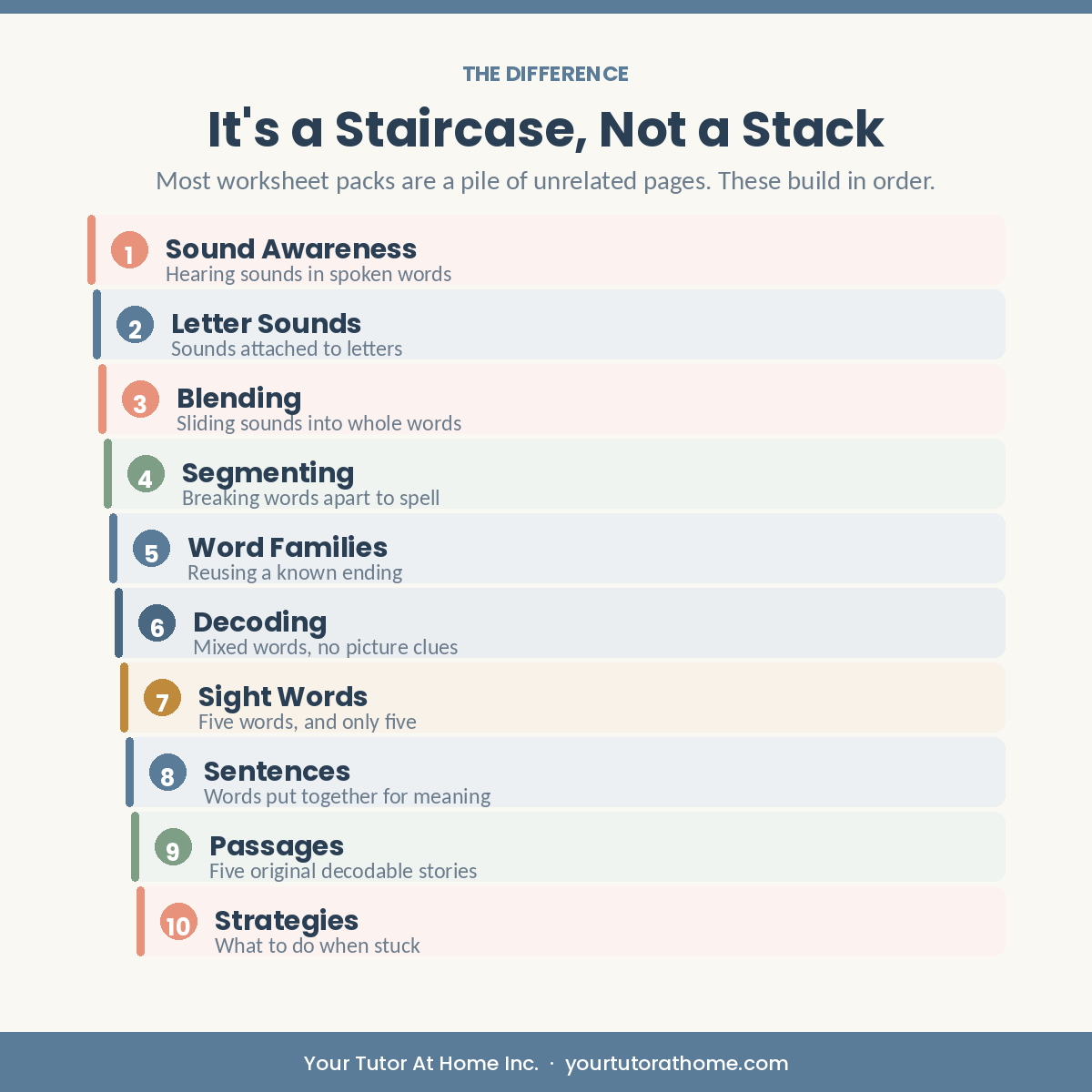
These phonics worksheets are a staircase. They start with hearing sounds inside spoken words,
before a single letter is written. Then they attach those sounds to letters.
Then they teach blending explicitly and practice it hard. Then they go
backwards — breaking words apart and spelling them — because
spelling and reading feed each other. Only then do they move on to patterns,
sentences and short passages.
Blending is the step most children get stuck on
Blending is the moment three separate noises become one word. It is not
obvious, it is not natural, and for a large number of children it does not
happen just because they know their letters. Reading research summarized by
Reading
Rockets is consistent on this point: blending has to be taught directly and
practiced until it is fast.
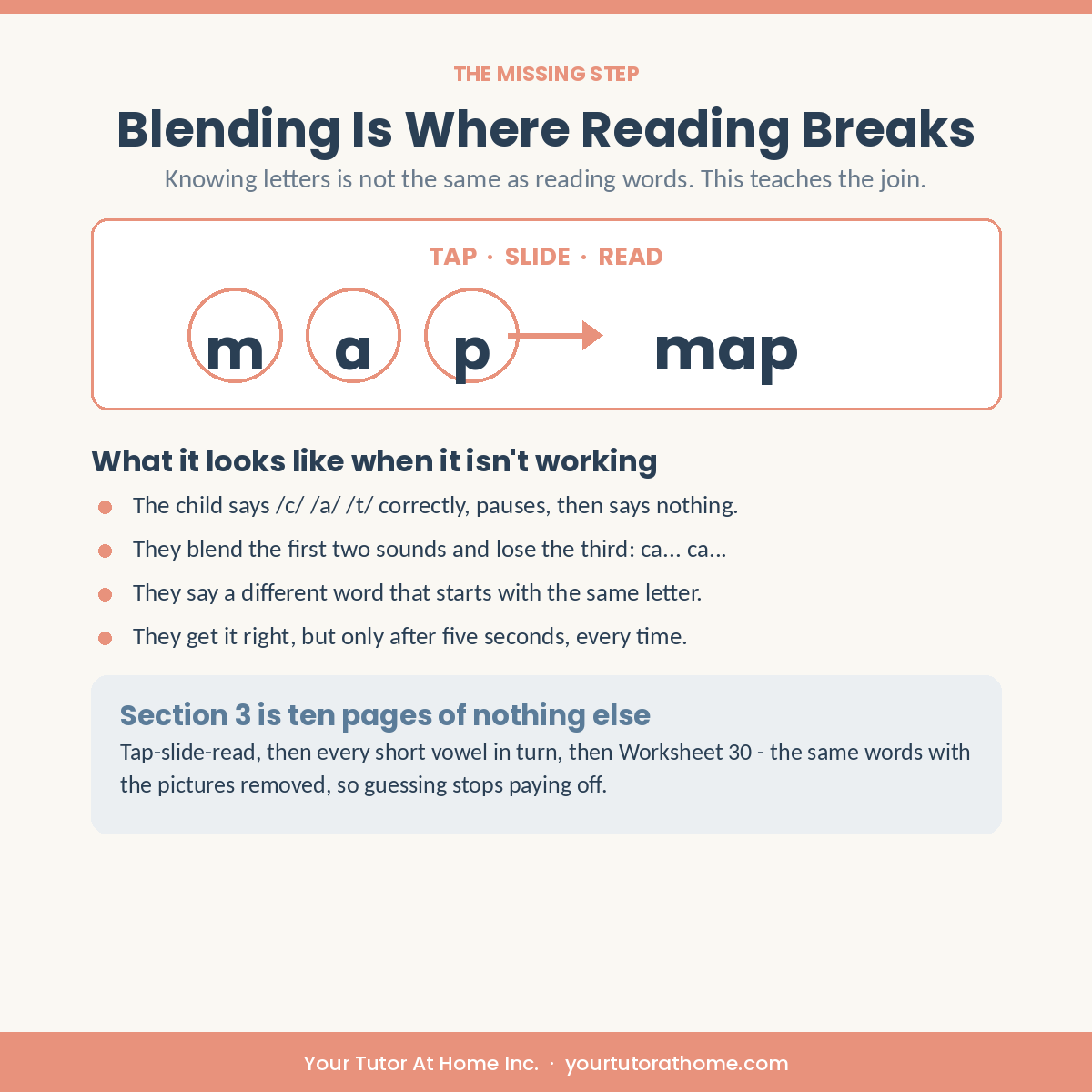
You will recognize the signs if this is where your child is stuck. They say
/c/ /a/ /t/ correctly, pause, and then say nothing. They blend the
first two sounds and lose the third. They produce a different word that starts
with the same letter. Or they get there, but only after five seconds, every
time, on words they have read before.
Section 3 of these phonics worksheets is ten pages of nothing but blending.
Tap-slide-read, then each short vowel in turn, then a page that removes the
picture clues entirely — because a child who reads well with pictures and
stalls without them has been guessing, and that is worth finding out now
rather than in two years.
What is inside these phonics worksheets
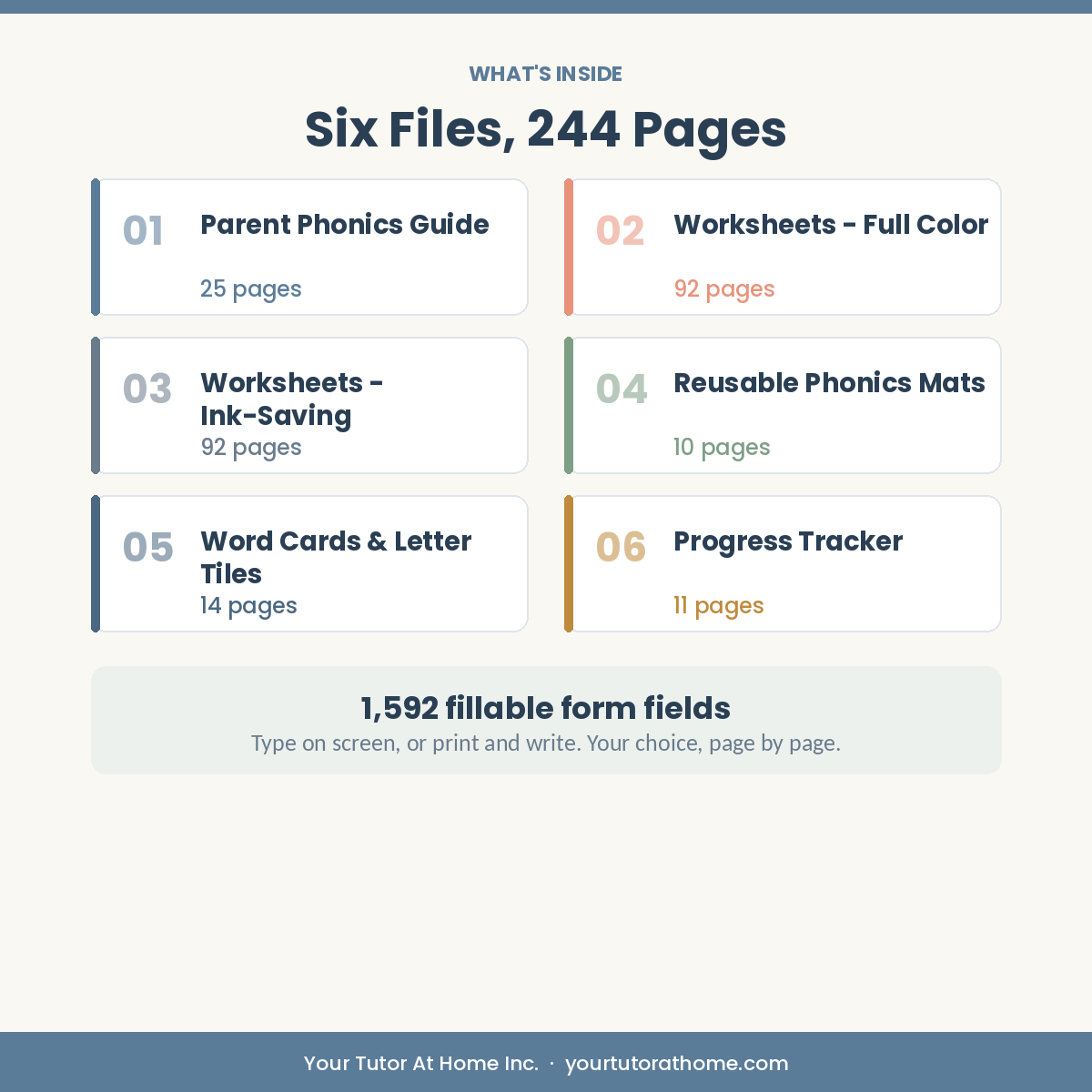
Six files, 244 pages, 1,592 fillable form fields. Every page can be typed
into on screen or printed and written on.
- 01 — Parent Phonics Guide (25 pages). How to say the
sounds cleanly, how to choose a starting point, three fully worked sessions
including one bad day, a calm five-step correction script, eight
troubleshooting answers and a seven-day first-week plan. - 02 — The workbook, full color (92 pages). 66
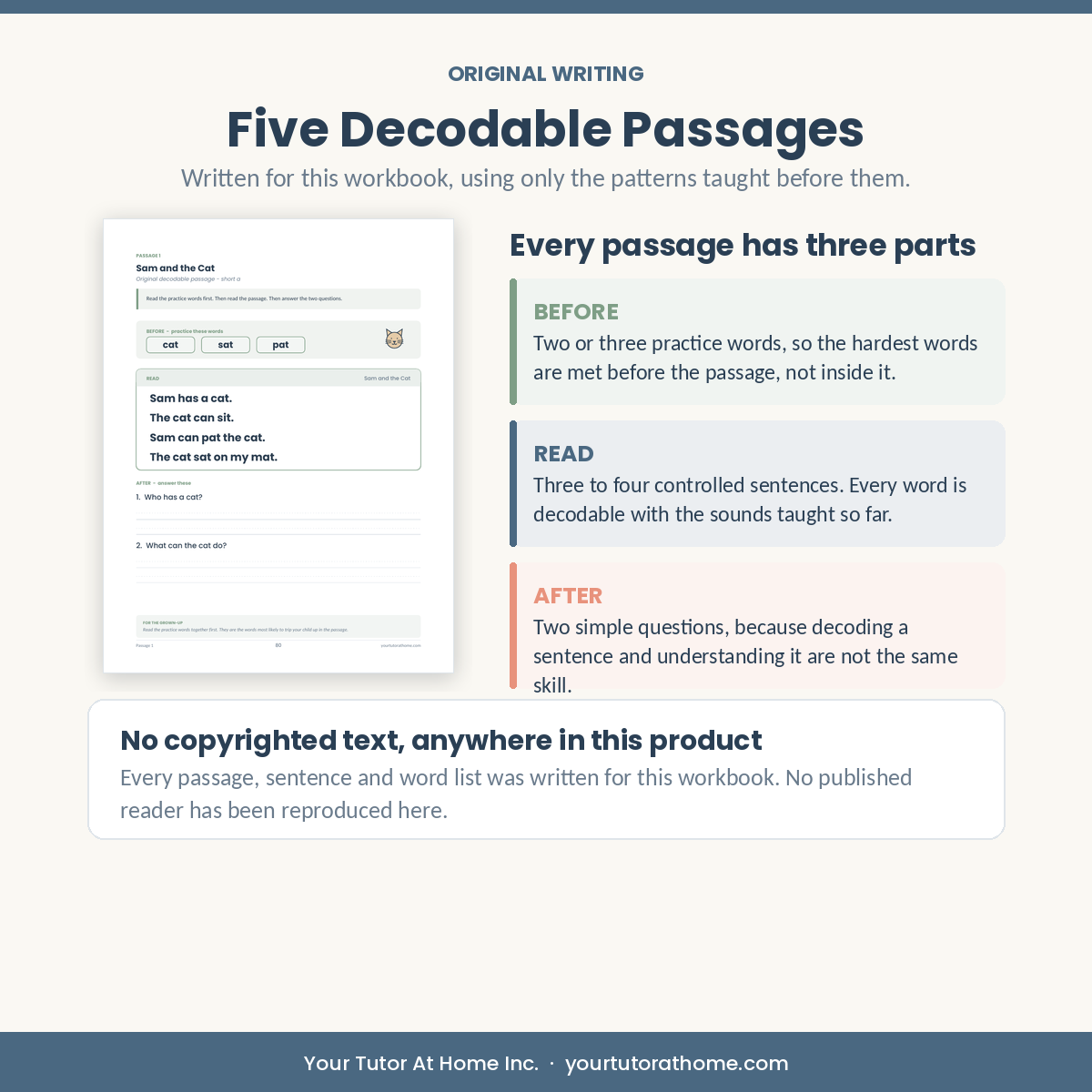
worksheets across 10 sections, 5 original decodable passages, four reading
strategy pages, a celebration page and a certificate. - 03 — The same workbook, ink-saving (92 pages).
Identical layouts and pictures, measured at 49% less ink. - 04 — Reusable Phonics Mats (10 pages). Sound and
blend mats, a word-building mat, vowel sorting, word families, real-or-silly
sorting and sentence building. - 05 — Word Cards & Letter Tiles (14 pages). 72
cut-apart tiles with vowels in a separate color, plus 76 word cards and
blanks. - 06 — Progress Tracker (11 pages). A monthly growth
tracker, a child-facing skills list, 40 spaces for new words read
independently, a confidence check and an eight-week practice log.
The ten sections, in teaching order
The phonics worksheets open with sound awareness, which is almost entirely spoken. Then letter
sounds, then blending, then segmenting and spelling, then word families, then
mixed decoding with no pattern and no picture to lean on. After that come five
carefully limited high-frequency words, then sentence reading, then five
original passages, then four pages on what to do when a word will not come.
Each section opens with a divider that tells you exactly when to move on
— a real criterion, not a guess. Sections 1 to 3 should be worked in
order. After that you have far more freedom.
What makes these phonics worksheets different
Every practice word is genuinely decodable. Nothing in these
phonics worksheets asks a child to read a word using sounds they have not been
taught. Word lists were
checked against the vowel actually heard, not the letter written.
Guessing from the picture is never taught as a strategy.
It works right up until books stop having pictures, usually around age seven,
and then it stops working very suddenly. The workbook deliberately removes
picture support partway through the blending section.
Only five sight words. The, is, it, my, to. Four more
appear in the passages. That is the entire list across all 66 phonics worksheets, on purpose — a
child who has memorized eighty words and cannot blend has a bigger problem in six months,
not a smaller one.
Every passage is original. No published reader, no leveled
text and no copyrighted passage has been reproduced anywhere in these phonics
worksheets.
The letters look like the ones children are taught to write.
Every word a child reads here is set in a typeface with a single-story
a and a single-story g. Adult-facing text uses a different
face, so a child never has to decode a letterform they have not met.
A note for the grown-up on every single page. Ten seconds
to read, and it tells you what that page is actually training and what to do
when it goes wrong.
Fifteen minutes, five times a week
The guide sets out a five-step routine: two minutes reviewing sounds your
child already knows, five minutes on part of one worksheet, five minutes
building words with tiles, two minutes reading, one minute closing. Fifteen
minutes is a ceiling, not a target.
Consistency beats length by a wide margin. The children who make the most
progress with these phonics worksheets are almost never the ones doing the
longest sessions — they are the ones doing them most often.
Who this is for
These phonics worksheets are for parents of children roughly 5 to 8 who know
some letters but cannot turn them into words, who guess from the first letter, who read a word correctly on
one page and not two pages later, or who are simply behind and need structured
practice at home. Skill level matters far more than age here; plenty of older
children are missing exactly these foundations.
It also works well alongside specialist support. The structure is
sequential and cumulative, which is the shape of practice most specialists
recommend. If you are unsure whether what you are seeing is typical,
Understood.org
has good plain-English explanations of learning differences, and the
CDC’s child development pages cover
milestones.
What this is not
These phonics worksheets are not a complete reading curriculum, a diagnostic
assessment, dyslexia treatment, or a substitute for individualized teaching. It does not diagnose
anything and it makes no promise about any particular outcome. If your child’s
reading is not moving after eight to ten weeks of regular short practice, that
is worth raising with their teacher.
Where this sits in the range
If your child needs narrow, intensive work on one specific short-vowel gap,
the Sound-by-Sound Practice
Pack is the smaller, cheaper option. If they can already decode but avoid
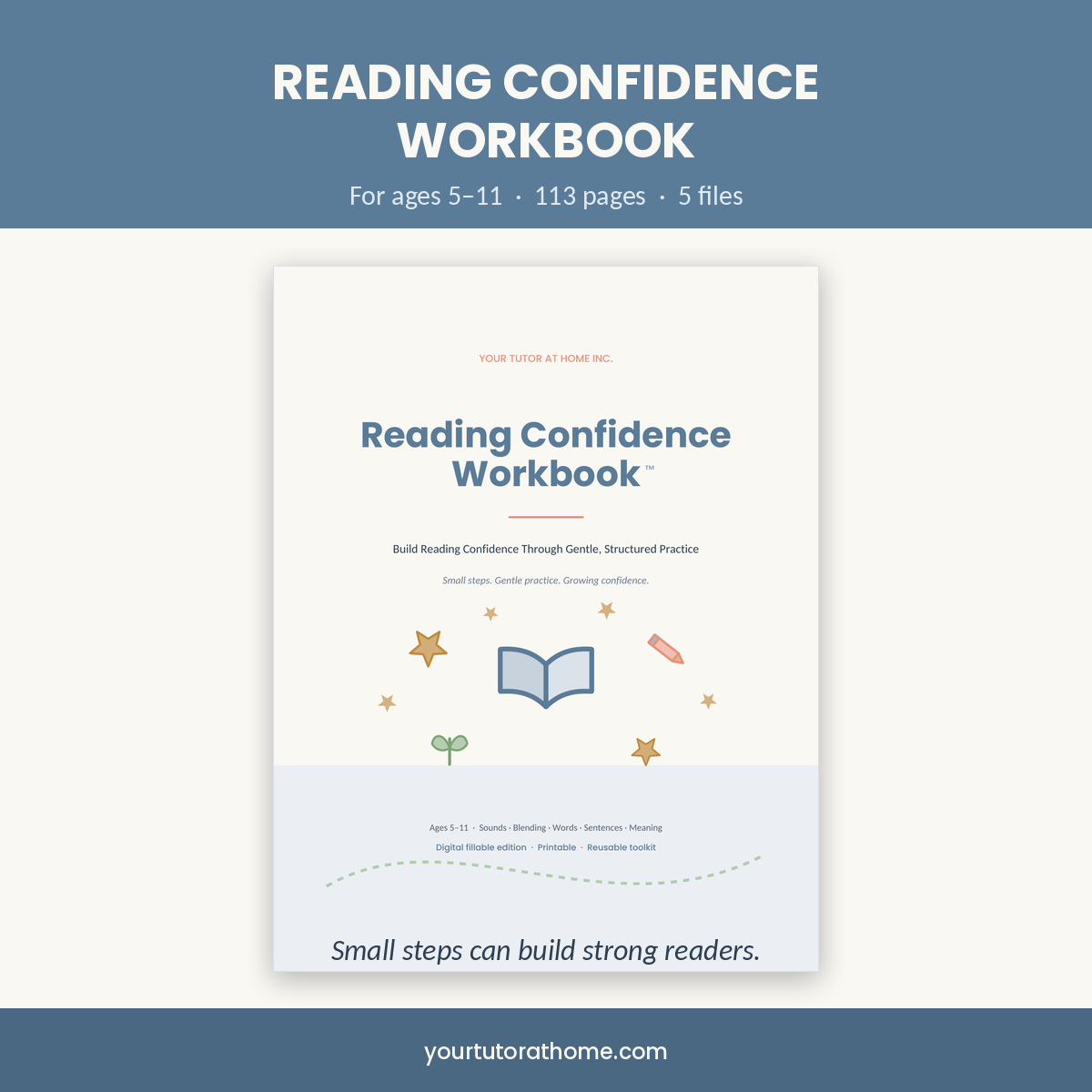
reading, the Reading Confidence
Workbook is built for that. If you cannot yet tell where reading is
breaking down, start with the free reading
quiz. These phonics worksheets are the broad foundational set that covers
sound awareness through to passages.
Printing and using your phonics worksheets
US Letter, 8.5 × 11 inches. Print at 100% rather than Fit to Page.
Print in full color for the copy your child works on and use the ink-saving
edition for reprints — and there will be reprints, because repeating a
blending page four times is normal and expected. Laminate the mats or slide
them into a dry-erase sleeve; cut the tiles on card stock. Nothing in these
phonics worksheets needs a special printer.
There is no need to print all 244 pages before you begin. The guide tells
you which three pages to print first.
Instant download
All six phonics worksheets files are delivered immediately after checkout. Unlimited downloads,
no expiry. Licensed for your own household, or for one tutor with the children
in their own care. Print as many copies as your family or class needs.
Reading words starts with understanding how sounds work together. These
phonics worksheets take a child through that, one sound at a time.

Reviews
There are no reviews yet.