
The C.A.L.M. Learning Method™: A Complete Parent-Led Transformation System
$67.00
Real homework help for parents of children who avoid, freeze, guess, or fall apart at the kitchen table.
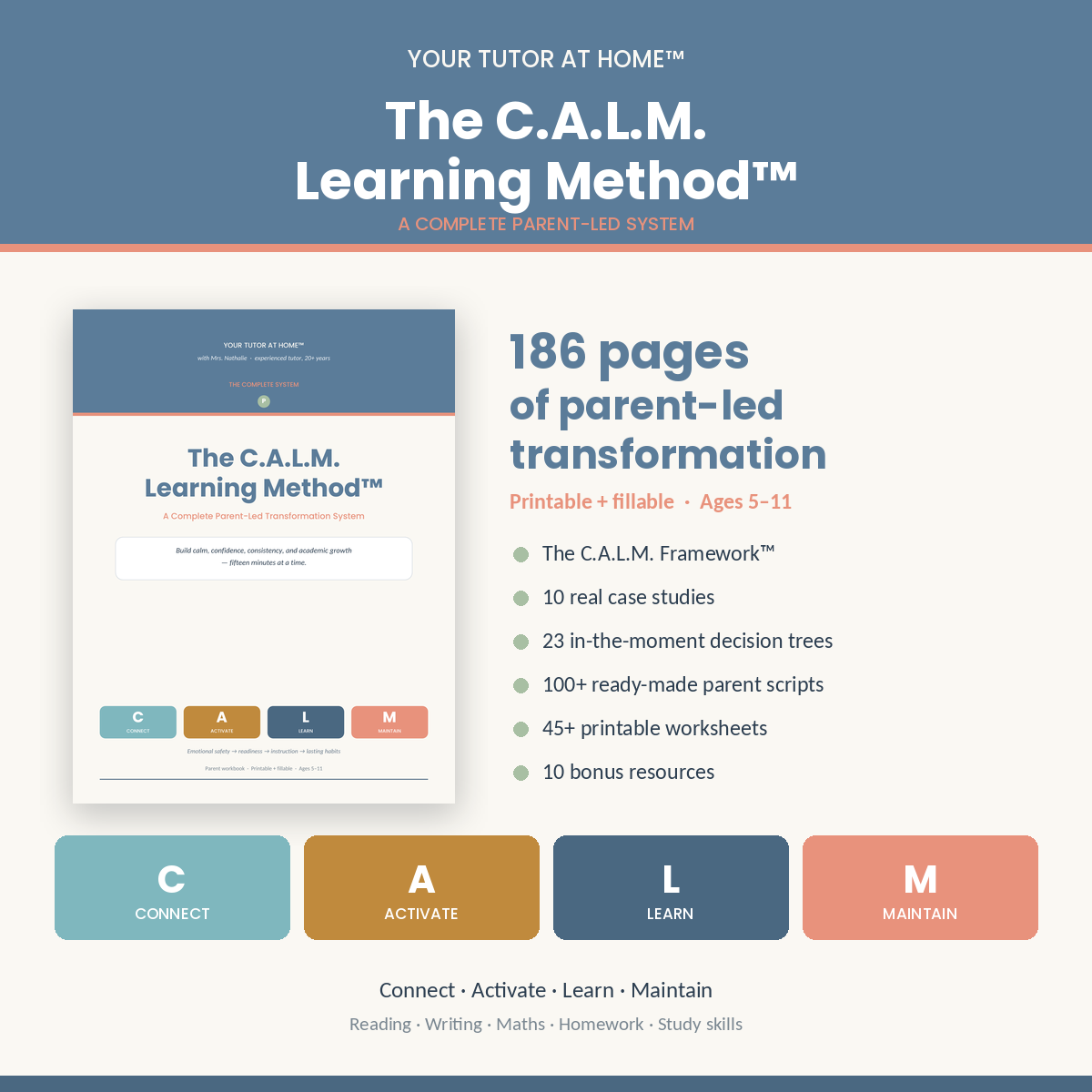
The C.A.L.M. Learning Method™ is a complete 186-page parent-led system built on four phases — Connect, Activate, Learn, Maintain. You’ll learn how to build emotional safety before instruction, prepare your child’s brain to focus, teach one small skill at a time, and turn a good fortnight into a habit that survives real life.
Includes 10 case studies, 23 decision trees, 100+ parent scripts, 45+ worksheets, and 10 bonus resources. 186 pages · Printable + fillable PDF · Ages 5–11
Product Description
Homework help for parents who have already tried everything
If evenings end in tears, avoidance, or an argument neither of you wanted, the problem is usually not effort — it is sequence. This is practical homework help for parents of struggling learners: a complete 186-page system that teaches families how to build calm routines, reduce homework battles, improve confidence, and support steady academic progress using a clear step-by-step framework.
Most support at home starts with the worksheet. But a child who is anxious, tired, or braced for failure cannot absorb instruction, however good that instruction is. Teaching a dysregulated child is like pouring water into a closed bottle. The C.A.L.M. Learning Method™ changes the order — and that single change is what makes everything after it work.
Why most homework help for parents does not work
Most homework help for parents arrives as tips: sit somewhere quiet, use a timer, praise effort. None of it is wrong, and none of it addresses why the session collapsed at minute four. Routines fail for predictable reasons — the session is too long, the time changes daily, materials are not ready, the child cannot see the ending, or a missed day is treated as failure.
A routine does not fail because a family misses a day. It fails when it becomes too difficult to restart. This system is built around that single insight.
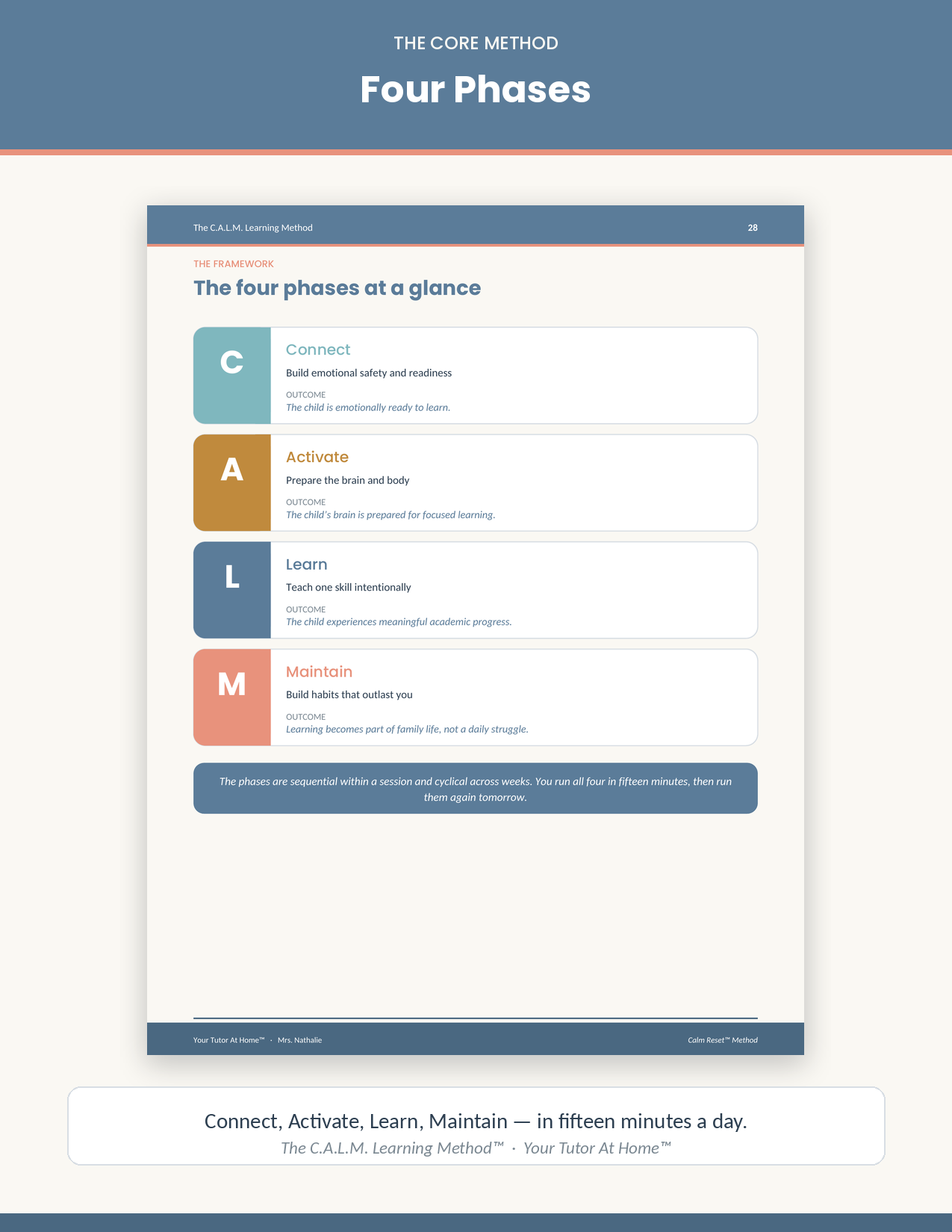
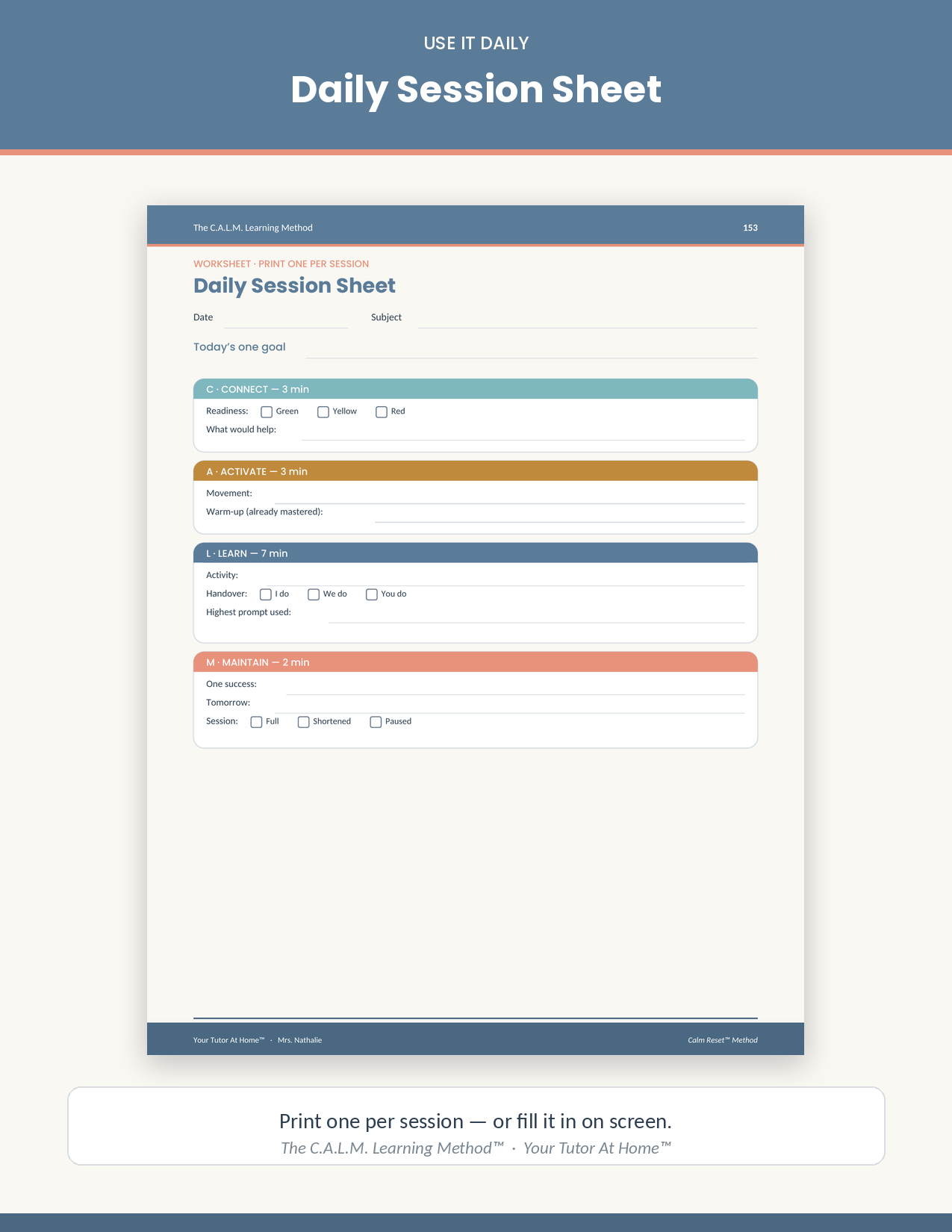
The four phases
- C — Connect: build emotional safety and readiness before instruction begins
- A — Activate: prepare the brain and body, and bank one early success
- L — Learn: teach one small skill using model, practice together, hand over
- M — Maintain: build habits that survive illness, holidays and busy weeks
The whole cycle runs in fifteen minutes a day. Nearly half of it happens before you teach anything, which will feel wasteful for about two weeks — and it is precisely what makes the teaching land. It is the part that most homework help for parents leaves out entirely.
The reasoning, not just the routine
This book explains what is actually happening inside a difficult session, in plain language. You will learn why stress narrows what a brain can do, why working memory limits how many instructions a child can hold, why retrieval beats re-reading, and why performance dips for a week after you increase difficulty. Understanding the mechanism is what lets you adapt when your child does something no book predicted.
If you want to read more widely on learning differences, Understood.org and Reading Rockets are both excellent free resources, and the British Dyslexia Association publishes helpful guidance for families seeking assessment.
What is inside this homework help for parents
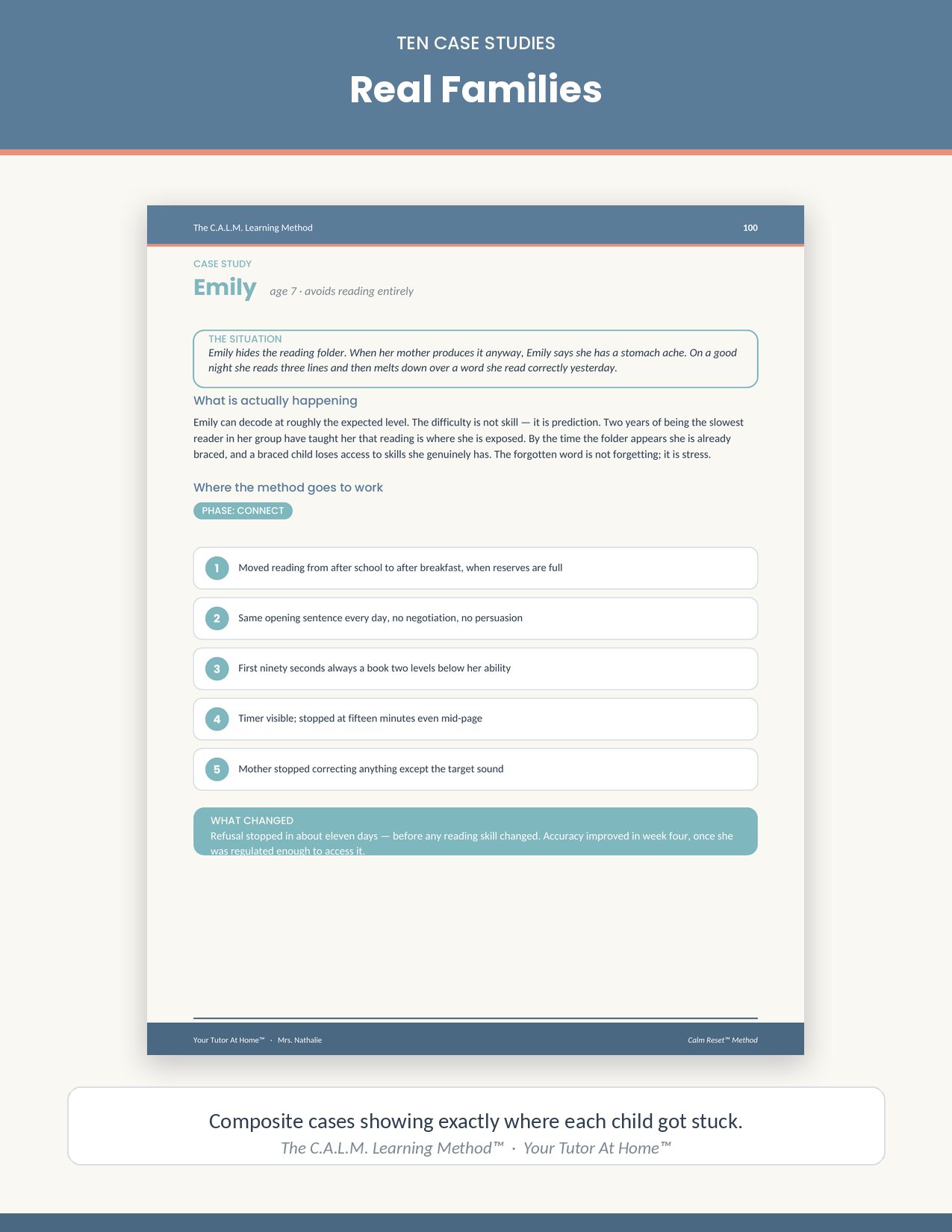
- 10 case studies — Emily who hides the reading folder, Maya who cannot get started, Aisha who is fine at school and falls apart at home, Tom who refuses to write, and six more
- 23 decision trees — should I correct this? should we stop early? do I help right now? am I correcting too much?
- 100+ parent scripts — the actual sentences to use when you cannot think of any
- 45+ printable worksheets — learning profile, routine builder, lesson planners, trackers, family agreement
- Subject chapters — reading, writing, spelling, maths, homework and study skills, executive functioning
- First 30 Days guide — a week-by-week plan so you always know what to do next
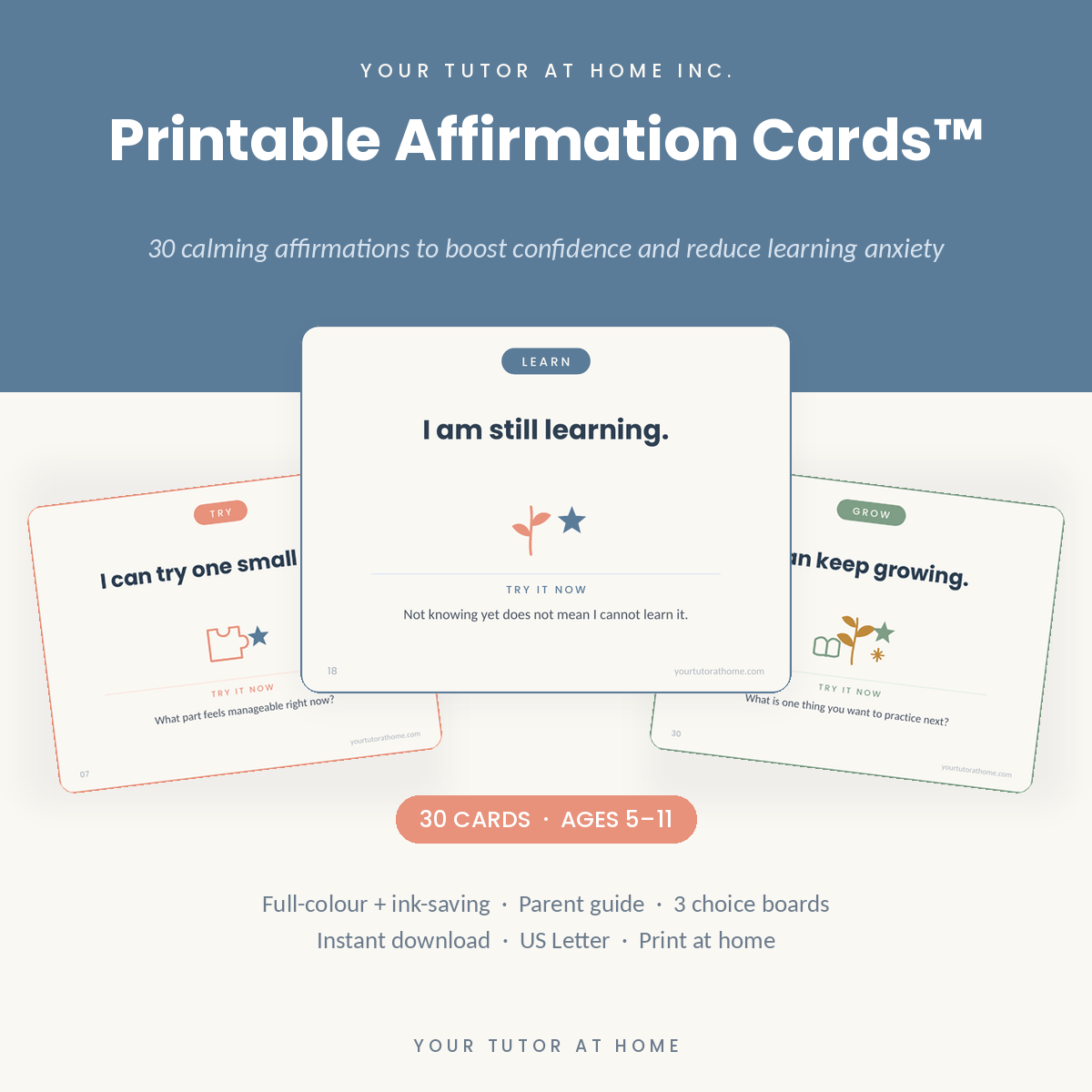
- 10 bonus resources — 50 brain warm-ups, 100 encouragement statements, 25 calm games, printable posters and cards
What you will be able to do
By the end you will have replaced improvised evenings with a process. This is homework help for parents that changes what you do at the table, not just how you think about it:
- Tell the difference between defiance and dysregulation
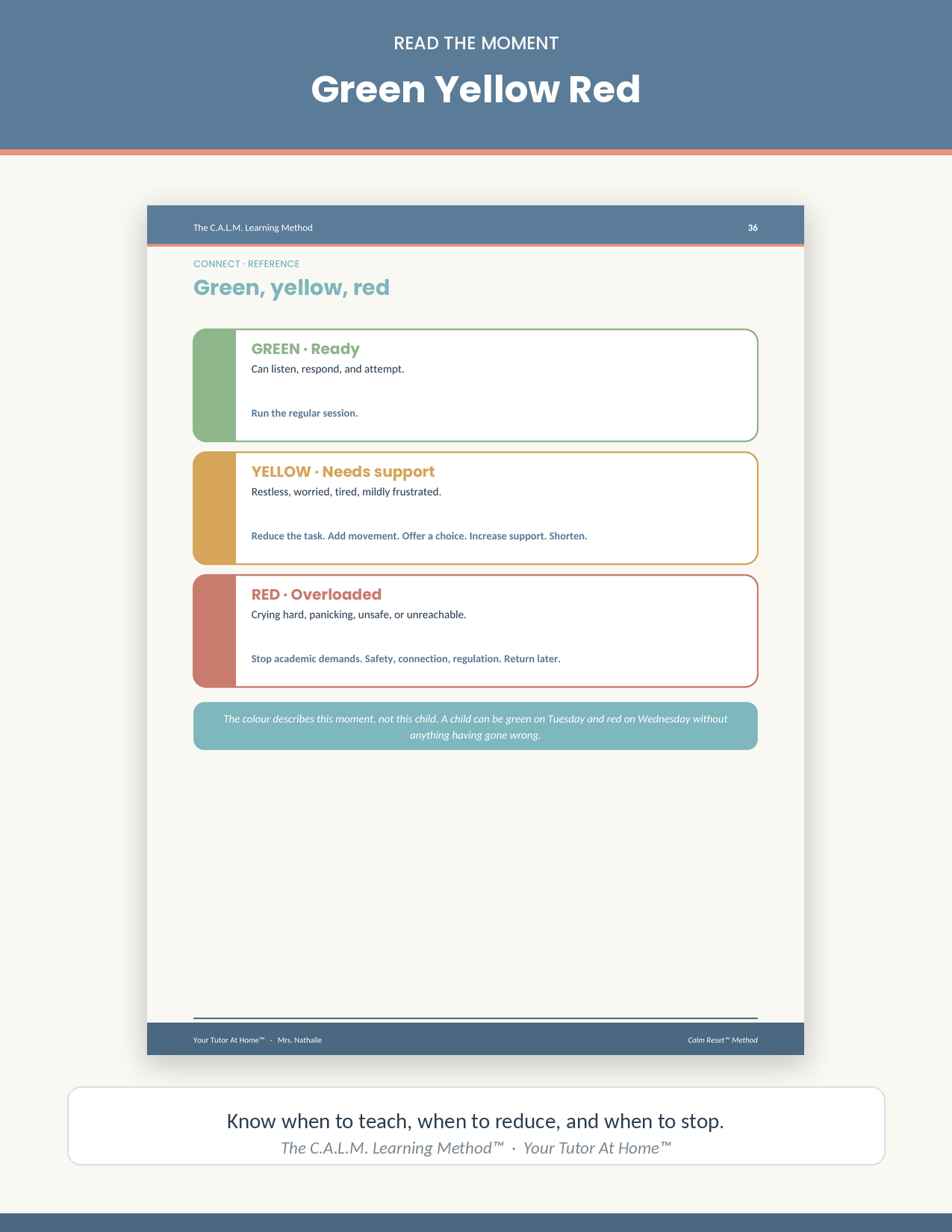
- Spot overload early, before the session collapses
- Give shorter directions and model before expecting independence
- Use the Help Ladder to support without taking over
- Correct the one thing that matters and let the rest go
- Hand over responsibility so your child works when you are not in the room
- Restart after a missed week without guilt or doubled workloads
Who this is for
This homework help for parents is built for caregivers of children aged 5–11 who resist homework, lose confidence after mistakes, struggle to begin, or need more predictability — including children with ADHD, dyslexia, autism and anxiety. It is designed to work alongside school and specialist support, never instead of them.
Where it fits with our other resources
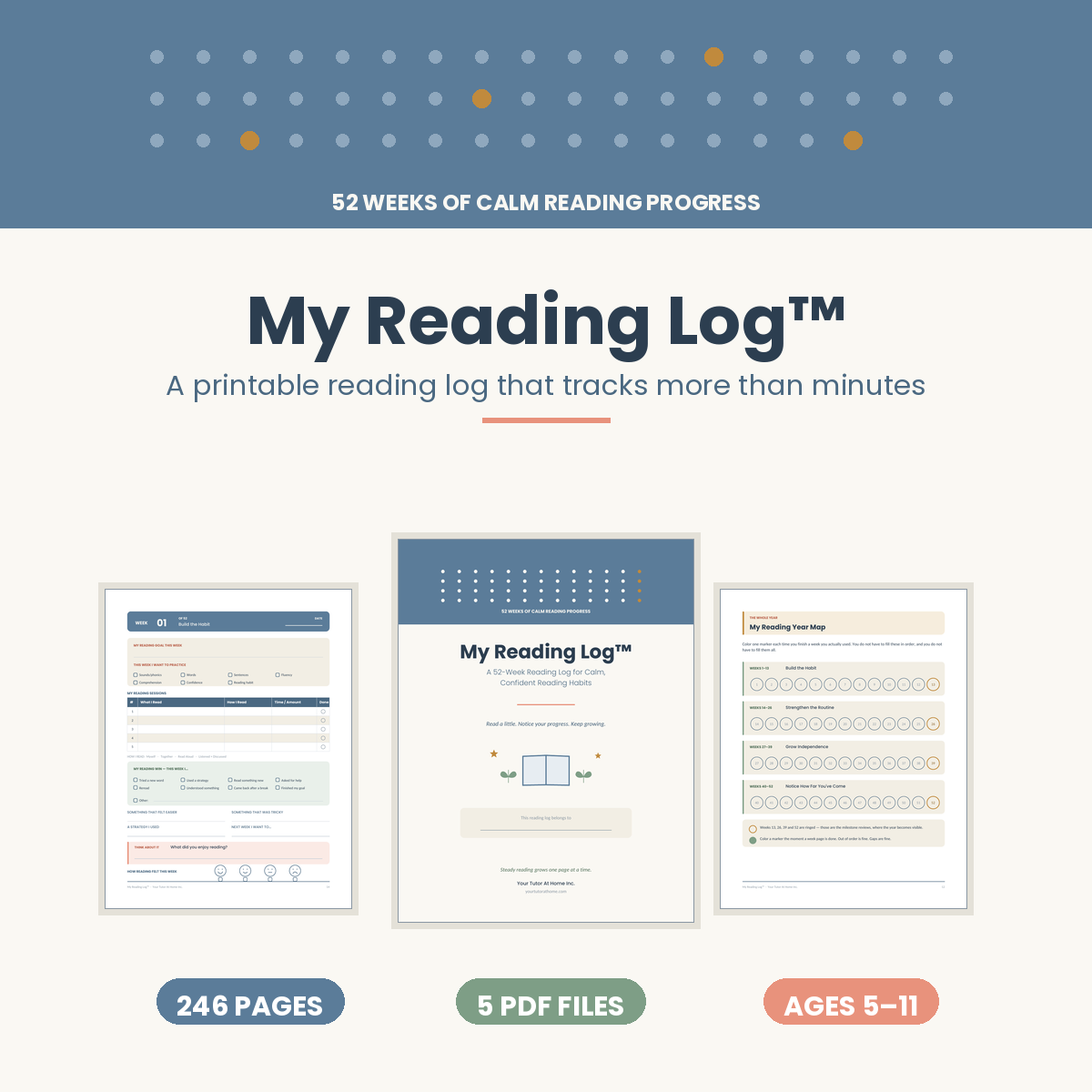
This is the most complete homework help for parents we publish, and it stands on its own. If you would rather start smaller, the Calm Learning Routine System™ covers routine-building alone, and the Why Reading Gets Stuck Toolkit™ helps you work out where reading has stalled. For skill-specific practice afterwards, families often move on to Read Ahead™ or the Calm Reading Toolbox. You can also try our free resources first to see whether this approach suits your family.
Common questions
How long before I see a change? Refusal and session behavior usually shift in two to three weeks. Measurable academic change typically takes six to twelve weeks. Unlike quick-fix homework help for parents, this system is designed around that real timeline rather than promising a breakthrough.
Fifteen minutes seems too short to matter. It is short by design, because you will actually do it. Five sessions of fifteen minutes beat one long session, both for memory and for sustainability. Lengthen only after four consistent weeks.
My child is fine at school and impossible at home. Very common, and covered in detail. Children hold themselves together all day and run out of reserves at home. It is a sign of trust, not disrespect.
Do I need to finish the book before starting? No. Read Parts One and Three, complete the Learning Profile, and begin. The rest is reference you return to as questions come up.
An honest note about what this is not
This is not a curriculum, an assessment, or therapy, and it will not make every child love learning. Persistent difficulty despite good support is information, not failure — and the book tells you exactly when to stop adjusting at home and speak to your child’s teacher or doctor instead.
What this homework help for parents gives you is a clear, repeatable process, the reasoning behind every step, and the words to use when you are tired and it is going badly.
Created by Mrs. Nathalie — experienced tutor with 20+ years working with struggling readers, neurodivergent learners, and children of all learning styles.
This is an instant digital download. Because access is immediate, all sales are final — please see our Refund Policy for full details. No physical product will be shipped.


Reviews
There are no reviews yet.