
Brain Break Cards™
$6.00
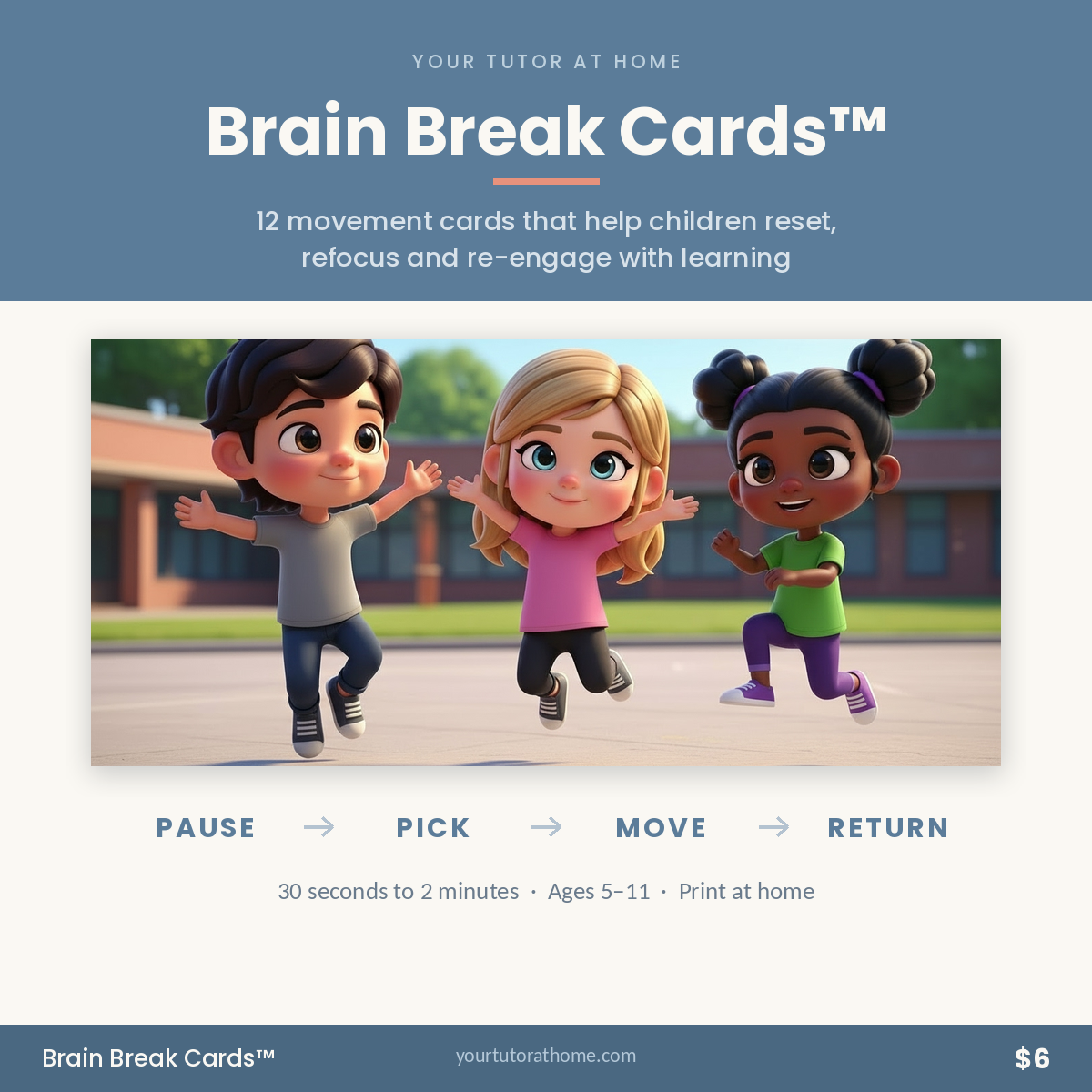
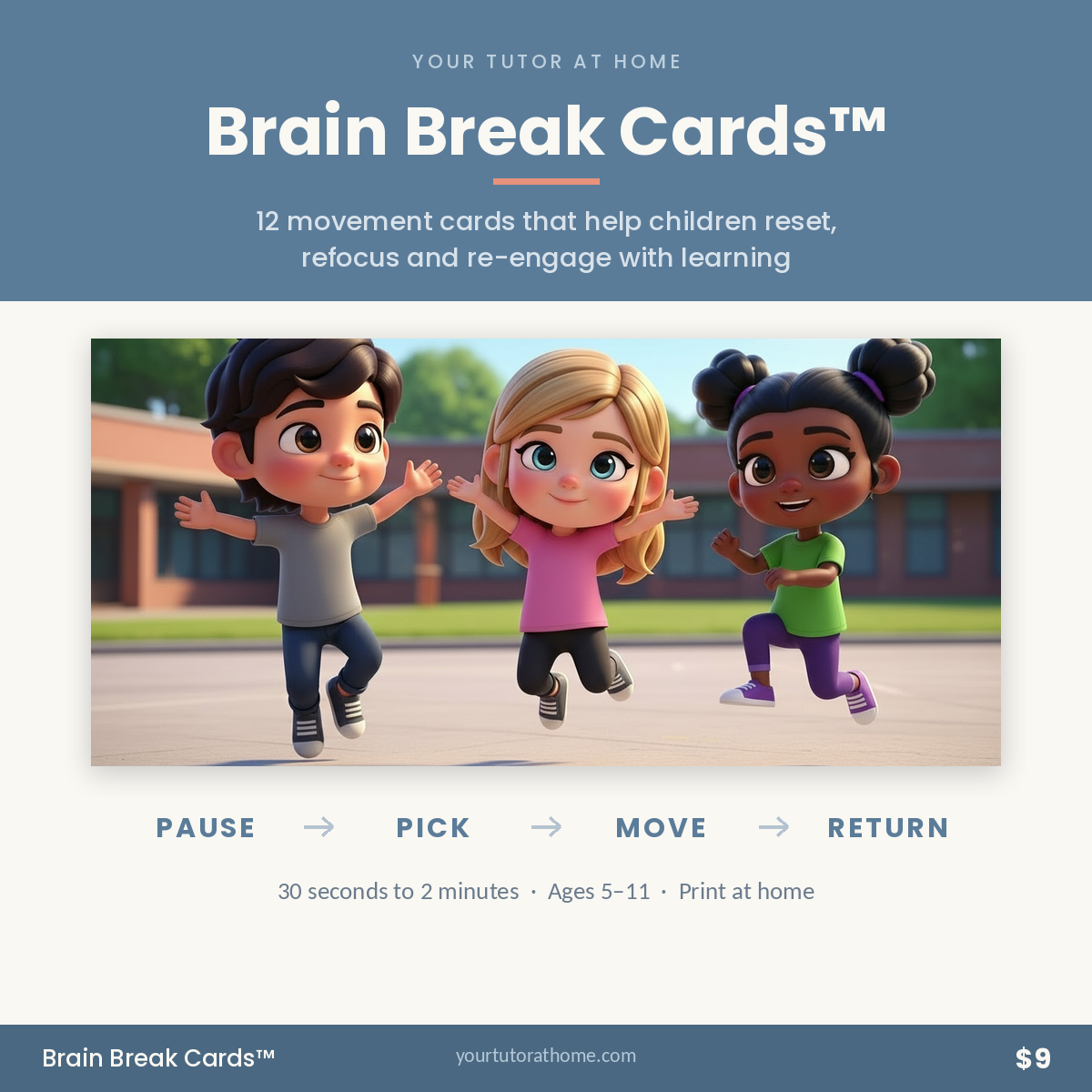
Twelve quick brain breaks on printable cards — ten movement breaks plus two functional cards, thirty seconds to two minutes each, for children aged five to eleven. Every card ends with a return cue — the step most break systems skip. Six files, forty pages, full-colour and ink-saving editions included. Instant download.
Product Description
Your child is fidgeting, slumping, or has stopped writing halfway down the page. You have already said “focus” twice. Brain Break Cards™ gives you something better to say: twelve quick brain breaks your child can actually do.
Ten movement breaks plus two functional cards, thirty seconds to two minutes each, designed for children aged five to eleven. These quick brain breaks do not just get a child moving — every single card ends with a return cue, because coming back is the part that decides whether a break helped or cost you the afternoon.
In this guide
- Why “focus” is not an instruction a child can follow
- What is inside the quick brain breaks pack
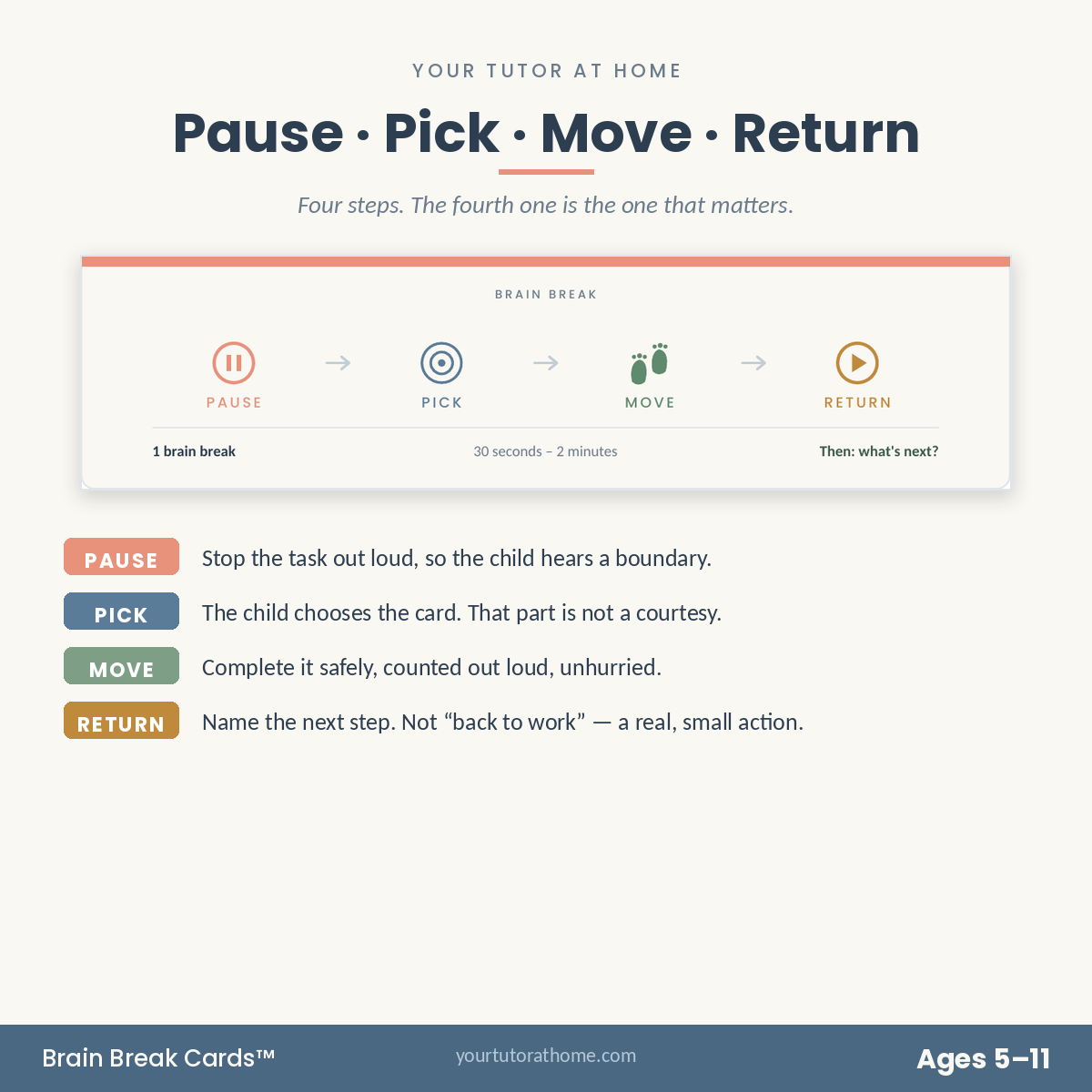
- Pause, pick, move, return
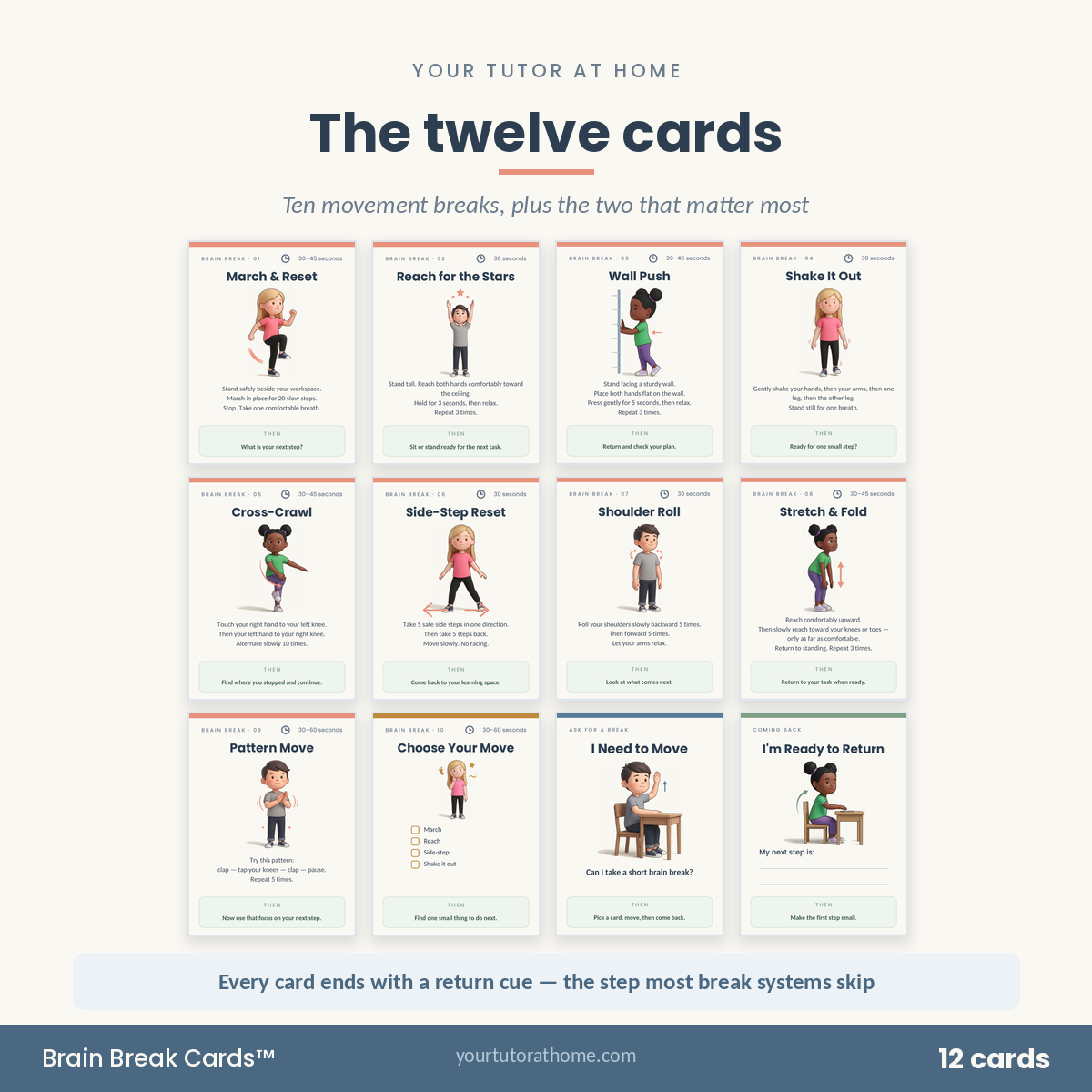
- The twelve cards
- What these quick brain breaks are not
- Breaks are not rewards
- Who this is for
- Two editions, both included
- Where these quick brain breaks fit in the wider toolkit
- What you get for $6
Why “focus” is not an instruction a child can follow
When your child stalls at the table, most of us reach for the same three sentences. Focus. Sit still. Pay attention. They are reasonable things to say and they almost never work, for one simple reason: none of them tells the child what to actually do. They describe a destination and skip the route entirely.
A child who cannot summon focus on request can almost always march in place for twenty steps. That is the whole idea behind quick brain breaks — replace an instruction the child cannot follow with a task they can, then walk them back to the work.
A brain break is not leaving learning behind. It is a short reset before finding the next step.
What is inside the quick brain breaks pack
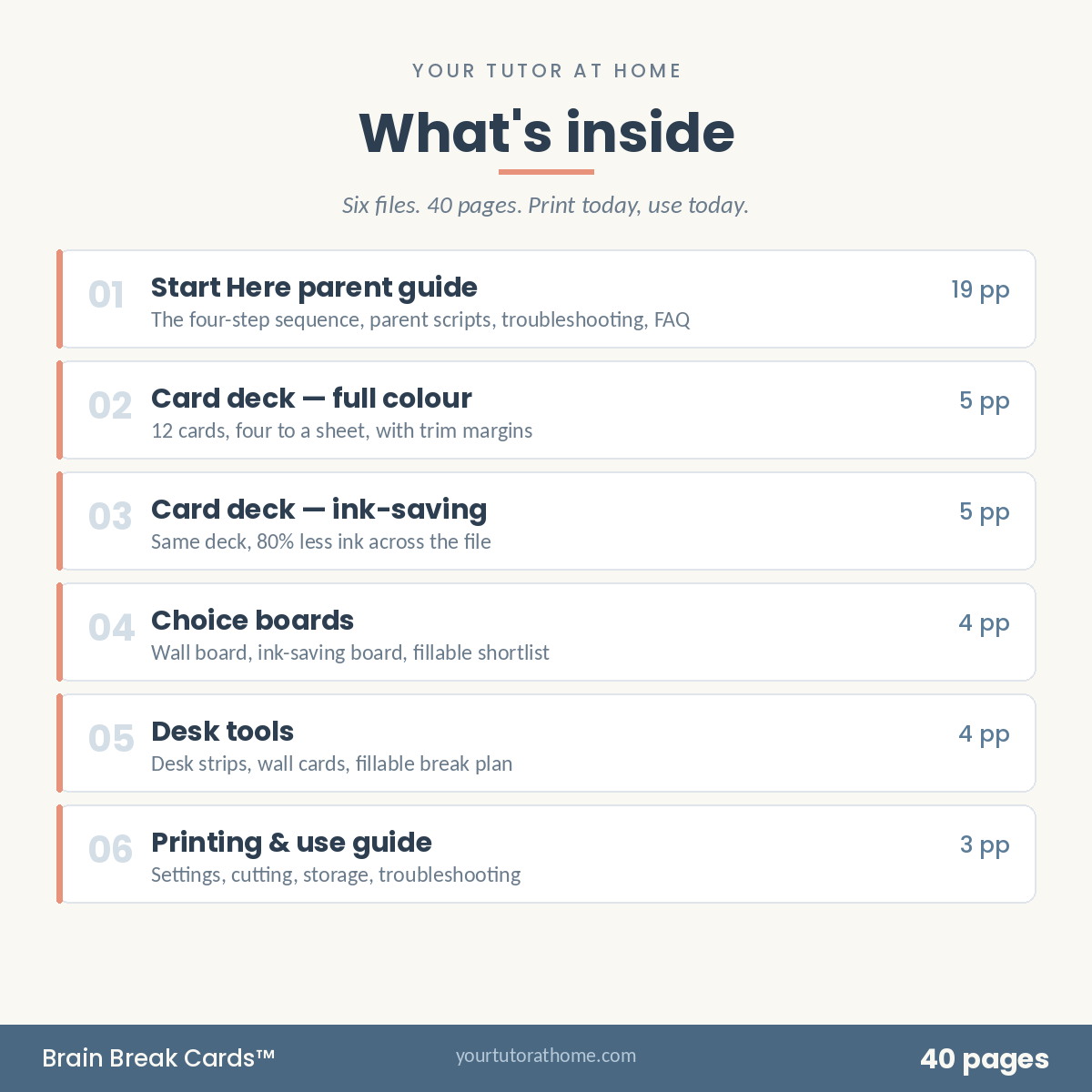
The pack is six files, forty pages, and about six minutes between downloading and having a working deck of quick brain breaks on your kitchen table. You only need two of the files to start.
- Twelve printable brain break cards — ten movement breaks plus the two functional cards that make the system work in real life
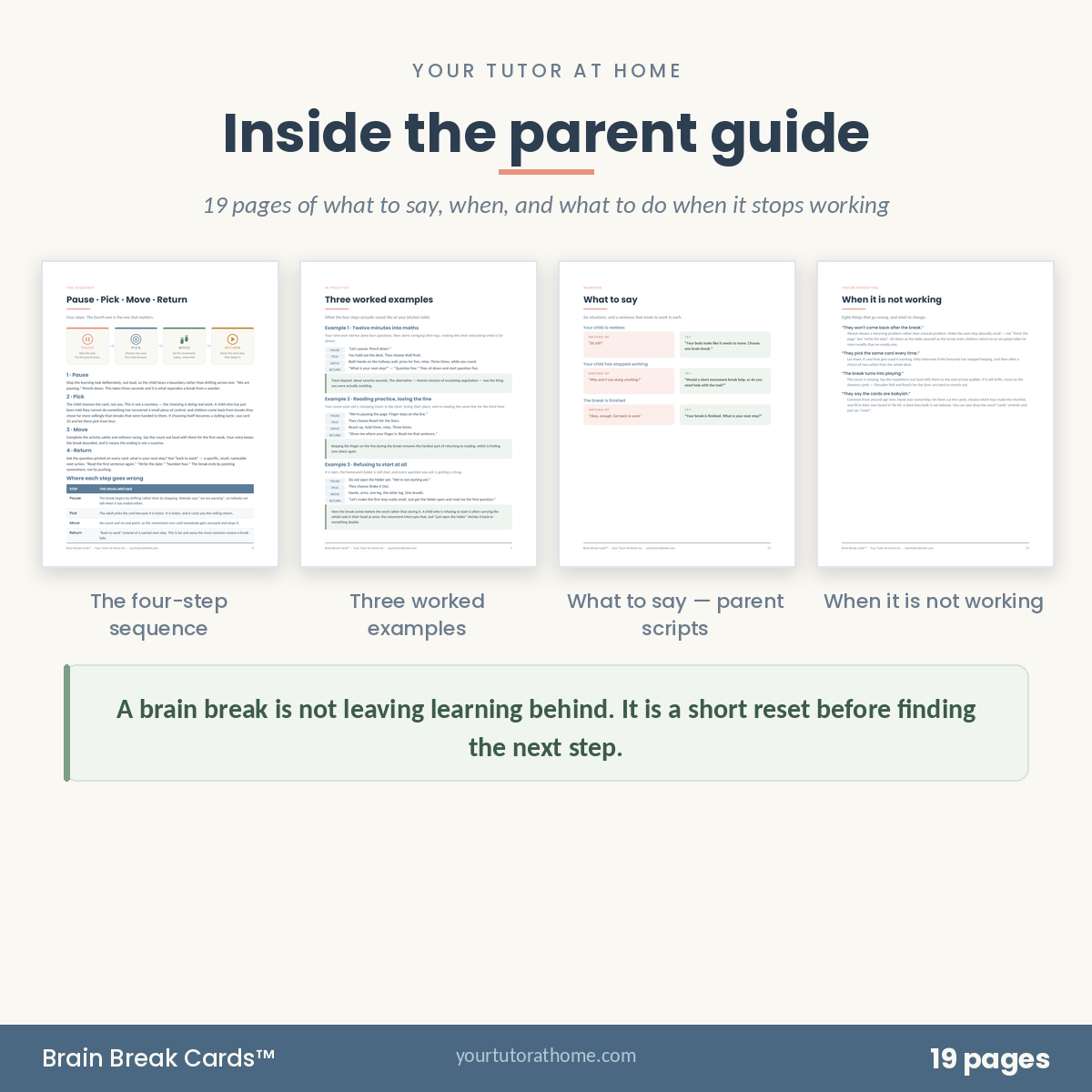
- A nineteen-page parent guide — the four-step sequence, three worked examples, six parent scripts, an eight-item troubleshooting section, a seven-day starting plan and an eight-question FAQ
- Choice boards — a wall board showing every break at a glance, plus a fillable shortlist you narrow down together
- Desk tools — a 2 × 8 inch desk strip, larger wall cards, and a fillable break plan
- A printing and use guide — settings, cutting, storage and troubleshooting
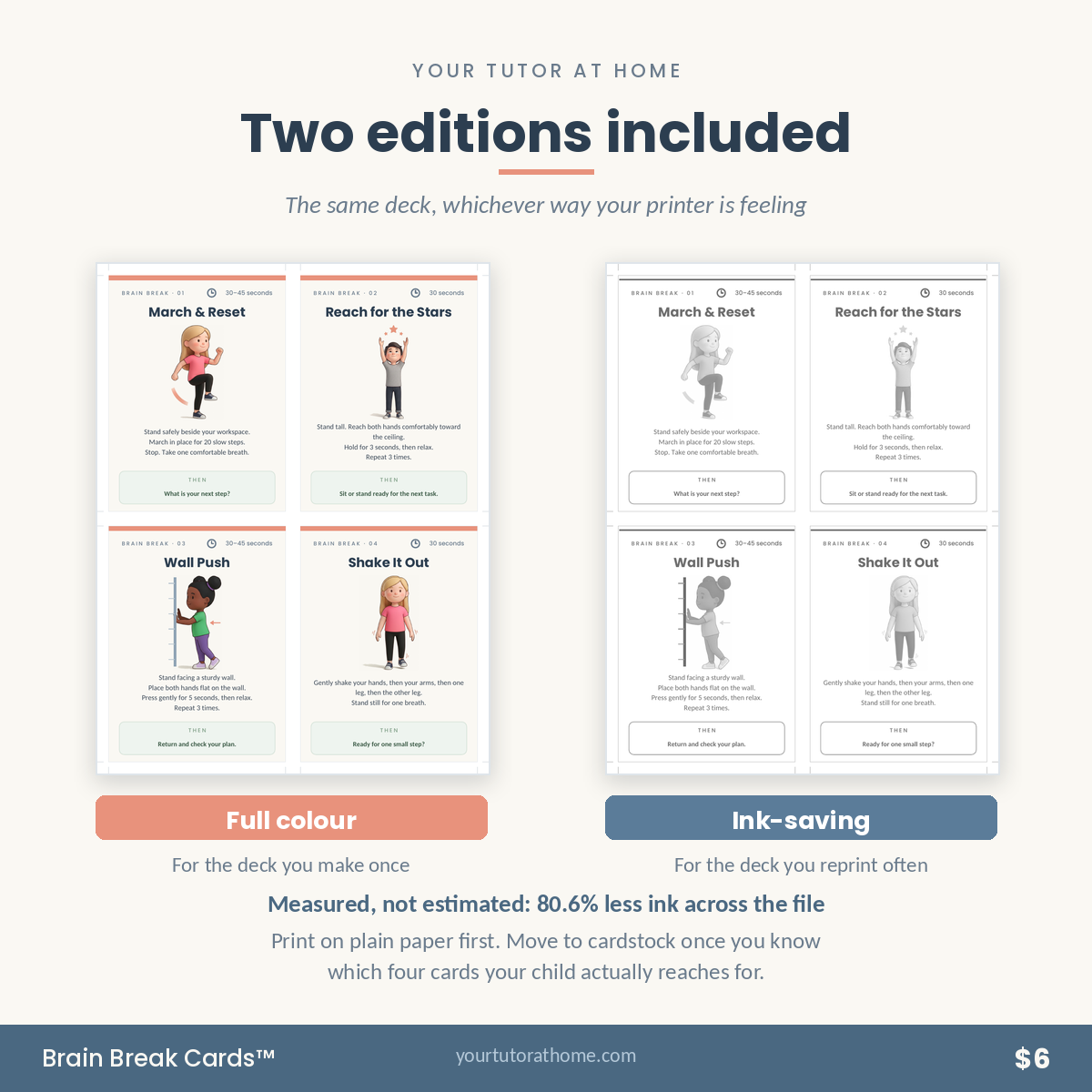
- Both a full-colour and an ink-saving edition of the deck
Every card is printed inside its own border with a clear quarter-inch channel around it, so no two cards share a cut line. A slightly wobbly cut still leaves you a clean card — which matters, because you are almost certainly doing this with kitchen scissors.
Pause, pick, move, return
Getting a child up and moving is the easy half. The half that decides whether a break helps or derails the whole afternoon is the return, and most break systems simply do not have one.
- Pause. Stop the task deliberately and out loud, so your child hears a boundary rather than drifting across one.
- Pick. Your child chooses the card, not you. Children come back from breaks they chose far more willingly than breaks handed to them.
- Move. Complete the activity safely and unhurried, with the count said out loud so the ending is not a surprise.
- Return. Ask the question printed on every card: what is your next step? Not “back to work” — a specific, small, nameable action.
That fourth step is why every one of these quick brain breaks ends with a return cue, and why two of the twelve cards exist purely to manage the boundary between break and work. One is a card your child shows you when they need to move. The other walks them back into the task afterwards.
The twelve cards
The ten movement cards are: March & Reset. Reach for the Stars. Wall Push. Shake It Out. Cross-Crawl. Side-Step Reset. Shoulder Roll. Stretch & Fold. Pattern Move. Choose Your Move. Plus I Need to Move and I’m Ready to Return.
Each of these quick brain breaks takes thirty seconds to two minutes, needs no equipment, and carries a simple illustration, a short instruction a child can read themselves, a time, and a return cue. Five of them need only about one square metre of space, which is marked in the guide for families working in small rooms.
What these quick brain breaks are not
This matters, so it is said plainly here and again inside the pack. These are general movement ideas for short learning breaks. They are not treatment for ADHD or any other condition, not occupational or physical therapy, not an exercise prescription, and not a behaviour-management system.
They do not promise your child will focus afterwards. What they offer is a short, structured reset — a smaller claim, and a more honest one. If your child is under the care of a doctor, physiotherapist or occupational therapist, their guidance takes priority over anything printed here. You can read more about movement and attention at Understood.org and HealthyChildren.org.
Breaks are not rewards
It is a natural move to attach a break to compliance. Finish five problems and you can have a brain break. It sounds like reasonable parenting, and it quietly reclassifies the break as a treat — which means it can be withheld. A child who needs to move in order to participate is then being asked to earn the very thing they need in order to do the earning.
The guide gives you the wording that holds up over months instead, along with six scripts for the moments that actually go wrong: the child who will not come back, the break that turns into playing, and the nine-year-old who has decided the whole thing is babyish. The aim is that these quick brain breaks stay a learning-support tool rather than a bargaining chip.
Who this is for
- Children roughly five to eleven, at home rather than in a classroom
- Homework, reading practice, revision, or any stretch of seated work
- The child who fidgets, slumps, wanders, or stops writing halfway down the page
- Parents who have run out of ways to say “concentrate”
- Small spaces — five of the ten movements need about a square metre
You do not need to be sporty, and neither does your child. None of these quick brain breaks require equipment, floor space beyond a clear corner, or any particular level of fitness. Movement of this kind is simply part of the daily activity children need, as the CDC sets out.
Two editions, both included
Both editions contain the same twelve brain break cards. The full-colour edition is for the deck you make once. The ink-saving edition prints the same twelve cards in light greyscale on plain white and uses 80.6% less ink across the file — measured by rasterising both editions and comparing coverage, not estimated. Print the ink-saving one on ordinary paper first, then commit cardstock once you know which four cards your child actually reaches for.
Where these quick brain breaks fit in the wider toolkit
This pack does one job: quick brain breaks with a clean return. If that is all you needed, you are finished — there is nothing you are missing.
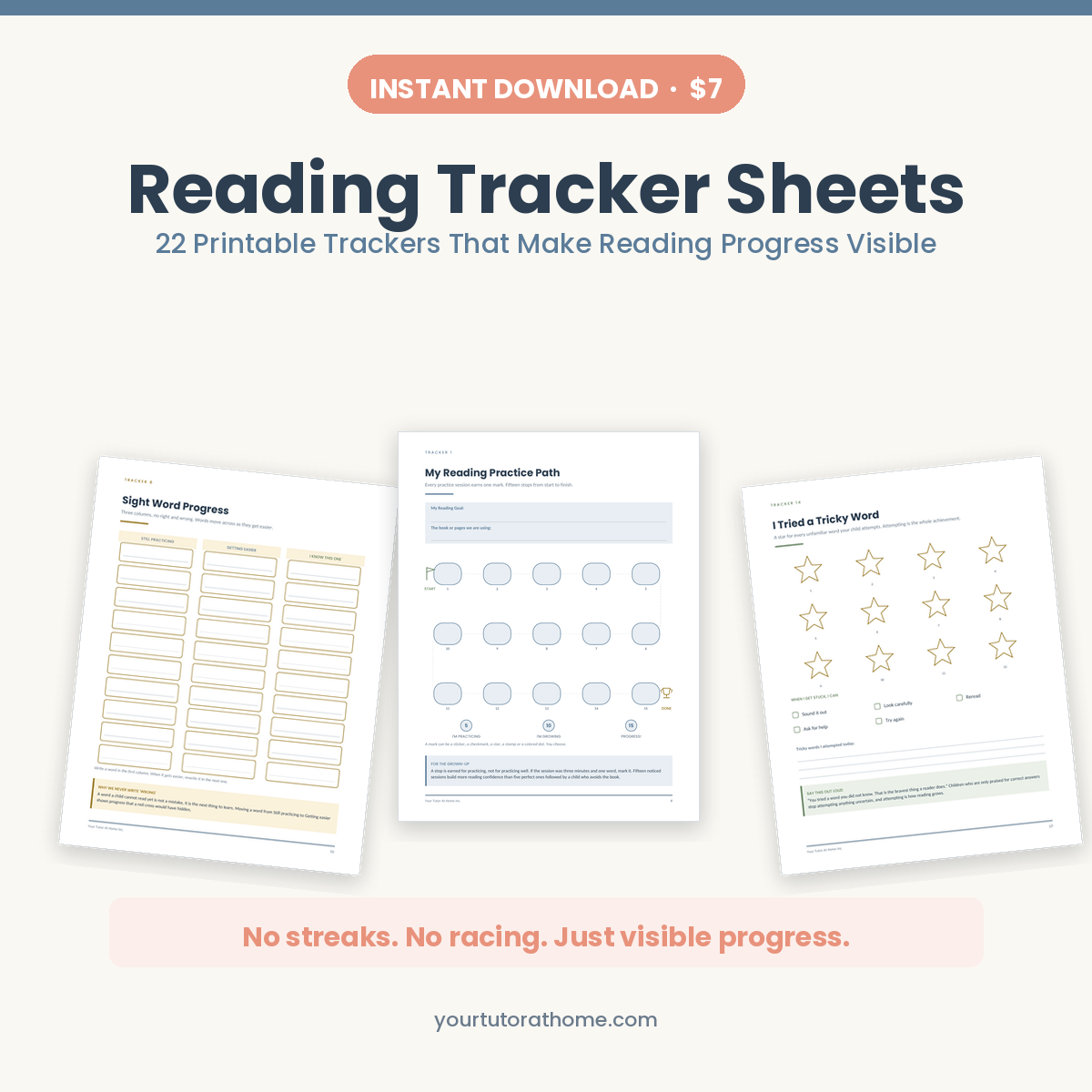
If your child regularly needs longer to come back, or needs quiet rather than movement, breathing, or a structured return routine, the larger Focus Break Cards™ deck carries sixty cards across six categories. For structured focus practice rather than one-off resets, see the Calm Focus & Attention Builder™. And if you are still working out what is going on, Focus & Attention™ is the parent guide to the wider picture.
What you get for $6
- 6 PDF files, 40 pages, instant download
- 12 printable cards at 3 × 4 inches, four to a US Letter sheet
- Full-colour and ink-saving editions of the deck
- 25 fillable form fields across the boards and the break plan
- Household printing licence — print as often as you like at home
Delivered as an instant download. No subscription, no upsell inside the files, and no waiting. If these quick brain breaks give you back even one afternoon that would otherwise have been an argument, they have done their job.

Reviews
There are no reviews yet.