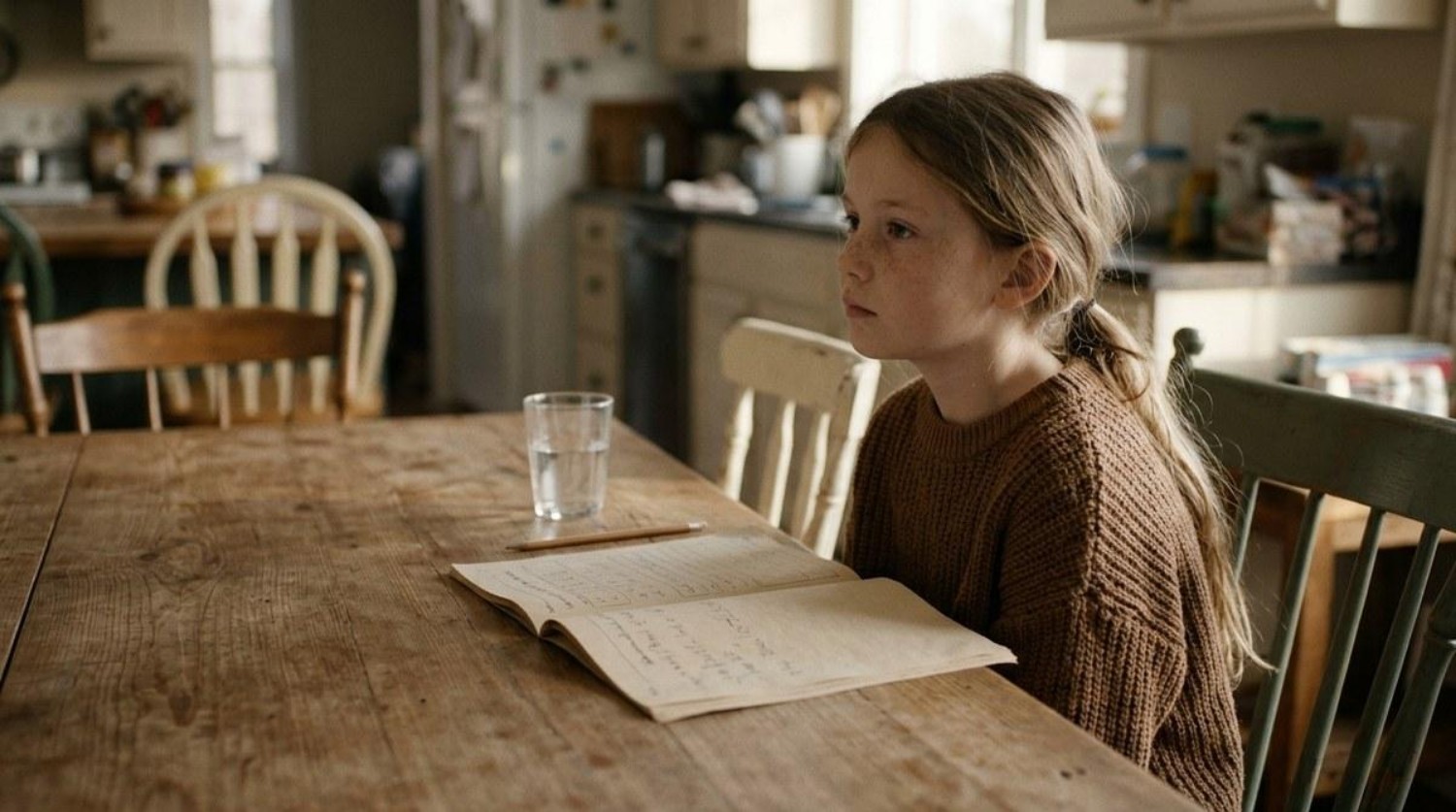
It’s 4:15 on a Monday afternoon. Ava is eight, and she always writes her name in big bubble letters before she starts anything. Today, her pencil hovers over the paper, and the bubble letters never come. If homework frustration turns your afternoons into tears, anger or total silence, this story is for you.
The short answer: homework frustration is rarely about the worksheet in front of your child. It’s the last drop in a cup that has been filling all day, with hard moments, small embarrassments and mistakes nobody saw. Some children spill over loud. Others go completely quiet. Both are saying the same thing: “I’m overwhelmed.” Below, we’ll follow Ava through one hard week, find the six hidden reasons hiding in her day, and share the three steps her mom used to catch the spill before it happened.
Prefer to watch?Watch Ava’s story on YouTube
You set the worksheet down and say the most ordinary sentence in the world. “Okay, sweetheart. Homework time.” Her face changes. The pencil hits the table. The paper slides away. “This is stupid. I hate homework. I can’t do this.” And then the tears.
That was Monday. On Tuesday, Ava didn’t yell. She didn’t cry. She just sat there, very still, staring at the page. And you thought, well, at least she’s calm.
She wasn’t calm. And almost every loving parent would have made the same mistake.
At Your Tutor At Home, we’ve spent more than twenty years at kitchen tables just like Ava’s, and we’ve watched this exact moment happen hundreds of times. Your child isn’t broken. Something very specific is happening inside them. Once you can see it, you can change it.
Homework Frustration Starts Long Before Homework
To see it, picture a cup.
Every child starts the morning with it almost empty. All day long, little drops fall in. A hard moment. A small embarrassment. A mistake in front of the class. Nobody sees the drops. Sometimes not even the child. But the cup remembers.
By 4:15, it isn’t the worksheet that makes the cup spill. It’s the last drop. That’s why homework frustration so often seems to come out of nowhere, over work that doesn’t even look hard.
6 Hidden Reasons Behind Homework Frustration
So let’s rewind Ava’s day. All six reasons were hiding in it.
1. The feeling arrives before the worksheet does
At 9:30 that morning, Ava read out loud in her reading group. She lost her place twice. The girl next to her sighed. Ava’s cheeks went hot. Drop.
So when you said “homework,” she wasn’t reacting to ten spelling words. She was reacting to every hard moment that came before them. A lot of homework frustration starts at school, hours before the backpack is even unzipped.
2. Repeated difficulty quietly wears down confidence
Her spelling test came back that day. Six out of ten. And at the top of the page, in red: “Keep trying.”
She did keep trying. And it still came back red. So a small, dangerous thought starts to grow: Why should I try, if I’m just going to get it wrong? What looks like low motivation is very often low confidence. Another drop.
3. Homework is heavier than it looks
To us, it’s one page. To Ava, it’s five jobs at once. Remember the directions. Keep her place. Recall the rule. Check her work. And hold it all together after a whole day of holding it together at school. One more drop.
4. Mistakes feel dangerous
Ava’s worksheets are worn thin from erasing. She rubs out answers that were already right. For a child who’s been corrected all day, one more mistake doesn’t feel like learning. It feels like proof that she’s just not good at this. And this drop is a big one.
5. She doesn’t have the words to ask for help
She can’t say, “I remember the rule, but I keep forgetting the second step.” So it comes out the only way it can: “This is stupid.” “I can’t do this.” Those words aren’t the problem. They’re the only words she has, and for many children, homework frustration is simply what “I need help” sounds like.
6. Our frustration pours into their cup
The sixth reason is the one almost no parent thinks about, because it’s about us. Back on that terrible Monday, Ava’s mom explained the word again, then again, a little louder. Every explanation was one more drop in a full cup. When Ava pushed the paper further away, her mom said the sentence almost every parent has said: “It’s easy! You did this this morning!”
By 4:40, a fifteen-minute worksheet had become an hour. Mom’s voice changed. Ava’s tears got louder. Homework wasn’t about spelling anymore. It was a tug of war, and both of them were losing. Parent homework frustration pours straight into the child’s cup. It doesn’t make you a bad parent. It makes you a tired one.
Why the Usual Fixes Make Homework Frustration Worse
Stop saying: “It’s easy.”
When a struggling child hears “it’s easy,” what they really hear is, “Then something must be wrong with me.”
Try this instead: “This part is tricky. Let’s do one together.”
But Monday didn’t have that line yet. That night, after Ava was asleep, her mom sat alone at the kitchen table with the crumpled worksheet and whispered the question so many of us have asked in the dark: “Am I doing this wrong?”
So on Tuesday, she made a new rule. No tablet until homework is done. And Tuesday was quiet. It looked like the rule had worked.
But inside, Ava had made a quiet little decision. If I don’t write anything, I can’t get anything wrong. A rule can stop the noise of homework frustration without touching what’s underneath it.
Quiet Isn’t Calm
Here’s what most parents never hear.
Quiet isn’t calm. Quiet can mean full.
Some children spill over loud. They argue, cry and push the paper away, and the storm fills the whole kitchen. Others spill over silent. They stare. They say “I don’t know,” even about work they knew yesterday.
The loud child is easy to notice. The quiet child is easy to call stubborn, or not trying. But both of them are saying the exact same thing: I’m overwhelmed. Ava hadn’t calmed down on Tuesday. Her cup was too full to even pour out. Understood.org makes the same point in its guide to responding when grade-schoolers get frustrated: what looks like avoidance is often worry about the work.
So the moment to help isn’t when the cup spills. It’s just before.
What to Do About Homework Frustration: 3 Steps
On Wednesday, Ava’s mom made a different choice. She put the rule away. She pulled her chair back. And she just watched. Here’s what she was watching for.
Step 1: Learn your child’s signs
Think of homework frustration like a thermometer with three bands:
Green: there’s still room in the cup. Your child is working, maybe with a sigh.
Yellow: the warning. Harder erasing, slower, quieter, “I can’t” in a certain voice.
Red: the spill. Tears, shouting, or a complete shutdown.
Most of us step in at red, because that’s when it gets loud. But at red, a child can’t learn anything new. The best time to help is yellow. And on Wednesday, Ava’s mom saw it: Ava’s yellow sign was the eraser. Hard, fast erasing, right before every storm.
Step 2: At yellow, change one small thing
At yellow, homework frustration is still small enough to turn around. Try a short break, one example together, or fold the page so only three words show. And offer one gentle choice.
Stop saying: “What’s wrong? Why aren’t you answering?”
To a quiet child, a pile of questions is one more weight in a cup that’s already full.
Try this instead: “Break, or help with the first one?”
Step 3: When it does spill, use the five-step reset
Pause. Reset. Name. Shrink. Notice.
Stop saying: “Just calm down.”
Nobody has ever calmed down because someone told them to.
Try this instead: “This is getting hard. Let’s pause.”
On Thursday, the storm came anyway, and that’s exactly what Ava’s mom said. Then came the reset: a glass of water and a few quiet minutes. When Ava came back, her mom asked, “Was it the directions, the steps, or the writing?” Ava whispered, “The steps.” So they shrank it to one word. And when Ava picked up her pencil, her mom said, “You took a break, and you came back.”
Your child isn’t only learning spelling. They’re learning what to do when something gets hard.
On a calm Sunday, Ava’s mom wrote little help phrases on cards: “I forgot the first step.” “I need a break.” Now Ava doesn’t have to explain. She just points.
Day 1: the tears still came, but later, and they ended sooner.
Week 1: Mom caught the eraser at yellow four nights out of five.
Week 4: something happened that she still talks about.
If homework frustration has turned your evenings into a nightly battle, our free Calm Reset™ Starter Guide helps you set up calmer, shorter learning sessions at home.
Watch Ava’s Story
Prefer to watch? In our companion video, we follow Ava through her hard week and share the three sentences that changed it.
PASTE-VIDEO-URL
When Homework Frustration Happens Most Days
Some hard homework nights are a normal part of learning. But if tears or shutdowns happen most days, if your child calls themselves stupid, or if they start avoiding school, talk with their teacher.
Ava’s mom kept a little note that month, and you can too. Each time homework falls apart, write down three things:
When it happened, and which subject
What came right before: a hard school day, a long assignment, a correction
Loud or quiet
A week of notes turns “homework is a nightmare” into something a teacher can use. If the distress keeps going, reach out to a qualified professional. Psychologist Richard Selznick describes how unresolved struggles can turn a child into a “shut-down learner” over time, which is why early, calm support matters. The goal is never to label your child. It’s to understand what they need. If the notes keep pointing to one subject, our guide on how to identify where your child’s learning is breaking down can help you trace it.
Back at the Kitchen Table
Four weeks later, it’s 4:15 on a Monday afternoon. Same table. Same ten spelling words.
Ava writes her name. In big bubble letters.
Halfway down the page, the eraser starts pressing hard. Her mom sees it. Yellow. “Break, or help with the first one?” Ava takes a breath. She points at a card. “I forgot the first step.”
They do one word together. Just one. And Ava finishes the other nine on her own.
At 4:35, she slides the worksheet across the table and says, “That one was tricky. But I did it.” That breath is everything. It’s the difference between a child who decides, “I’m bad at school,” and a child who learns, “When it gets hard, I know what to do.”
That Friday, the spelling test came home. Eight out of ten. Not perfect. It went on the fridge, right in the empty spot she’d been saving.
So why does your child get frustrated, angry, or shut down during homework? Because the cup was filling long before the worksheet came out. And loud or quiet, a full cup is saying the same thing: I need help. The person who notices the yellow, before the spill, is almost always the one sitting at that table. That can be you.
To find where your child is getting stuck, take our free Learning Quiz. It takes about two minutes. And if your child also takes forever to finish homework they understand, read Why Does My Child Take So Long to Finish Homework?
FAQ: Homework Frustration
Is homework frustration normal?
Some homework frustration is a normal part of learning, especially after a long school day. It deserves a closer look when it happens most days, is intense, or comes with your child calling themselves stupid or avoiding school.
Why does my child shut down instead of getting angry?
Some children show overwhelm quietly. Staring at the page, going silent, or saying “I don’t know” can be the same overload as tears, just harder to see. Offer one simple choice instead of a pile of questions.
Should I let my child stop homework when they get upset?
A short pause is not quitting. Pause, reset, then come back to one small step. If you stop for the night, tell the teacher what happened so they understand the gap.
What is the best time to help with homework frustration?
At “yellow,” the early warning signs such as harder erasing, slowing down or getting quieter. One small change at yellow, like a short break or one example together, often brings a child back before homework frustration turns into a meltdown.
What Comes Next?
Does your child say, “I can’t do it,” before even trying?
Sometimes a child expects to fail before the learning even starts. In our next article and video, we’ll follow a child who gives up before the story even begins, and show where that belief comes from. Once you see it, you can’t unsee it.
Until then, remember: a difficult homework moment is not always a sign that a child doesn’t want to learn. Sometimes it’s a sign that the child needs help making learning feel manageable again.
Educational disclaimer: The information provided by Your Tutor At Home is for general educational and informational purposes only. It is not intended to diagnose, treat, or replace professional medical, psychological, educational, or therapeutic advice, assessment, or evaluation. If you have concerns about your child’s development, learning, health, or well-being, consider discussing them with an appropriately qualified professional.
Ready to Help Your Child Thrive?
Explore our programs designed to build reading confidence, strengthen focus, and create lasting learning habits