Free Reading Worksheets for Children Who Find Reading Hard
If your child struggles with reading, you have probably already printed plenty of pages. These free reading worksheets are built on a different assumption: the problem is rarely that a child has not done enough worksheets. It is that nobody showed you which page to reach for, or when to stop.
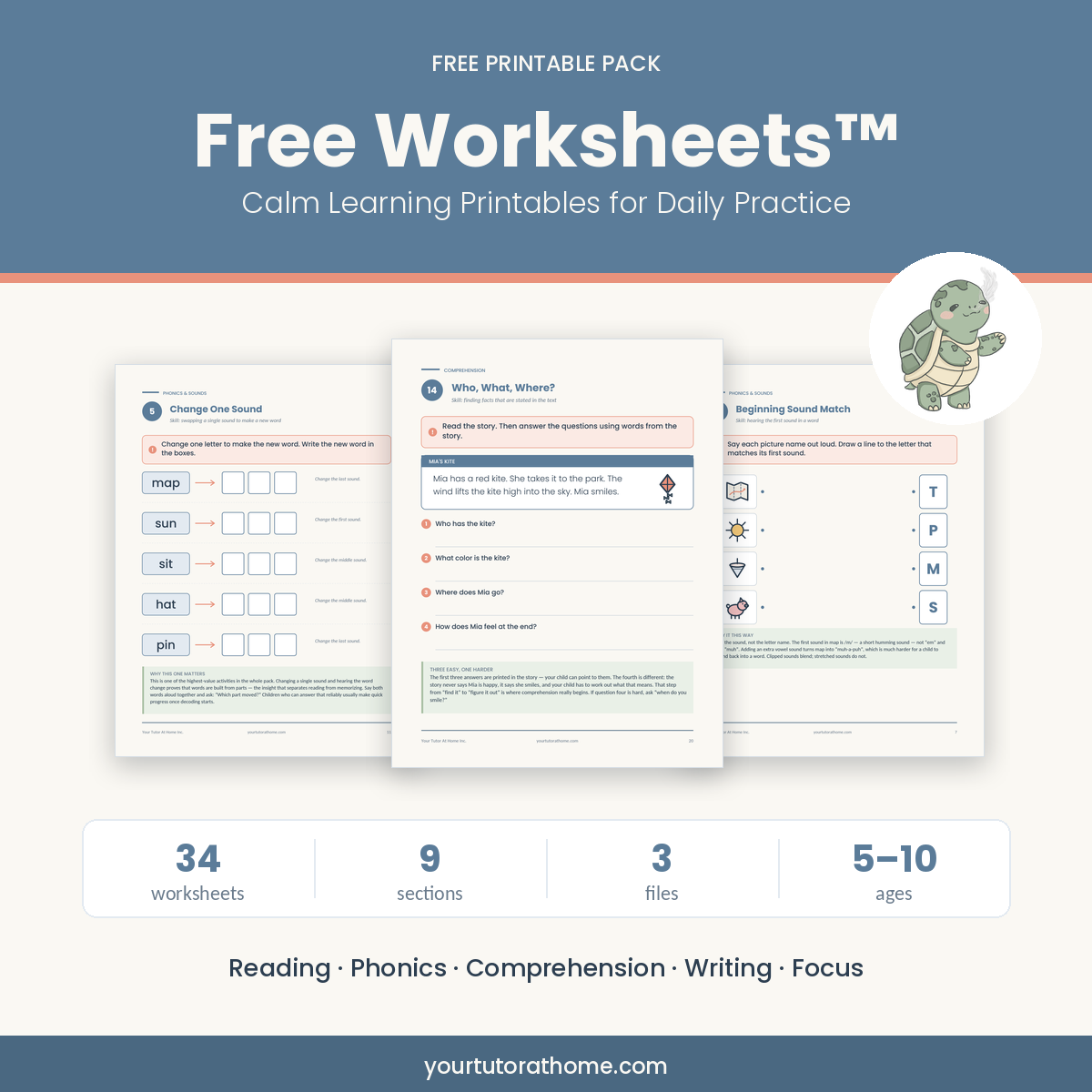
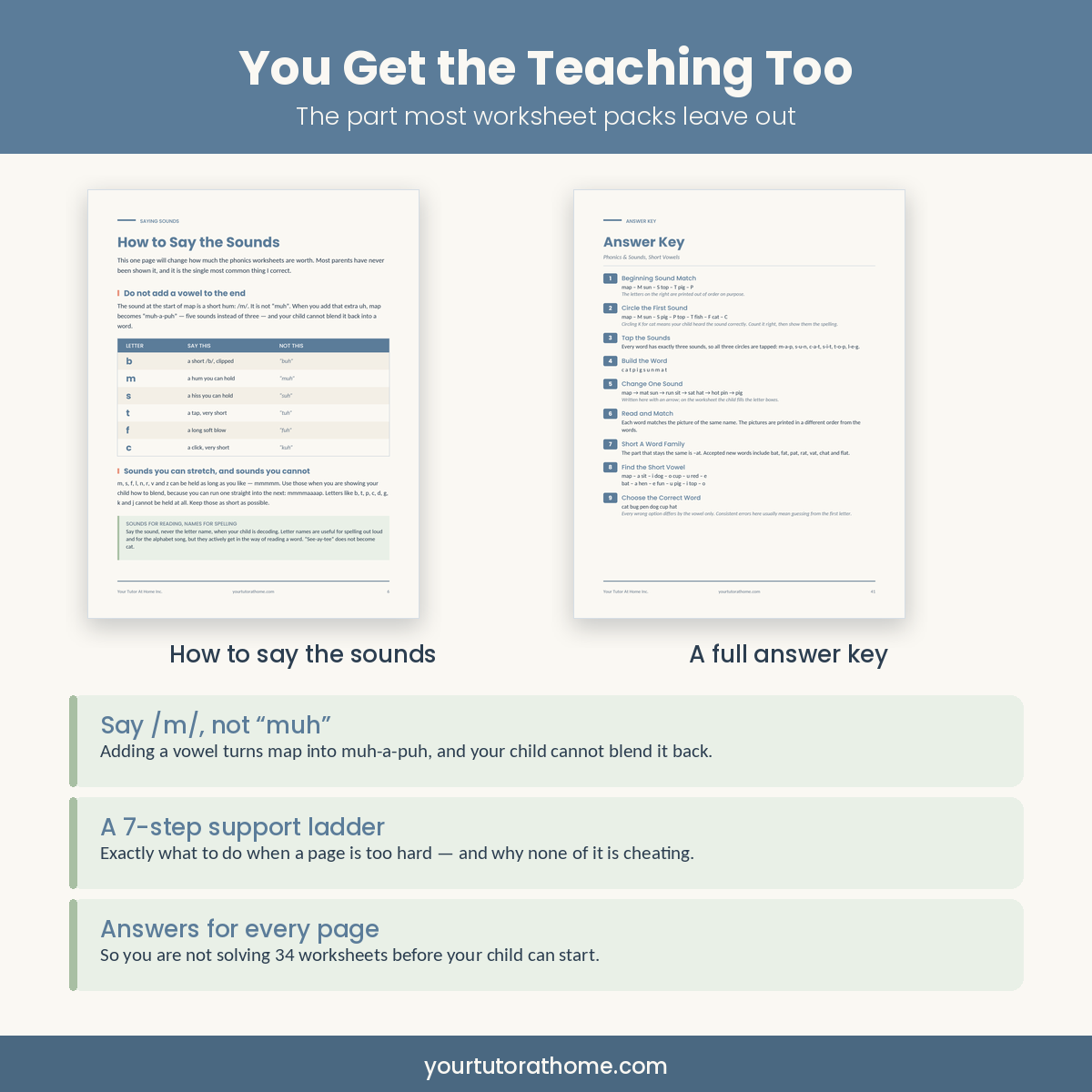
These free reading worksheets run to 34 pages across nine sections, designed for short practice of five to fifteen minutes at a time. The pack comes with a parent quick guide and a three-page answer key, so you are never solving the pages yourself before your child can use them.
What is inside the free reading worksheets pack
Three files, and you only need to print one of them.
- Start Here quick guide — twelve pages for you, not your child. How to run a calm session, how to choose a page, and how to say letter sounds correctly.
- The worksheet pack — 45 pages, containing 34 worksheets plus a three-page answer key.
- Ink-saving edition — the same pages with the color fills removed, for when the printer is running low.
The nine sections cover phonics and sounds, short vowels, word reading, comprehension, writing, focus and attention, daily learning routine, confidence, and early numbers. Every worksheet carries a short note for the parent explaining what the page is actually testing and what to do when it goes wrong.
Who these worksheets are for
These free reading worksheets suit children roughly aged five to ten, and they are written specifically for the child who finds reading harder than their classmates. That includes children with dyslexia, ADHD or autism, children who read the words but do not absorb the meaning, and children who have simply lost their nerve after a difficult year.
They are practice materials, not a diagnostic assessment. If your child shows persistent difficulty despite regular practice, that is worth raising with their teacher or the school's learning support lead. Understood.org has clear, parent-facing guidance on what learning differences look like at home and what support you can ask for.
How to use them: the 15-minute calm session
Two minutes to set up, ten to practice, three to close. That structure is the whole system, and it works because your child can see where it ends. Use the free reading worksheets inside that frame rather than treating them as a pile to get through.
Clear the table and put out one pencil and one page. Say what the activity is in a single sentence so the shape of the task is visible. Then work through one page, or part of one, sitting close enough to help. When your child hesitates for more than about three seconds, help — supply the sound, read the word, do the first one together. Waiting for a struggle does not build resilience, it builds avoidance.
Stop when the time is up, even mid-page. Ask one question: what felt easier today? Ending while things are still going well is what makes tomorrow's session possible.

Phonics, sounds and short vowels
The first nine worksheets work on the sound level: hearing the first sound in a word, tapping out each sound, building a word from its letters, and changing a single sound to make a new word. That last one matters more than it looks — hearing map become mat is the insight that separates reading from memorising.
The parent guide includes a page most parents have never been shown: how to say the sounds without adding a vowel. The first sound in map is a short hum, not "muh". Say "muh" and map becomes "muh-a-puh", five sounds instead of three, and your child cannot blend it back into a word. Reading Rockets has excellent free background on phonemic awareness if you want to understand the research underneath it.
Word reading and comprehension
Worksheets ten to seventeen separate two skills that look identical from the outside: whether your child can read the words, and whether your child understands them. A fluent reader who cannot tell you what happened needs completely different help from a child who is stuck on decoding.
All four comprehension passages in the free reading worksheets are original. They move deliberately from questions whose answers are printed in the text to questions your child has to work out — the step where comprehension actually begins.
Writing, focus, routine and confidence
The remaining worksheets cover sentence writing with handwriting guides, attention tasks that practice holding an instruction in mind, a weekly tracker with no streak counter, and a confidence page on which not one item is about getting an answer right. There are also three light number pages, because reading and number sense develop separately.
If focus rather than reading is your main concern, the CDC's ADHD pages are a sober, non-alarmist starting point for understanding what you are seeing. The attention pages in these free reading worksheets are practice activities, not clinical tests.
Why this is not another hundred-page worksheet dump
Most free reading worksheets come in enormous bundles, and enormous bundles quietly punish the parent. Faced with two hundred pages, you either work through them in order — which guarantees your child spends time on things they can already do — or you stop opening the file.
Thirty-four pages with a guide telling you which one to pick is more useful than two hundred without. Print only what you need this week.
When worksheets are not the answer
Practice helps when a child broadly knows what to do and needs repetition. It does not help when something underneath is missing, and more pages will not fix that. If you work through a section and the same difficulty keeps surfacing, the next step is finding out what is actually stuck.
Our free reading quiz takes about three minutes and points you to one place to start. If reading itself is the barrier, Reading Struggles™ works through eight profiles of what goes wrong and what to do about each. If reading has damaged your child's confidence, the Calm Reading Confidence Builder™ rebuilds willingness to try alongside the reading itself. For the complete plan, see The C.A.L.M. Learning Method™.
Questions parents ask
Are the free reading worksheets really free? Yes. Enter an email address and all three files arrive. There is no card and no trial.
What age are they for? Roughly five to ten. Some pages stretch further depending on where your child is, which is why the guide sorts them by difficulty rather than by age.
Do I need a color printer? No. The ink-saving edition prints cleanly in black and white and uses about a third less ink.
Can I use these with more than one child? Yes, within your own household. Reprint any page as often as you need.
Download the free reading worksheets
Pause. Breathe. Start small.
Enter your email below and the three files arrive straight away. These free reading worksheets are yours to print at home as often as you like, for as many children as you have.
Written by Mrs. Nathalie, an experienced tutor with more than twenty years working with struggling readers, neurodivergent learners, and children of every learning style.